Issue published October 8, 2025 Previous issue | Next issue
- Volume 10, Issue 19
On the cover:
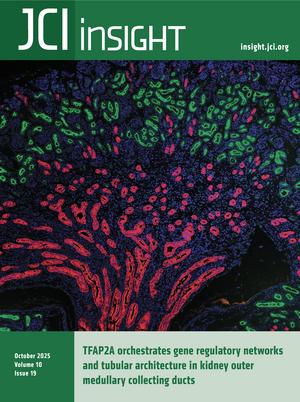
TFAP2A orchestrates gene regulatory networks and tubular architecture in kidney outer medullary collecting ducts
Leiz and López-Cayuqueo et al. report that transcription factor TFAP2A is essential for adult kidney collecting duct architecture, while embryonic kidney development remains unaffected. The cover image shows collecting ducts (AQP2, red), proximal tubules (LTL, green), and nuclei (DAPI, blue) from a neonatal Tfap2a conditional knockout mouse kidney.
Leiz and López-Cayuqueo et al. report that transcription factor TFAP2A is essential for adult kidney collecting duct architecture, while embryonic kidney development remains unaffected. The cover image shows collecting ducts (AQP2, red), proximal tubules (LTL, green), and nuclei (DAPI, blue) from a neonatal Tfap2a conditional knockout mouse kidney.
Go to section:


-
Research Articles
×
Abstract
Adipose inflammation plays a key role in obesity-induced metabolic abnormalities. Epigenetic regulation, including DNA methylation, is a molecular link between environmental factors and complex diseases. Here we found that high-fat diet (HFD) feeding induced a dynamic change of DNA methylome in mouse white adipose tissue (WAT) analyzed by reduced representative bisulfite sequencing. Interestingly, DNA methylation at the promoter of estrogen receptor α (Esr1) was significantly increased by HFD, concomitant with a downregulation of Esr1 expression. HFD feeding in mice increased the expression of DNA methyltransferase 1 (Dnmt1) and Dnmt3a and binding of DNMT1 and DNMT3a to Esr1 promoter in WAT. Mice with adipocyte-specific Dnmt1 deficiency displayed increased Esr1 expression, decreased adipose inflammation, and improved insulin sensitivity upon HFD challenge; mice with adipocyte-specific Dnmt3a deficiency showed a mild metabolic phenotype. Using a modified CRISPR/RNA-guided system to specifically target DNA methylation at the Esr1 promoter in WAT, we found that reducing DNA methylation at Esr1 promoter increased Esr1 expression, decreased adipose inflammation, and improved insulin sensitivity in HFD-challenged mice. Our study demonstrated that DNA methylation at Esr1 promoter played an important role in regulating adipose inflammation, which may contribute to obesity-induced insulin resistance.
Authors
Rui Wu, Fenfen Li, Shirong Wang, Jia Jing, Xin Cui, Yifei Huang, Xucheng Zhang, Jose A. Carrillo, Zufeng Ding, Jiuzhou Song, Liqing Yu, Huidong Shi, Bingzhong Xue, Hang Shi
×Abstract
Clinical trials have identified 2 distinct eosinophilic esophagitis (EoE) treatment phenotypes: those that show proton pump inhibitor (PPI) responsiveness (PPI-R) and those that show PPI unresponsiveness (PPI-UR). Comprehensive clinical, endoscopic, and RNA-Seq analyses of patients with EoE prior to and following PPI therapy have not previously been performed to our knowledge. We showed that clinical, endoscopic, and histologic evaluation of esophageal biopsies from pediatric PPI-R and PPI-UR individuals with EoE prior to PPI therapy (diagnosis) were indistinguishable. RNA-Seq analyses revealed common immune and inflammatory transcriptional signatures in both PPI-R EoE and PPI-UR EoE esophageal biopsy samples at diagnosis and distinct signatures enriched for processes related to neuropeptide signaling and cell cycle and division. PPI therapy induced histologic, endoscopic, and transcriptional remission in PPI-R EoE, but not in PPI-UR EoE. Persistent disease in PPI-UR EoE was associated with the presence of Th2 inflammatory and dedifferentiated esophageal epithelial transcriptomic signatures, while PPI-R EoE revealed genes enriched in cellular responses to LPS, host defense against viruses, and type I IFN signaling. In silico analyses identified common and unique EoE disease gene drivers in PPI-R and PPI-UR EoE. These studies indicate that the 2 EoE phenotypes have unique transcriptomic elements that underlie the molecular nature of PPI-R and PPI-UR EoE disease.
Authors
Somdutta Chakraborty, Ankit Sharma, Sahiti Marella, Christian F. Rizza, Patrick A. O’Brien, Varsha Ganesan, Gila Idelman, Susie Min, Mayee Chen, Talaya McCright-Gill, Nancy Gonzalez, Alexandros D. Polydorides, Paul S. Foster, Simon P. Hogan, Mirna Chehade
×Abstract
In allogeneic hematopoietic transplantation, donor αβ T cells attack recipient tissues, causing graft versus host disease (GVHD). A longstanding question has been how GVHD is maintained despite T cell exhaustion from chronic alloantigen stimulation. In other exhaustion models, CD8 responses are sustained by CD39loTim-3loToxhiTCF-1hi precursor exhausted T cells (TPEX). Here we characterize CD8+ TPEX in the B6(H-2b)→129(H-2b) GVHD model wherein responses against the minor histocompatibility antigen H60 can be tracked using MHCI-tetramers (TetH60). Early after transplant, TetH60+ CD8 cells were uniformly PD-1hiToxhi, whereas TetH60– cells also had PD-1loToxlo cells, indicative of more diverse antigen experiences. Among TetH60+ and TetH60– populations were CD39loTCF-1hi cells. Upon competitive retransplantation, TetH60+CD39loTCF-1hi cells outcompeted TetH60+CD39hiTCF-1lo cells and underwent self-renewal, whereas CD39hiTCF-1lo cells did not yield TCF-1hi cells. To test the role of TCF-1, we studied CD8 cells lacking long TCF-1 isoforms (p45–/–). P45–/– cells were outcompeted by WT cells when transplanted into 129 recipients, though they expanded similarly in syngeneic recipients. In the B6→C3H.SW(H-2b) model, p45–/– CD8 cells caused less weight loss than did WT CD8 cells; however, histopathologic GVHD was similar in both groups. P45–/– and WT CD8 cells also had similar graft versus leukemia activity. These results highlight the complex biology of TCF-1 in supporting alloreactive T cell function.
Authors
Kevin Quann, Faruk Sacirbegovic, Sarah Rosenberger, Emily R. McFerran, Kentin C. Codispot, Laura Garcia-Dieguez, Alexander M. Rowe, Wenzhong Wei, Dhanpat Jain, Jennifer M. McNiff, Warren Shlomchik
×Abstract
Recurrent acute anterior uveitis is a frequent extra-articular manifestation of the axial spondyloarthropathies (AxSpA): chronic inflammatory diseases affecting the spine, enthesis, peripheral joints, skin, and gastrointestinal tract. Pathology in AxSpA has been associated with local tissue-resident populations of IL-23 responsive lymphoid cells. Here we characterize a population of ocular T cell defined by CD3+CD4–CD8–CD69+γδTCR+IL-23R+ that reside within the anterior uvea as an ocular entheseal analogue of the mouse eye. Localized cytokine expression demonstrates that uveal IL-23R+ IL-17A–producing cells are both necessary and sufficient to drive uveitis in response to IL-23. This T cell population is also present in humans, occupying extravascular tissues of the anterior uveal compartment. Consistent with the concept of IL-23 as a unifying mediator in AxSpA, we present evidence that IL-23 can also act locally on tissue resident T cells in the anterior compartment of the eye at sites analogous to the enthesis to drive ocular inflammation.
Authors
Robert Hedley, Amy Ward, Colin J. Chu, Sarah E. Coupland, Serafim Kiriakidis, Peter C. Taylor, Stephanie G. Dakin, ORBIT Research Consortium, Christopher D. Buckley, Jonathan Sherlock, Andrew D. Dick, David A. Copland
×Abstract
Inflammation plays important roles in the pathogenesis of vascular diseases. We here show the involvement of perivascular inflammation in aortic dilatation of Marfan syndrome (MFS). In the aorta of patients with MFS and Fbn1C1041G/+ mice, macrophages markedly accumulated in periaortic tissues with increased inflammatory cytokine expression. Metabolic inflammatory stress induced by a high-fat diet (HFD) enhanced vascular inflammation predominantly in periaortic tissues and accelerated aortic dilatation in Fbn1C1041G/+ mice, both of which were inhibited by low-dose pitavastatin. HFD feeding also intensifies structural disorganization of the tunica media in Fbn1C1041G/+ mice, including elastic fiber fragmentation, fibrosis, and proteoglycan accumulation, along with increased activation of TGF-β downstream targets. Pitavastatin treatment mitigated these alterations. For noninvasive assessment of perivascular adipose tissues (PVAT) inflammation in a clinical setting, we developed an automated analysis program for CT images using machine learning techniques to calculate the perivascular fat attenuation index of the ascending aorta (AA-FAI), correlating with periaortic fat inflammation. The AA-FAI was significantly higher in patients with MFS compared with patients without hereditary connective tissue disorders. These results suggest that perivascular inflammation contributes to aneurysm formation in MFS and might be a target for preventing and treating vascular events in MFS.
Authors
Hiroyuki Sowa, Hiroki Yagi, Kazutaka Ueda, Masaki Hashimoto, Kohei Karasaki, Qing Liu, Atsumasa Kurozumi, Yusuke Adachi, Tomonobu Yanase, Shun Okamura, Bowen Zhai, Norifumi Takeda, Masahiko Ando, Haruo Yamauchi, Nobuhiko Ito, Minoru Ono, Hiroshi Akazawa, Issei Komuro
×Abstract
The cellular etiology of seizures in CLN2 disease, a childhood-onset neurodegenerative lysosomal storage disorder caused by a deficiency of tripeptidyl peptidase 1 (TPP1), remains elusive. Given that Cln2R207X/R207X mice display fatal spontaneous seizures and an early loss of several cortical GABAergic interneuron populations, we hypothesized that these 2 events might be causally related. To study the cell-autonomous effects of interneuron-specific TPP1 deficiency, we first generated transgenic mice expressing loxP-flanked lysosomal membrane–tethered TPP1 (TPP1LAMP1 mice) on the Cln2R207X/R207X genetic background, and then crossed TPP1LAMP1 mice with Vgat-Cre mice. These Vgat-Cre; TPP1LAMP1 mice accumulated storage material in cortical and striatal interneurons. Vgat-Cre; TPP1LAMP1 mice also died more readily after pentylenetetrazole-induced seizures, indicating that interneuron-specific TPP1 deficiency renders these mice more susceptible to seizure-induced mortality. We also selectively activated interneurons using designer receptors exclusively activated by designer drugs (DREADDs) in Vgat-Cre; Cln2R207X/R207X mice. Electroencephalogram monitoring revealed that DREADD-mediated activation of interneurons markedly accelerated the onset of spontaneous seizures and seizure-associated death in Vgat-Cre; Cln2R207X/R207X mice, suggesting that modulating interneuron activity can exacerbate epileptiform abnormalities. Taken together, these results provide mechanistic insights into the underlying etiology of seizures and premature death that characterize CLN2 disease.
Authors
Keigo Takahashi, Nicholas R. Rensing, Elizabeth M. Eultgen, Letitia L. Williams, Sophie H. Wang, Hemanth R. Nelvagal, Steven Q. Le, Marie S. Roberts, Balraj Doray, Edward B. Han, Patricia I. Dickson, Michael Wong, Mark S. Sands, Jonathan D. Cooper
×Abstract
Mutations on genes encoding polycystin-1 (PC1) and PC2 cause autosomal-dominant polycystic kidney disease. How these 2 proteins work together to exert anticystogenesis remains elusive. PC1 resembles adhesion G-protein coupled receptors and undergoes autocleavage in the extracellular N-terminus to expose a hidden “stalk” region, which is hypothesized to act as a “tethered agonist.” Here, we show that WT PC1 and PC2 formed functional heteromeric channel complexes in Xenopus oocytes with different biophysical properties from PC2 homomeric channels. Deletion of PC1 N-terminus, which exposed the stalk, increased calcium permeability in PC1/PC2 heteromers that required the presence of stalk. Extracellular application of synthetic stalk peptide increased calcium permeation in stalkless PC1/PC2. Application of Wnt9B protein increased calcium permeability in PC1/PC2 but not in heteromers containing cleavage-resistant mutant PC1. Wnt9B interacted with N-terminal leucine-rich repeat (LRR) of PC1. Pretreatment with LRR blunted the increase in calcium permeability by Wnt9B. Thus, PC1 and PC2 form receptor-channel complexes that is activated by exposure of the stalk region following ligand binding to the PC1 N-terminus. The stalk peptide acts as a tethered agonist to activate PC1/PC2 by affecting ion selectivity of the complexes.
Authors
Runping Wang, Danish Idrees, Mohammad Amir, Biswajit Padhy, Jian Xie, Chou-Long Huang
×Abstract
The efficacy of anti-CD20 therapies places B cells and their interaction with T cells at the center of attention for multiple sclerosis (MS) pathogenesis. Follicular T helper cells (Tfh), which guide B cell maturation in germinal centers within lymph nodes (LNs), are elevated in the circulation and cerebrospinal fluid of patients with MS (pwMS). However, the LN spatial landscape has remained largely without investigation for pwMS. Using cyclic immunofluorescence, we assessed cell abundance and spatial connections in FFPE LNs of 33 pwMS and 35 non-MS controls. The presence of EBV was analyzed through EBER immunostaining and multiplex quantitative PCR. Our analysis showed that Tfh cells were expanded in LNs of pwMS and accumulated especially in the mantle zone and B cell follicles compared with controls. The Tfh/T follicular regulator ratio was increased in pwMS, while B cell ratios were similar between the cohorts. The interaction of Tfh cells with follicular B cells was higher in pwMS. Interestingly, Tfh accumulation was also observed in 5 prediagnostic MS cases. No signs of EBV latency were detected in either group. These findings highlight LNs as a site of early and persistent immune activation in pwMS, with therapeutic implications to be further addressed.
Authors
Joona Sarkkinen, Eliisa Kekäläinen, Leo Hannolainen, Ada Junquera, Johannes Dunkel, Maria F. Perdomo, Mikko I. Mäyränpää, Sini M. Laakso
×Abstract
The unfolded protein response (UPR), triggered by endoplasmic reticulum (ER) stress, comprises distinct pathways orchestrated by conserved molecular sensors. Although several of these components have been suggested to protect cardiomyocytes from ischemic injury, their precise functions and mechanisms remain elusive. In this study, we observed a marked increase in glucose-regulated protein 94 (GRP94) expression at the border zone of cardiac infarct in a mouse model. GRP94 overexpression ameliorated post-infarction myocardial damage and reduced infarct size. Conversely, GRP94 deficiency exacerbated myocardial dysfunction and infarct size. Mechanistically, GRP94 alleviated hypoxia-induced mitochondrial fragmentation, whereas its depletion exacerbated this fragmentation. Molecular investigations revealed that GRP94 specifically facilitated the cleavage of Opa1 into L-Opa1, but not S-Opa1. The study further elucidated that under hypoxic conditions, the binding shift of Yy1 from lncRNA Oip5os1 to AI662270 promoted Yy1’s binding on the GRP94 promoter, thereby enhancing GRP94 expression. AI662270 attenuated mitochondrial over-fragmentation and ischemic injury after myocardial infarction similarly to GRP94. Moreover, coimmunoprecipitation coupled with LC-MS/MS identified the interaction of GRP94 with Anxa2, which regulates Akt1 signaling to maintain L-Opa1 levels. Overall, these findings unveiled what we believe is a novel role for the AI662270/GRP94 axis in linking ER stress to mitochondrial dynamics regulation, proposing new therapeutic avenues for managing cardiovascular conditions through ER stress modulation.
Authors
Suling Ding, Wen Liu, Zhiwei Zhang, Xiyang Yang, Dili Sun, Jianfu Zhu, Xiaowei Zhu, Shijun Wang, Mengshi Xie, Hongyu Shi, Junbo Ge, Xiangdong Yang
×Abstract
Epigenetic scarring of terminally dysfunctional (TDysf) CD8+ T cells hinders long-term protection and response to immune checkpoint blockade during chronic infections and cancer. We developed a faithful in vitro model for CD8+ T cell terminal dysfunction as a platform to advance T cell immunotherapy. Using TCR-transgenic CD8+ T cells, we found that 1-week peptide stimulation, mimicking conditions in previous models, failed to induce a stable exhaustion program. In contrast, prolonged stimulation for 2–3 weeks induced T cell dysfunction but triggered activation-induced cell death, precluding long-term investigation of exhaustion programs. To better mimic in vivo exhaustion, we provided post-effector, chronic TGF-β1 signals, enabling survival of chronically stimulated CD8+ T cells for over 3 weeks. These conditions induced a state of terminal dysfunction, marked by a stable loss of effector, cytotoxicity, and memory programs, along with mitochondrial stress and impaired protein translation. Importantly, transcriptomic and epigenetic analyses verified the development of terminal exhaustion-specific signatures in TDysf cells. Adoptive transfer of TDysf cells revealed their inability to recall effector functions or proliferate after acute lymphocytic choriomeningitis virus rechallenge. This tractable model system enables investigation of molecular pathways driving T cell terminal dysfunction and discovery of therapeutic targets for cancer or chronic infections.
Authors
Amir Yousif, Abbey A. Saadey, Ava Lowin, Asmaa M. Yousif, Ankita Saini, Madeline R. Allison, Kelley Ptak, Eugene M. Oltz, Hazem E. Ghoneim
×Abstract
Mutations in the transcription factor TFAP2A are linked to congenital anomalies of the kidney and urinary tract in humans. While Tfap2a knockout (KO) in mouse collecting ducts leads to tubular epithelial abnormalities, its precise molecular functions in kidney tubules remain unclear. To investigate Tfap2a-dependent gene regulatory networks in the mouse kidney collecting ducts, we employed conditional KO (Hoxb7-Cre; Tfap2afl/fl) models combined with transcriptomics. Histomorphological and physiological assessments of Tfap2a-KO mice revealed progressive postnatal dilation of the outer medullary collecting ducts. Integrating bulk and single-nucleus RNA sequencing with in silico motif mapping in ATAC-seq datasets demonstrated that Tfap2a is highly expressed and active in normal collecting duct principal cells. Comparative transcriptomics between 3-month-old Tfap2a-KO and control mice identified dysregulated genes associated with cell adhesion and WNT signaling, including Alcam and Wnt9b. These changes were confirmed by in situ hybridization. Our findings reveal that Tfap2a regulates medullary collecting duct diameter by orchestrating a transcriptional network involving Wnt9b and Alcam, providing insights into its role in kidney structural integrity.
Authors
Janna Leiz, Karen I. López-Cayuqueo, Shuang Cao, Louisa M.S. Gerhardt, Christian Hinze, Kai M. Schmidt-Ott
×Abstract
Recent findings suggest that the small intestine (SI) is a potentially novel site for B cell lymphopoiesis during fetal and neonatal life. However, the unique and/or conserved features that enable B cell development at this site remain unclear. To investigate the molecular and cellular scaffolds for B cell lymphopoiesis in mouse and human fetal intestines, we leveraged single-cell RNA-Seq, in situ immunofluorescence, spatial transcriptomics, and high-dimensional spectral flow cytometry. We found that SI mesenchymal and stromal cells expressed higher levels of chemokines known to recruit common lymphoid progenitors. Importantly, local lymphatic endothelial cells expressed IL-7 and TSLP in proximity to IL-7R+ precursor B cells, likely promoting their differentiation in the SI. Notably, we found that fetal-derived lymphoid tissue inducer (LTi) cells were required for B cell development and localization in the SI, but not fetal liver. These findings identify a lymphoid tissue development–independent role for this immune cell in B cell development. Collectively, our data reveal a conserved intestinal B cell niche in mice and humans, challenging traditional models of lymphopoiesis. The identification of a requisite cellular/molecular scaffold for fetal B cell development allows future studies to test the importance of this de novo B cell lymphopoiesis to long-term immunity.
Authors
Kimberly A. Carroll, Weihong Gu, Long Phan, Eduardo Gonzalez Santiago, Wenjia Wang, George C. Tseng, Liza Konnikova, Shruti Sharma
×Abstract
Talc pleurodesis is highly effective for preventing recurrence of pneumothorax and pleural effusion, but it can be complicated by dissemination, acute lung injury, lead exposure, and foreign body–induced chronic inflammation and pain. Our objective is to develop a safe, biodegradable, contaminant-free particle for pleurodesis. We used mouse models of pneumothorax and malignant pleural effusion to compare the efficacy and safety of pleurodesis with talc and hydroxyapatite microspheres (HAM). Intrapleural instillation of microspheres induced pleural adhesions, fibrosis, and symphysis as effectively as talc and resulted in more durable protection from experimental pneumothorax. HAM and talc both induced an osteoclastogenic, inflammatory, and fibrotic response in pleural lavage cells. Intrapleural HAM was resorbed by osteoclast action over 3 months, whereas talc was not cleared. Deletion of the osteoclast effector, CTSK, diminished pleural adhesion formation and fibrosis by HAM, and inhibition of osteoclastogenesis with anti-RANKL antibody delayed HAM clearance. We found no difference in activity level, feeding behavior, or lung compliance between particles, but talc induced more persistent pleural inflammation. We conclude that HAM resulted in an osteoclastogenic and fibrogenic pleural response that induced pleurodesis that was more durable than talc with a superior safety profile due in part to osteoclast-mediated particle clearance.
Authors
Yusuke Tanaka, Yuki Takahashi, Yuma Shindo, Lori B. Pitstick, Steven L. Teitelbaum, Wei Zou, Xiangning Wang, Jason C. Woods, Kathryn A. Wikenheiser-Brokamp, Francis X. McCormack
×Abstract
Pulmonary veno-occlusive disease (PVOD) is a rare and severe subtype of pulmonary arterial hypertension, characterized by progressive remodeling of small pulmonary arteries and veins with no therapies. Using a mitomycin C–induced (MMC-induced) rat model, we previously demonstrated that protein kinase R–mediated (PKR-mediated) integrated stress response (ISR) drives endothelial dysfunction and vascular remodeling. To determine whether PKR is the primary mediator of ISR and the pathogenesis, we treated control (Ctrl) and PKR-knockout (KO) mice with the same dose of MMC. Consistent with rat data, Ctrl mice displayed ISR activation, vascular remodeling, and pulmonary hypertension after MMC treatment, while KO mice showed none of these phenotypes. Proteomic analysis revealed that MMC-mediated ISR activation attenuated protein synthesis in Ctrl but not in KO mice. These findings underscore the critical role of PKR-dependent ISR activation and subsequent perturbation of proteostasis as central mechanisms driving PVOD pathogenesis and identify PKR as a promising therapeutic target.
Authors
Amit Prabhakar, Rahul Kumar, Meetu Wadhwa, Abhilash Barpanda, Joseph Lyons, Asavari Gowda, Simren Gupta, Ananyaa Arvind, Prajakta Ghatpande, Arun P. Wiita, Brian B. Graham, Giorgio Lagna, Akiko Hata
×Abstract
BACKGROUND Icosapent ethyl (IPE), an ethyl ester of eicosapentaenoic acid (EPA), reduces cardiovascular disease (CVD), but the mechanism remains elusive. We examined the effect of IPE supplementation on lipoprotein subclasses, lipidomes, and pro-atherogenic properties.METHODS Using 3 independent metabolomic platforms, we examined the effect of high-dose IPE supplementation for 28 days on fatty acid profiles, lipoprotein subclasses, lipidomes, and pro-atherogenic properties in normolipidemic volunteers (n = 38).RESULTS IPE supplementation increased lipoprotein EPA on average 4-fold within 7 days, returning to baseline after a 7-day washout. Notably, the incorporation displayed marked interindividual variance, negatively correlating with baseline levels. We identified persistent participant-specific lipoprotein fingerprints despite uniform IPE-induced lipidome remodeling across all lipoprotein classes. This remodeling resulted in reductions in saturated, monounsaturated, and n-6 polyunsaturated fatty acids, resulting in reduced clinical risk markers, including triglyceride, remnant cholesterol, and apolipoprotein B (apoB) levels and 10-year CVD risk score. Of the pro-atherogenic properties tested, IPE significantly reduced apoB lipoprotein binding to proteoglycans, which correlated with lower apoB particle concentration, cholesterol content, and specific lipid species in LDL, including phosphatidylcholine 38:3 previously associated with CVD.CONCLUSION These findings highlight IPE’s rapid, uniform remodeling of lipoproteins and reduced proteoglycan binding, likely contributing to previously observed CVD risk reduction. Persistent interindividual lipidome signatures underscore the potential for personalized therapeutic approaches in atherosclerotic CVD treatment.TRIAL REGISTRATION NCT04152291.FUNDING Jenny and Antti Wihuri Foundation, Research Council of Finland, Sigrid Jusélius Foundation, Finnish Foundation for Cardiovascular Research, Emil Aaltonen Foundation, Ida Montin Foundation, Novo Nordisk Foundation, Finnish Cultural Foundation, and Jane and Aatos Erkko Foundation.
Authors
Lauri Äikäs, Petri T. Kovanen, Martina B. Lorey, Reijo Laaksonen, Minna Holopainen, Hanna Ruhanen, Reijo Käkelä, Matti Jauhiainen, Martin Hermansson, Katariina Öörni
×Abstract
Maternal low thyroxine (T4) serum levels during the first trimester of pregnancy correlate with cerebral cortex volume and mental development of the progeny, but why neural cells during early fetal brain development are vulnerable to maternal T4 levels remains unknown. In this study, using iPSCs obtained from a boy with a loss-of-function mutation in MCT8 — a transporter previously identified as critical for thyroid hormone uptake and action in neural cells — we demonstrate that thyroid hormone induces transcriptional changes that promote the progression of human neural precursor cells along the dorsal projection trajectory. Consistent with these findings, single-cell, spatial, and bulk transcriptomics from MCT8-deficient cerebral organoids and cultures of human neural precursor cells underscored the necessity for optimal thyroid hormone levels for these cells to differentiate into neurons. The controlled intracellular activation of T4 signaling occurs through the transient expression of the enzyme type 2 deiodinase, which converts T4 into its active form, T3, alongside the coordinated expression of thyroid hormone nuclear receptors. The intracellular activation of T4 in neural precursor cells results in transcriptional changes important for their division mode and cell cycle progression. Thus, T4 is essential for fetal neurogenesis, highlighting the importance of adequate treatment for mothers with hypothyroidism.
Authors
Federico Salas-Lucia, Sergio Escamilla, Amanda Charest, Hanzi Jiang, Randy Stout, Antonio C. Bianco
×Abstract
BK virus nephropathy is a severe, graft-threatening complication of kidney transplantation that requires an effective T cell response. It typically emerges in the kidney medulla. Elevated osmolyte concentrations that dynamically respond to loop diuretic therapy characterize this environment. Here, BK viremia development in kidney graft recipients negatively correlated with loop diuretic therapy. The association remained significant in multivariable and propensity score–matched analyses. Kidney function was better preserved and CD8+ T cell abundance higher in loop diuretic–exposed allografts. CD8+ T cell densities in healthy human and murine kidney medulla were lower than in cortex and increased upon loop diuretic therapy in mice. As a potential underlying mechanism, kidney medullary NaCl and urea concentrations decreased primary human CD8+ T cell numbers in vitro by induction of cell death and limitation of proliferation, respectively. Both osmolytes downregulated interferon-related gene expression. NaCl induced p53-dependent apoptosis and upregulated Na+-transporter SLC38A2, which promoted caspase-3 activation. Both decreased T cell response and cytokine secretion in response to viral peptide and allogeneic tubular epithelial cell killing, components of anti-BK virus response in the kidney allograft. Our results propose osmolyte-mediated mitigation of CD8+ T cell function as a what we believe to be novel mechanism that impairs immune response to BK virus, the therapeutic potential of which is testable.
Authors
Peyman Falahat, Adrian Goldspink, Lucia Oehler, Jessica Schmitz, Julia Miranda, Islem Gammoudi, Jan Hinrich Bräsen, Niklas Klümper, Olena Babyak, Christian Kurts, Herrmann Haller, Marieta Toma, Sibylle von Vietinghoff
×Abstract
Type I interferons (IFNs) are critical cytokines for antiviral defense and are linked to painful diseases like rheumatoid arthritis, lupus, and neuropathic pain in humans. IFN-α therapy can cause myalgia, headache, and joint and abdominal pain. Studies in rodent models demonstrate that direct action of IFNs on sensory neurons in the dorsal root ganglion (DRG) promotes hyperexcitability, but rodent behavioral data on IFNs are conflicting, with reports of both pro- and antinociceptive actions. We sought to clarify the action of IFN-α and IFN-β on human DRG (hDRG) nociceptors. We found that IFN receptor subunits IFNAR1 and IFNAR2 are expressed by these neurons, and their engagement induces canonical STAT1 signaling and noncanonical MAPK activation as measured by increased phosphorylation of the cap-binding protein elongation initiation factor 4E by MAPK interacting kinases 1/2 (MNK1/2). Using patch-clamp electrophysiology, Ca2+ imaging, and multielectrode arrays, we demonstrated that IFN-α and -β increase the excitability of hDRG neurons with acute and long-term exposure. Type I IFNs prolonged the duration of capsaicin responses, an effect that is blocked by inhibition of MNK1/2 with eFT508, a specific inhibitor of these kinases. This study supports the conclusion that type I IFNs induce hyperexcitability and transient receptor potential vanilloid 1 sensitization when they interact with IFNAR1/2 in hDRG nociceptors.
Authors
Úrzula Franco-Enzástiga, Keerthana Natarajan, Felipe Espinosa, Rafael Granja-Vazquez, Hemanth Mydugolam, Theodore J. Price
×Abstract
BACKGROUND. Emerging evidence indicates a reduced incidence of multiple cancers in users of glucagon-like peptide-1 receptor agonists (GLP-1RAs), drugs widely used for glycemic control and weight reduction that modulate several key regulators of metabolism. We sought to examine their association with non–small cell lung cancer (NSCLC) outcomes in overweight and obese patients and gain mechanistic insights from mouse models. METHODS. Two clinical cohorts of overweight and obese patients with NSCLC — one undergoing surgical resection (n = 1,177, 71 GLP-1RA users) and another receiving immune checkpoint inhibitors (n = 300, 10 GLP-1RA users), were propensity score matched for relevant covariates and analyzed for clinical outcomes. RESULTS. GLP-1RA use was associated with increased recurrence-free survival in overweight and obese patients (HR: 0.41, 95% CI: 0.16–1.04, P = 0.026) after lobectomy. GLP-1RA treatment reduced tumor burden in obese but not normal-weight mice and altered the frequency and phenotypes of leukocyte populations and gene expression patterns in obese tumors, crucial to cancer progression and antitumor immunity. Concurrent GLP-1RA and immunotherapy was also associated with improved overall (HR: 0.41, 95% CI: 0.16–1.01, P = 0.027) and progression-free survival (HR: 0.31, 95% CI: 0.10–0.94, P = 0.019) for patients with advanced NSCLC. CONCLUSIONS. In our cohort, GLP-1RAs enhanced lung cancer–specific clinical outcomes and augment immunotherapy efficacy. Preclinical evidence suggested this effect to be obesity restricted and mediated by immune modulation of the tumor microenvironment. FUNDING. George Duke, Department of Defense (W81XWH-21-1-0377), NIH/NIGMS (GM147497), American Cancer Society (RSG-22-071-01-TBE), NIH (1R01 CA255515-01A1), NIH/NCI (P30CA013696 and P30CA016056).
Authors
Akhil Goud Pachimatla, Bailey Fitzgerald, Joyce Ogidigo, Meera Bhatia, Randall J. Smith Jr., Kalyan Ratnakaram, Sukumar Kalvapudi, Yeshwanth Vedire, Deschana Washington, Robert Vethanayagam RR, Hua-Hsin Hsiao, Spencer Rosario, Viraj R. Sanghvi, Joseph Barbi, Sai Yendamuri
×Abstract
To radically diminish tuberculosis (TB) incidence and mortality by 2035, as set out by the WHO End TB Strategy, there is a desperate need for improved TB therapies and a more effective vaccine against the deadly pathogen Mycobacterium tuberculosis. Aerosol vaccination with the MtbΔsigH mutant protects 2 species of nonhuman primates against lethal TB challenge by invoking vastly superior T and B cell responses in the lungs through superior antigen presentation and interferon conditioning. Since the Geneva Consensus on essential steps toward the development of live mycobacterial vaccines recommends that live TB vaccines incorporate at least 2 independent gene knockouts, we have now generated several rationally designed, double-knockout (DKO) and triple-knockout (TKO) mutants in Mtb, each containing the ΔsigH deletion. Here, we report preclinical studies in the rhesus macaque model of aerosol infection and SIV/HIV coinfection, aimed at assessing the safety of these MtbΔsigH-based DKOs and TKOs. We found that most of these mutant strains were attenuated in both immunocompetent and SIV-coinfected macaques, and combinatorial infection with these generated strong cellular immune responses in the lung, akin to MtbΔsigH. Aerosol infection with these KO strains elicited inducible bronchus-associated lymphoid tissue, which is a correlate of protection from TB.
Authors
Garima Arora, Caden W. Munson, Mushtaq Ahmed, Vinay Shivanna, Annu Devi, Venkata S.R. Devireddy, Basil Antony, Shannan Hall-Ursone, Olga D. Gonzalez, Edward J. Dick Jr., Chinnaswamy Jagannath, Xavier Alvarez, Smriti Mehra, Shabaana A. Khader, Dhiraj K. Singh, Deepak Kaushal
×Abstract
In celiac disease (CeD), a gluten-dependent autoimmune disorder, transglutaminase 2 (TG2), deamidates selected glutamine residues in gluten peptides, while HLA-DQ2 presents deamidated antigens to inflammatory T cells. The cellular sources of pathogenic TG2 and DQ2 are unclear. Using chemical biology tools, we show that intestinal CD103+ dendritic cells (DCs) couple cell-surface TG2 to the endocytic LRP1 receptor to simultaneously deamidate gluten antigens and concentrate them in lysosomes. In DQ2-transgenic mice, CD103+ DCs loaded with deamidated antigens migrate from intestinal lamina propria and Peyer’s patches into mesenteric lymph nodes, where they engage T cells. In turn, gluten antigen presentation upregulates intestinal TG2 activity. The tool (HB-230) used to establish a role of CD103+ DCs in gluten antigen presentation and TG2 activation in mice also revealed that the TG2/LRP1 pathway is active in human CD14+ monocytes. Within this population of circulating monocytes, a DC subset with the gut-homing β7-integrin marker is elevated in patients with CeD with active disease compared with nonceliac controls or patients on a gluten-free diet. Our findings not only inform the cellular basis for gluten toxicity in CeD, but they also highlight the immunologic role of an enigmatic protein of growing therapeutic relevance in CeD and other immune disorders.
Authors
Fu-Chen Yang, Harrison A. Besser, Hye Rin Chun, Megan Albertelli, Nielsen Q. Fernandez-Becker, Bana Jabri, Chaitan Khosla