
Research ArticleImmunologyTransplantation
Open Access |  10.1172/jci.insight.181568
The role of TCF-1+CD8+ exhausted progenitors and TCF-1 in graft-versus-host responses
Kevin Quann,1 Faruk Sacirbegovic,2 Sarah Rosenberger,1 Emily R. McFerran,1 Kentin C. Codispot,1 Laura Garcia-Dieguez,1,3 Alexander M. Rowe,1,3 Wenzhong Wei,1,3 Dhanpat Jain,4 Jennifer M. McNiff,5 and Warren Shlomchik1,2,3
1Department of Medicine, Division of Malignant Hematology and Medical Oncology, University of Pittsburgh, Pittsburgh, Pennsylvania, USA.
2Starzl Transplantation Institute, University of Pittsburgh/University of Pittsburgh Medical Center, Pittsburgh, Pennsylvania, USA.
3Department of Immunology, University of Pittsburgh, Pittsburgh, Pennsylvania, USA.
4Department of Pathology and
5Department of Dermatology, Yale University School of Medicine, New Haven, Connecticut, USA.
Address correspondence to: Warren Shlomchik, Assembly Building, Room 3055, 5051 Centre Ave., Pittsburgh, Pennsylvania, 15213, USA. Phone: 203.257.1553; Email: warrens@pitt.edu.
Find articles by Quann, K. in: PubMed | Google Scholar
1Department of Medicine, Division of Malignant Hematology and Medical Oncology, University of Pittsburgh, Pittsburgh, Pennsylvania, USA.
2Starzl Transplantation Institute, University of Pittsburgh/University of Pittsburgh Medical Center, Pittsburgh, Pennsylvania, USA.
3Department of Immunology, University of Pittsburgh, Pittsburgh, Pennsylvania, USA.
4Department of Pathology and
5Department of Dermatology, Yale University School of Medicine, New Haven, Connecticut, USA.
Address correspondence to: Warren Shlomchik, Assembly Building, Room 3055, 5051 Centre Ave., Pittsburgh, Pennsylvania, 15213, USA. Phone: 203.257.1553; Email: warrens@pitt.edu.
Find articles by Sacirbegovic, F. in: PubMed | Google Scholar
1Department of Medicine, Division of Malignant Hematology and Medical Oncology, University of Pittsburgh, Pittsburgh, Pennsylvania, USA.
2Starzl Transplantation Institute, University of Pittsburgh/University of Pittsburgh Medical Center, Pittsburgh, Pennsylvania, USA.
3Department of Immunology, University of Pittsburgh, Pittsburgh, Pennsylvania, USA.
4Department of Pathology and
5Department of Dermatology, Yale University School of Medicine, New Haven, Connecticut, USA.
Address correspondence to: Warren Shlomchik, Assembly Building, Room 3055, 5051 Centre Ave., Pittsburgh, Pennsylvania, 15213, USA. Phone: 203.257.1553; Email: warrens@pitt.edu.
Find articles by Rosenberger, S. in: PubMed | Google Scholar
1Department of Medicine, Division of Malignant Hematology and Medical Oncology, University of Pittsburgh, Pittsburgh, Pennsylvania, USA.
2Starzl Transplantation Institute, University of Pittsburgh/University of Pittsburgh Medical Center, Pittsburgh, Pennsylvania, USA.
3Department of Immunology, University of Pittsburgh, Pittsburgh, Pennsylvania, USA.
4Department of Pathology and
5Department of Dermatology, Yale University School of Medicine, New Haven, Connecticut, USA.
Address correspondence to: Warren Shlomchik, Assembly Building, Room 3055, 5051 Centre Ave., Pittsburgh, Pennsylvania, 15213, USA. Phone: 203.257.1553; Email: warrens@pitt.edu.
Find articles by McFerran, E. in: PubMed | Google Scholar
1Department of Medicine, Division of Malignant Hematology and Medical Oncology, University of Pittsburgh, Pittsburgh, Pennsylvania, USA.
2Starzl Transplantation Institute, University of Pittsburgh/University of Pittsburgh Medical Center, Pittsburgh, Pennsylvania, USA.
3Department of Immunology, University of Pittsburgh, Pittsburgh, Pennsylvania, USA.
4Department of Pathology and
5Department of Dermatology, Yale University School of Medicine, New Haven, Connecticut, USA.
Address correspondence to: Warren Shlomchik, Assembly Building, Room 3055, 5051 Centre Ave., Pittsburgh, Pennsylvania, 15213, USA. Phone: 203.257.1553; Email: warrens@pitt.edu.
Find articles by Codispot, K. in: PubMed | Google Scholar
1Department of Medicine, Division of Malignant Hematology and Medical Oncology, University of Pittsburgh, Pittsburgh, Pennsylvania, USA.
2Starzl Transplantation Institute, University of Pittsburgh/University of Pittsburgh Medical Center, Pittsburgh, Pennsylvania, USA.
3Department of Immunology, University of Pittsburgh, Pittsburgh, Pennsylvania, USA.
4Department of Pathology and
5Department of Dermatology, Yale University School of Medicine, New Haven, Connecticut, USA.
Address correspondence to: Warren Shlomchik, Assembly Building, Room 3055, 5051 Centre Ave., Pittsburgh, Pennsylvania, 15213, USA. Phone: 203.257.1553; Email: warrens@pitt.edu.
Find articles by Garcia-Dieguez, L. in: PubMed | Google Scholar
1Department of Medicine, Division of Malignant Hematology and Medical Oncology, University of Pittsburgh, Pittsburgh, Pennsylvania, USA.
2Starzl Transplantation Institute, University of Pittsburgh/University of Pittsburgh Medical Center, Pittsburgh, Pennsylvania, USA.
3Department of Immunology, University of Pittsburgh, Pittsburgh, Pennsylvania, USA.
4Department of Pathology and
5Department of Dermatology, Yale University School of Medicine, New Haven, Connecticut, USA.
Address correspondence to: Warren Shlomchik, Assembly Building, Room 3055, 5051 Centre Ave., Pittsburgh, Pennsylvania, 15213, USA. Phone: 203.257.1553; Email: warrens@pitt.edu.
Find articles by Rowe, A. in: PubMed | Google Scholar
1Department of Medicine, Division of Malignant Hematology and Medical Oncology, University of Pittsburgh, Pittsburgh, Pennsylvania, USA.
2Starzl Transplantation Institute, University of Pittsburgh/University of Pittsburgh Medical Center, Pittsburgh, Pennsylvania, USA.
3Department of Immunology, University of Pittsburgh, Pittsburgh, Pennsylvania, USA.
4Department of Pathology and
5Department of Dermatology, Yale University School of Medicine, New Haven, Connecticut, USA.
Address correspondence to: Warren Shlomchik, Assembly Building, Room 3055, 5051 Centre Ave., Pittsburgh, Pennsylvania, 15213, USA. Phone: 203.257.1553; Email: warrens@pitt.edu.
Find articles by Wei, W. in: PubMed | Google Scholar
1Department of Medicine, Division of Malignant Hematology and Medical Oncology, University of Pittsburgh, Pittsburgh, Pennsylvania, USA.
2Starzl Transplantation Institute, University of Pittsburgh/University of Pittsburgh Medical Center, Pittsburgh, Pennsylvania, USA.
3Department of Immunology, University of Pittsburgh, Pittsburgh, Pennsylvania, USA.
4Department of Pathology and
5Department of Dermatology, Yale University School of Medicine, New Haven, Connecticut, USA.
Address correspondence to: Warren Shlomchik, Assembly Building, Room 3055, 5051 Centre Ave., Pittsburgh, Pennsylvania, 15213, USA. Phone: 203.257.1553; Email: warrens@pitt.edu.
Find articles by Jain, D. in: PubMed | Google Scholar
1Department of Medicine, Division of Malignant Hematology and Medical Oncology, University of Pittsburgh, Pittsburgh, Pennsylvania, USA.
2Starzl Transplantation Institute, University of Pittsburgh/University of Pittsburgh Medical Center, Pittsburgh, Pennsylvania, USA.
3Department of Immunology, University of Pittsburgh, Pittsburgh, Pennsylvania, USA.
4Department of Pathology and
5Department of Dermatology, Yale University School of Medicine, New Haven, Connecticut, USA.
Address correspondence to: Warren Shlomchik, Assembly Building, Room 3055, 5051 Centre Ave., Pittsburgh, Pennsylvania, 15213, USA. Phone: 203.257.1553; Email: warrens@pitt.edu.
Find articles by
McNiff, J.
in:
PubMed
|
Google Scholar
|

1Department of Medicine, Division of Malignant Hematology and Medical Oncology, University of Pittsburgh, Pittsburgh, Pennsylvania, USA.
2Starzl Transplantation Institute, University of Pittsburgh/University of Pittsburgh Medical Center, Pittsburgh, Pennsylvania, USA.
3Department of Immunology, University of Pittsburgh, Pittsburgh, Pennsylvania, USA.
4Department of Pathology and
5Department of Dermatology, Yale University School of Medicine, New Haven, Connecticut, USA.
Address correspondence to: Warren Shlomchik, Assembly Building, Room 3055, 5051 Centre Ave., Pittsburgh, Pennsylvania, 15213, USA. Phone: 203.257.1553; Email: warrens@pitt.edu.
Find articles by Shlomchik, W. in: PubMed | Google Scholar
Published October 8, 2025 - More info
JCI Insight. 2025;10(19):e181568. https://doi.org/10.1172/jci.insight.181568.
© 2025 Quann et al. This work is licensed under the Creative Commons Attribution 4.0 International License. To view a copy of this license, visit http://creativecommons.org/licenses/by/4.0/.
Received: April 1, 2024; Accepted: August 20, 2025


-
Results
TCF-1+ TPEX develop and persist in GVHD target tissues. To study the generation and function of alloreactive CD8+ TPEX in GVHD responses, we employed the B6→129 GVHD model. An advantage of this system is that 129 mice (but not B6 mice) express the immunodominant miHA H60, allowing the tracking of H60-reactive T cells with MHCI-tetramers (TetH60) (Supplemental Figure 1A; supplemental material available online with this article; https://doi.org/10.1172/jci.insight.181568DS1) (11, 26–28). A second benefit is that most gene-modified mice are available on the B6 background, which enables mechanistic studies. We first investigated the time-course of the development of TPEX-like cells. Lethally irradiated 129 recipients were reconstituted with B6 CD45.1 BM and CD4+ T cells and B6 CD90.1 CD8+ T cells. Cohorts were sacrificed weekly through day +28 and infiltrating T cells in SLTs, and GVHD target tissues were analyzed (Figure 1A, Supplemental Figure 1B, and Supplemental Figure 1C).
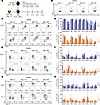 Figure 1
Time-course of TCF-1+ TPEX development and TPEX immunophenotypes. (A) Experimental design. In total, 129 recipients were lethally irradiated and reconstituted with BM and CD4+ T cells from B6 CD45.1+ donors and CD8+ T cells from CD90.1+ donors. Cohorts of mice (n = 3–9 each across 2 experiments) were sacrificed at days +7, +14, +21, and +28 after transplant for analysis of T cells in secondary lymphoid tissues and in GVHD target tissues. (B) Representative flow plot with TetH60 demonstrating discreet populations of TetH60+ and TetH60– cells. (C and D) Tox and PD-1 expression of TetH60+ and TetH60– CD8 cells. Representative staining (C) and quantitation in tissues (D; mLN, mesenteric lymph node; SI-IEL, small intestine intraepithelial lymphocytes; SI-LP, small intestine lamina propria). (E and F) Development of TetH60+ and TetH60– CD39loTCF-1hiCD8+ cells over time. Representative staining (E) and quantitation in tissues (F). (G and H) TetH60+ TCF-1hi cells are Toxhi, whereas there are Toxlo and Toxhi TCF-1hi cells among TetH60– cells. Representative staining (G); quantitation in H.
At day +7 in spleen and mesenteric lymph node (mLN), sites of T cell priming (29, 30), clear TetH60+ and TetH60– populations were already present (Figure 1B and Supplemental Figure 1D). Most TetH60+ cells were PD-1hiToxhi and a majority of these had also upregulated Tim-3 (Figure 1, C and D, and Supplemental Figure 1, E and F). In contrast, among TetH60– cells there were distinct populations of PD-1hiToxhi and PD-1loToxlo cells with a substantial fraction of PD-1hi cells also expressing Tim-3 (Figure 1, C and D, and Supplemental Figure 1, E and F). Whereas the TetH60–PD-1hiToxhi cells likely had an antigen experience similar to that of TetH60+ cells, TetH60–PD-1loToxlo cells may have had less antigen stimulation and could also include cells that did not respond to miHAs but underwent lymphopenia-induced proliferation (31–33). Among both TetH60+ and TetH60– cells were CD39loTCF-1hiTim3lo cells (Figure 1, E and F, and Supplemental Figure 1G). As TetH60+ cells were nearly all PD-1hiToxhi, so too were the CD39loTCF-1hi cells, suggesting that TPEX development had already begun (Figure 1, G and H). Among the TetH60– cells there were also TCF-1hiToxhi TPEX-like cells (Figure 1, G and H); however, unlike in the TetH60+ population, there were also TCF-1hi cells that were Toxlo (Figure 1, G and H). Of note, within this TetH60– Toxlo TCF-1hi population were CD62L+ cells, both CD44hi and CD44lo, whereas TetH60–TCF-1hi Toxhi cells were mostly CD62L– beyond day 7, as were all TCF-1hi TetH60+ cells (Supplemental Figure 1H).
At day +14 in spleen, most TetH60+ cells remained PD-1hiToxhi. However, fewer TetH60– cells were PD-1loToxlo than was observed at day +7, potentially indicative of the progressive expansion of CD8 cells targeting well-presented miHAs other than H60 (Figure 1, C and D). Among splenic TetH60+ and TetH60– cells, 9.7% (±3.4% SD) and 11.3% (±3.6% SD) were CD39loTCF-1hi, respectively (Figure 1, E and F). The day +21 and +28 data were similar to those at day +14 (Figure 1, C–F).
TetH60+ and TetH60– CD8 cells also distributed to nonlymphoid tissues, including those canonically affected by GVHD (Supplemental Figure 1D). Except for liver, alloreactive CD8 cells isolated from tissues were largely excluded from intravenous CD45.2 labeling, indicative of intraparenchymal distributions (Supplemental Figure 1I). The phenotypes of TetH60+ cells were consistent across mice and each tissue at each time point; most were PD-1hiToxhi with small populations of CD39loTCF-1hi cells (Figure 1, D and F, and Supplemental Figures 2 and 3). Among TetH60– cells, there were again distinct populations of PD-1hiToxhi and PD-1loToxlo cells (Figure 1D and Supplemental Figure 3), with TCF-1hi cells found in both Toxhi and Toxlo subsets (Figure 1H and Supplemental Figure 4). However, there was variability in these fractions across tissues.
TCF-1+ TPEX have increased potential for expansion in GVHD. To test the fitness of TCF-1hi TPEX, we competed them against TCF-1lo effectors (TEFF) using a secondary transfer approach. We first created congenically distinct alloreactive CD8+ T cells by transplanting 129 mice with B6 CD45.1 BM and either CD45.2 B6 CD90.1+ or CD90.2+ CD8+ T cells. At day +14, donor-derived splenic CD8 cells were sorted into CD39lo and CD39hi subsets to create populations that were enriched for (CD39lo) or depleted of (CD39hi) TCF-1hi cells as confirmed by a postsort analysis (Figure 2A). We chose to compete T cells harvested at day 14, as the TPEX population appeared to be stable at this point and therefore unlikely to be contaminated by effectors that had yet to downregulate TCF-1. To minimize variation introduced by T cells having a heterogeneous mix of target antigens, we focused only on H60-reactive CD8 cells. Sorted congenic CD39hiTCF-1lo and CD39loTCF-1hi containing equal numbers of TetH60+ cells were transferred along with CD45.1 B6 BM and unmanipulated B6 splenic CD8 cells into a second cohort of irradiated 129 mice (Figure 2A). The frequencies and phenotypes of the TetH60+ progeny of CD39hi and CD39lo cells were analyzed 14 days later.
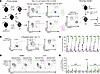 Figure 2
CD39loTCF-1–enriched CD8 cells outcompete CD39hiTCF-1–depleted CD8 cells on retransplantation. (A) Competitive secondary transfer experimental design. In parallel, primary 129 recipients were lethally irradiated and reconstituted with B6 CD45.1 BM and CD4+ cells and CD90.1+ or CD90.2+ B6 CD8 T cells. At day +14, CD8+ donor T cells from spleens were sorted into CD39hi and CD39lo fractions. New unmanipulated 129 recipients were lethally irradiated and reconstituted with B6 CD45.1 BM, CD4, and CD8 cells, and congenically distinct CD39hi and CD39lo CD8 cells containing the same number of TetH60+ cells. Shown are pre- and post-sort analyses (right panels) from 1 of 2 replicated experiments. (B and C) At day +14 after the second transplant, the progeny of congenic CD39hi and CD39lo sorted TetH60+ cells were enumerated. Representative flow cytometry (B) and quantitation (C). **P < 0.01, ***P < 0.001 by 2-sided Student’s t test. (D and E) Representative TCF-1 and CD39 staining of the progeny of transferred CD39hi and CD39lo sorted cells 14 days after secondary transfer and their quantitation in tissues (QNS, quantity of CD39hi-sorted cells not sufficient for statistical comparison). *P <0.05, **P < 0.001 by 1-sided Student’s t test.
In all tissues, TetH60+ progeny of CD39loTCF-1hi cells outnumbered TetH60+ progeny of CD39hiTCF-1lo cells by an average of 21-fold (Figure 2, B and C). Most progeny of CD39loTCF-1hi cells became CD39hiTCF-1lo TEFF (Figure 2, D and E), consistent with what we reported for CD4 cells in GVHD (25) and which has been described for CD8+ TPEX in LCMV clone 13 infection when similar populations were studied through adoptive transfer approaches (13, 15, 34). Importantly, in most tissues in most mice, there were progeny of CD39lo cells that retained TCF-1 expression, which could represent a self-renewing population of T cells with preserved stemness. In contrast, there were few progeny of CD39hi cells expressing TCF-1. We only recovered sufficient progeny of CD39hi cells from spleen, mLN, and liver to allow for a statistical comparison of the frequencies of TCF-1hi cells. In spleen and mLN higher percentages of sorted CD39lo progeny were TCF-1hi (Figure 2E). Taken together, these data suggest that TCF-1hi cells can self-renew, whereas CD39hi TCF-1lo cells are largely unable to differentiate into TCF-1hi cells.
Full-length TCF-1 is required for optimal expansion of alloreactive CD8 cells in GVHD responses. In the time-course analysis (Figure 1), we observed TPEX development, manifest by upregulation of Tox, PD-1, and continued expression of TCF-1, as early as day +7 among both TetH60+ and TetH60– splenic CD8 cells. If these SLT-resident TPEX, which also distribute to nonlymphoid tissues, are important for inducing and maintaining GVHD, and if TCF-1 itself is important for TPEX function, a prediction would be that TCF-1–deficient CD8 cells from unmanipulated donors should have impaired expansion in GVHD models. Constitutive Tcf7-KO mice have a block in the development of early thymic progenitors and double-negative thymocytes and, therefore, would not have been appropriate for such studies (18, 35). We therefore chose as a source of Tcf7-impaired T cells mice that lack the full-length (p45) isoform of TCF-1, wherein there is a deletion of the N-terminal portion of TCF-1 that binds β-catenin. Such mice were created by knocking into the first intron of Tcf7 an EGFP expression cassette engineered with a 5′ splice acceptor and a 3′ polyadenylation signal such that exon 1 splices to the cassette without incorporating subsequent exons (p45–/– mice) (36, 37). However, transcription can be initiated at an alternate transcription start site upstream of the third exon, enabling expression of the short p33 and p30 isoforms lacking the N-terminal β-catenin binding domain. These mice do not have a stage-specific block in thymocyte development, though the number of thymocytes is modestly reduced (37). Staining with an N-terminal-specific TCF-1 antibody confirmed the absence of full-length TCF-1 from p45–/– mice, whereas staining with a C-terminal-specific antibody, which captures both short- and long TCF-1 isoforms, demonstrates preserved expression of p33 in CD8 cells from p45–/– donors as described previously (37) (Figure 3A).
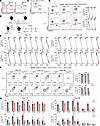 Figure 3
P45–/– CD8 cells are outcompeted by WT CD8 cells. (A) Staining for TCF-1 using N-terminal and C-terminal antibodies confirms the lack of the N-terminal β-catenin binding domain in p45–/– CD8+ donor cells (red), similar to negative control CD19+ B cells (gray). TCF-1 C-terminal inclusive isoforms are still detected in p45–/– CD8 cells using a C-terminal antibody, though expression is lower than in WT cells (black). (B) Experimental design. WT CD90.1+ CD8 cells were transferred in a 1:1 ratio with CD90.2+ p45–/– cells into lethally irradiated 129 recipients with B6 CD45.1 BM and CD4 cells. Tissues were harvested from recipients on days +10 (spleen only), +14, and +28. (C) Flow cytometry of the T cell mix prior to infusion, gated on CD8+CD44–CD62L+ cells. (D) Representative flow plots from 2 separate experiments (left panel) and quantitation of TetH60+ and TetH60– progeny of competed donor CD8 cells in spleen at days +10, +14, and +28. (E) Quantitation of TetH60+ and TetH60– progeny of competed CD8 cells at days +14 and +28 in other tissues and blood. (F) Representative Tox and PD-1 staining (left panel) and quantitation (right panel) of PD-1+Tox+ progeny of p45–/– and WT cells in spleen over time. (G) Quantitation of PD-1+Tox+ TetH60+ and TetH60– progeny of p45–/– and WT CD8 cells in tissues at days +14 and +28. QNS, quantity of p45–/– cells not sufficient for statistical comparison. *P < 0.05, **P < 0.01, ***P < 0.001 by 2-sided Student’s t test.
Irradiated 129 recipients were reconstituted with B6 CD45.1 BM and a 1:1 mix of CD8 cells containing 1 × 10⁶ WT CD90.1+ and 106 p45–/– CD90.2+ naive T cells (TN) cells (experimental design, Figure 3B, flow cytometry confirmation of the WT and p45–/– T cell mix, and Figure 3C). We initially focused on early T cell expansion in spleen and analyzed cells at days +10 or +14 in independent experiments. In spleen, WT T cells greatly outperformed p45–/– cells among both TetH60+ and TetH60– subsets (Figure 3D). The reduced competitiveness of p45–/– CD8 cells in spleen was paralleled in other tissues analyzed at days +14 and +28, wherein the majority of TetH60+ and TetH60– CD8 cells were WT (Figure 3E). Despite impaired expansion, splenic p45–/– TetH60+ cells were mostly PD-1hiToxhi (Figure 3F). Among TetH60– cells, a smaller percentage of p45–/– progeny were PD-1hiToxhi, suggesting that there could have been selective culling of cells that had the most sustained TCR stimulation (Figure 3F). However, the decrease in the percentage of PD-1hiToxhi cells cannot alone account for the reduced number of TetH60– p45–/– progeny, indicating that the long isoform of TCF-1 was also required for optimal expansion of cells that were not induced to express high levels of Tox and PD-1. These features of PD-1 and Tox expression in splenocytes were also observed in donor CD8 cells infiltrating other tissues (Figure 3G). Taken together, these data demonstrate that GVH-reactive CD8 cells, and especially those activated sufficiently to induce high levels of Tox and PD-1, require the long TCF-1 isoforms for optimal expansion.
Full-length TCF-1 is not required for optimal expansion of CD8 cells with less intense antigen challenge. We first tested whether long TCF-1 isoforms are required for optimal lymphopenia-induced proliferation, which is also dependent on TCR stimulation (32). In contrast to what was observed in 129 recipients, p45–/– CD8 cells were not at a competitive disadvantage when cotransplanted with WT CD8 cells into syngeneic B6 mice, indicating that the long TCF-1 isoform is not required for lymphopenia-induced proliferation (Figure 4, A and B).
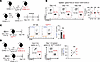 Figure 4
P45–/– CD8 cells are not impaired in lymphopenia-induced proliferation or response to vaccination. (A) WT CD90.1+ CD8 cells were transferred in a 1:1 ratio with CD90.2+ p45–/– CD8 cells, along with CD45.1 BM and CD4 cells into lethally irradiated syngeneic B6 CD45.1 recipients. At days +10, +14, and +28, spleens were harvested to enumerate frequencies of donor CD8 cells. (B) Representative staining from 2 separate experiments and quantitation. (C) WT and p45–/– mice were vaccinated against H60 with DEC-H60 and an anti-CD40 agonist antibody (FGK45; left panel). Two months later, spleens were enumerated for the presence of TetH60+ CD8 cells. Representative flow (middle panel) and quantitation (right panel) are shown. (E) In total, 1 × 10⁶ CD8+ TN from CD90.1 WT and CD90.2 p45–/– spleens were cotransferred into WT CD45.1 B6 mice, followed by vaccination with DEC-H60 and FGK45. Two-weeks later, competing donor cells were enumerated from spleens (left panel). Representative staining (middle panel) and quantitation (right panel) are shown. NS: not significant by 2-sided Student’s t test.
We next tested whether long TCF-1 isoform is required for responses against H60 delivered by vaccination instead of in the context of alloSCT. In one approach, p45–/– and WT mice were immunized against H60 using an anti-DEC205 antibody modified to express the immunodominant LTFNYRNL epitope from H60, along with an agonist antibody against CD40 (clone FGK45) as an adjuvant (28). There were similar numbers of WT and p45–/– TetH60+ CD8 cells in spleen after 8 weeks (Figure 4C). In a second approach, we cotransferred 1 × 10⁶ CD8 cells from CD45.2+CD90.1+ WT and CD45.2+CD90.2+ p45–/– mice into CD45.1+ B6 mice followed by DEC-H60/FGK45 immunization. Mice were sacrificed 14 days later to enumerate TetH60+ CD8 cells from each T cell source. Although there was mouse to mouse variability, possibly due to stochastic effects operating on small numbers of anti-H60 precursors, overall, WT and p45–/– cells responded similarly (Figure 4D). Taken together, these results indicate that p45–/– T cells are not impaired in responding to H60 as presented after immunization, despite their competitive disadvantage when challenged against H60 in a GVHD model.
P45–/– CD8 cells cause less clinical but similar histopathologic GVHD. While the B6→129 model enables the tracking and study of CD8+ T cell responses against H60, CD8 cells alone do not induce robust GVHD. Therefore, to test whether full length TCF-1 is required for maximal CD8-mediated GVHD, we switched to the B6→C3H.SW (H-2b) model. C3H.SW recipients were irradiated and transplanted with T cell–depleted B6 CD45.1+ BM and CD8+ T cells from WT B6 CD90.1+ or p45–/– CD90.1+ mice (Figure 5A). Recipients of WT CD8 cells had significantly greater weight loss than did BM-only controls and p45–/– CD8 recipients (Figure 5B). Mice were sacrificed on day +39 and tissues were harvested for GVHD scoring as described previously (38). Contrary to the difference in weight loss, both WT and p45–/– CD8 cells caused similar degrees of histopathologic GVHD compared with BM-only controls in liver, small intestine, and colon, whereas skin was unaffected in this model (Figure 5C).
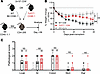 Figure 5
p45–/– cells cause less clinical but similar histologic GVHD. (A) Experimental design. C3H.SW recipients (H-2b) were irradiated with 1,000 cGy and reconstituted with 5 × 10⁶ T cell–depleted BM cells from B6 CD45.1+ mice with or without 2 × 10⁶ CD8+ T cells from WT B6 CD90.1+ or p45–/– CD90.1+ mice. (B) Recipients were followed for weight loss over time. *P < 0.05, **P < 0.001 by 1-way ANOVA. (C) Histopathological scores of recipient tissues. NS, not significant comparing WT to p45–/– by 2-sided Mann-Whitney U test. †P < 0.05 and ††P < 0.01 comparing WT or p45–/– to BM alone control by 2-sided Mann-Whitney U test.
P45–/– CD8 cells mediate GVL. To test the importance of full-length TCF-1 in GVL responses, we compared GVL mediated by p45–/– and WT CD8 cells against a mouse model of blast-crisis chronic myeloid leukemia (mBC-CML) in which the oncogenic fusion genes bcr-abl (linked to the expression of human NGFR) and NUP98-HOXA9 (linked to GFP expression) are retrovirally transduced into BM cells 39, 40). Irradiated 129 mice were reconstituted with 129-derived mBC-CML cells and B6 BM with or without graded doses of WT or p45–/– CD8+ cells (Figure 6A, experimental design). Mice were sacrificed on day +21 to enumerate mBC-CML cells and donor T cells. In both spleen and BM, there were fewer mBC-CML cells in high-dose CD8+ T cell recipients (2 × 10⁶ / mouse) compared with mice that received lower CD8+ T cell doses (Figure 6, B and C). Surprisingly, mBC-CML numbers were similar in p45–/– and WT CD8 recipients at all doses. Consistent with what was observed in the competitive setting, at high CD8 cell doses (2 × 10⁶/mouse), we observed significantly fewer donor p45–/– donor CD8 cells as a percentage of total live cells compared with WT CD8 cells in spleen and BM (Figure 6D). However, there were no differences between percentages of p45–/– and WT cells at lower cell doses (Figure 6D), or when comparing total number of donor CD8 cells recovered at all dose levels (Figure 6E).
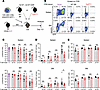 Figure 6
P45–/– CD8 cells mediate GVL. (A) Lethally irradiated 129 mice were reconstituted with B6 CD45.1 BM and 129-derived mBC-CML cells (containing 5 × 10⁴ that were CD11b–) with or without CD8 cells (5 × 10⁴ to 2 × 10⁶ per mouse) from B6 WT or p45–/– donors. Three-weeks later, GFP+humanNGFR+ mBC-CML cells (B, representative flow cytometry) were enumerated in spleen and BM (one femur; C). Data shown are combined from 2 separate experiments, represented by triangle and circle symbols. NS, not significant. *P < 0.05 and **P < 0.01 comparing recipients of WT or p45–/– CD8 cells; or †P < 0.05, ††P < 0.01, or †††P < 0.001 comparing a T cell recipient group to the no T cell group using a 2-sided Student’s t test.


