
Inflammation

Abstract
Sepsis, a systemic inflammatory response to infection, remains a leading cause of mortality in intensive care units, with sepsis-induced immunosuppression being a critical pathophysiological process. In this study, we investigated the role of histone deacetylase 1 (HDAC1) in sepsis-induced CD8+ T cell exhaustion, a key driver of immunosuppression. Clinical analyses of patients with sepsis revealed that reduced peripheral blood lymphocyte levels, particularly CD8+ T cell depletion, strongly correlated with worsened outcomes. In a murine sepsis model, single-cell RNA-Seq revealed a significant decrease in the proportion of CD8+ T cells and an increase in the proportion of exhausted CD8+ T cells in mouse lungs. Adoptive transfer of CD8+ T cells effectively reduced sepsis mortality by preserving organ function. We further demonstrated that HDAC1 expression was significantly upregulated in CD8+ T cells from patients with sepsis. In vitro studies showed that HDAC1 inhibition preserved CD8+ T cell function by maintaining T cell activity and reducing the expression of inhibitory molecules such as PD-1. Pharmacological inhibition of HDAC1 reduced mortality and reversed CD8+ T cell exhaustion by restoring the balance between activator protein-1 (AP-1) and nuclear factor of activated T cells (NFAT). Additionally, we found that HDAC1 directly interacted with NFAT1, promoting its nuclear translocation and further enhancing the expression of inhibitory molecules. Our findings highlight HDAC1 as a potential therapeutic target for sepsis-induced immunosuppression. By elucidating the molecular mechanisms underlying HDAC1-mediated immunosuppression, we have provided potential strategies for developing immunomodulatory therapies for the treatment of sepsis.
Authors
Liu Di, Jiang-bo Fan, Rui Wang, You Li, Wan-da Bi, Si-yuan Huang, Heng-hai Nie, Xi-feng Feng, Hua-cai Zhang, Juan Du, Xiao-fei Huang, An-yong Yu, Zhe Xu, Fei Xia, Jian-xin Jiang, Shuang-shuang Dai, Xiang Xu, Zhen Wang, Ling Zeng
Abstract
Authors
Sebastian Kämpf, Marjan Hematianlarki, Leon Altmann, Jessica M. Bright, Alyssa M. A. Toda, Zohreh Mirzapoor, Valentin Zollner, Anja Werner, Johanna Bulang, Barbara Radovani, Miriam Wöhner, William Avery, Mark J. Karbarz, Pamela B. Conley, Greg P. Coffey, Falk Nimmerjahn
Abstract
Adeno-associated viruses (AAVs) have been used in gene therapy, especially for inherited retinal diseases. Despite their effectiveness in gene transduction, immune responses to the AAV capsid and transgene products have been reported, which can compromise both the efficacy and safety of AAV-mediated therapies. The eye is regarded as an immune-privileged organ where immune activity is constitutively suppressed. Here, we highlight that immunomonitoring in an ocular gene transfer reveals variable immune responses, whatever the species (human clinical trial, non-human primates, mice), the site of injection, the cassette, and the dose. We further explored factors contributing to this variability, investigating the potential correlation among immune parameters in a controlled experimental setting. In a syngeneic murine model after a subretinal injection of AAV, our results highlight an inter-individual variability of immune parameters, emphasizing the importance of considering inherent variability among individuals while designing personalized therapies.
Authors
Duohao REN, Gaelle A. CHAUVEAU, Julie VENDOMELE, Emilie CABON, Audrey PINEIRO, Catherine VIGNAL-CLERMONT, Hanadi SALIBA, Giuseppe RONZITTI, Anne GALY, Deniz DALKARA, Juliette PULMAN, Divya AIL, Sylvain FISSON

Abstract
Epigenetic modifications play a crucial role in the pathogenesis of inflammatory bowel disease (IBD) by mediating gene-environment interactions. We previously showed that UHRF1, a central regulator of DNA methylation, contributes to cancer progression; however, its function in IBD remains poorly understood. Here, we revealed that UHRF1 was frequently reduced in inflamed tissues of patients with IBD and that its deficiency exacerbated intestinal epithelial cell (IEC) damage. Through a multilevel approach incorporating human cell models and an intestinal epithelial-specific Uhrf1-KO mouse model, we established UHRF1 as a key mitigator of IBD progression. Mechanistically, UHRF1 bound to the NPY1R promoter, promoted its methylation, and led to transcriptional suppression. The NPY1R upregulation resulting from UHRF1 deficiency attenuated cAMP/PKA/CREB signaling in IECs, thereby enhancing NF-κB activation and subsequent proinflammatory responses, which compromised intestinal epithelial barrier integrity. Furthermore, we identified miR-141 as a negative regulator of NPY1R, highlighting its potential as a therapeutic agent. Collectively, our results identified the UHRF1/NPY1R regulatory axis as a critical epigenetic mechanism in intestinal inflammation and underscored its dual promise for IBD diagnostics and therapy.
Authors
Yanan Han, Lina Sun, Yanxing Liu, Xiaohui Zhang, Hao Liu, Haohao Zhang, Xiaoxia Ren, Fenfan Wang, Huafeng Fan, Jie Chen, Dan Liu, Daiming Fan, Yuanyuan Lu, Xue Bai, Ying Fang, Kaichun Wu, Xiaodi Zhao
Abstract
Authors
Alessandra Ciullo, Xaviar M. Jones, Hiroaki Komuro, Liang Li, Anh Nguyen, Eduardo Marbán, Ahmed Gamal-Eldin Ibrahim
Abstract
Chronic hyperglycemia changes the expression of various transcription factors and mRNA transcripts, which impair the cellular functionality and delayed wound healing. ZEB2 (zinc finger E-box binding homeobox 2), a key transcription factor maintains the tissue specific macrophage identities, however, its role in regulating macrophage polarization during wound healing under hyperglycemic conditions remains unclear. Here, we have found that persistent hyperglycemia increases ZEB2 expression in wound macrophages via histone acetylation, contributing to chronic inflammation, and delayed wound healing. Exposure to high glucose levels activates P300/CBP, a transcriptional coactivator involved in histone acetylation, enhances ZEB2 expression in wound macrophages. The forced expression of ZEB2 shifts macrophage polarity toward a pro-inflammatory state by upregulating myeloid lineage directed transcription factors (MLDTFs). Conversely, silencing Zeb2 at the wound site reduced hyperglycemia induced macrophage inflammation. Topical application of C646, an inhibitor of P300, at the wound edges of streptozotocin induced high-fat diet fed diabetic mice significantly decreased ZEB2 expression, reduced inflammation and accelerated wound healing. Therefore, targeted inhibition of P300 represents a promising therapeutic strategy for improving diabetic wound healing by modulating ZEB2 driven inflammation in wound macrophages.
Authors
Soumyajit Roy, Debarun Patra, Palla Ramprasad, Shivam Sharma, Parul Katiyar, Ashvind Bawa, Kanhaiya Singh, Kulbhushan Tikoo, Suman Dasgupta, Chandan K. Sen, Durba Pal
Abstract
Although renal fibrosis is predominantly driven by the accumulated inflammatory cells that secrete pro-inflammatory factors within the kidney, the key mechanisms underlying macrophage clearance from the kidney are not well understood. The interaction of hyaluronan (HA) with lymphatic endothelial hyaluronan receptor 1 (LYVE1) constitutes a critical initial step in macrophage adhesion and removal by lymphatic vessels. This study investigates alterations in LYVE1 during kidney disease and elucidates its role in macrophage trafficking. Three renal fibrosis models demonstrated a reduction in full-length LYVE1 and an increase in the soluble LYVE1 fragment. Immunostaining of fibrotic kidneys showed significantly reduced expression of soluble LYVE1 compared with intracellular fragment (Cyto-LYVE1), demonstrating ectodomain shedding of LYVE1 in vivo and in vitro. Functionally, human lymphatic endothelial cells exposed to TGF-β1 exhibited significant decrease in macrophage adhesion and transendothelial migration compared to controls. Mechanistic analyses identified increased matrix metalloproteinase (MMP)9 in renal injury as a key upstream regulator of LYVE1 shedding. MMP9 inhibitors reduced LYVE1 shedding, enhanced macrophage adhesion and trafficking, and mitigated macrophage accumulation and disease progression. In conclusion, MMP9-induced LYVE1 shedding is linked to progressive kidney fibrosis and macrophage accumulation. LYVE1 shedding inhibitors offer potential as therapeutic agents for mitigating immune overload and kidney fibrosis.
Authors
Jing Liu, Yuqing Liu, Wenqian Zhou, Saiya Zhu, Jianyong Zhong, Haichun Yang, Annet Kirabo, Valentina Kon, Chen Yu
Abstract
Type 2 diabetic nephropathy (T2DN) is a major complication of type 2 diabetes and a leading cause of chronic kidney disease. This study aimed to explore MYO1C as both a candidate biomarker and elucidate its role as a mechanistic mediator of podocyte injury in T2DN. Using urinary extracellular vesicle RNA biomarkers identified from a training and validation cohort of 33 type 2 diabetes and 40 T2DN patients, we developed a machine learning diagnostic model for T2DN. The model achieved an AUC of 0.877 in validation and performed well in an independent test cohort with an AUC of 0.824. MYO1C was identified as the most influential feature in the final model. Mechanistic investigations in vitro and in vivo revealed that high glucose and high-fat conditions induced podocyte injury, inflammation, and apoptosis, with increased MYO1C expression. MYO1C knockdown in vitro and in vivo reduced podocyte damage and inflammatory responses. MYO1C overexpression enhanced p38, p-CREB, and TNF-α levels, while p38 inhibition mitigated these effects. These findings support MYO1C not only as a potential urinary biomarker for T2DN but also as a key pathogenic driver that promotes podocyte injury via p38 MAPK signaling, thereby highlighting its therapeutic promise.
Authors
Zihao Zhao, Qianqian Yan, Sijie Zhou, Fengxun Liu, Yong Liu, Jingjing Ren, Shaokang Pan, Zhenjie Liu, Dongwei Liu, Zhangsuo Liu, Jiayu Duan
Abstract
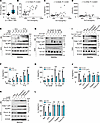
The activation of the NLRP3 inflammasome is a pivotal step in hyperinflammation in sepsis; however, the regulatory mechanisms underlying its activation are not fully understood. In this study, we found that 14-3-3ε facilitates NLRP3 inflammasome activation by enhancing NLRP3 K63 deubiquitination and promoting its translocation to the mitochondria-associated ER membranes (MAMs) for full activation. Mass spectrometry revealed that 14-3-3ε binds to NLRP3 in macrophages during sepsis. Plasma 14-3-3ε levels were elevated in patients with sepsis and were positively associated with disease severity. 14-3-3ε promoted NLRP3 inflammasome activation by facilitating NLRP3 aggregation and NLRP3–ASC assembly. The interaction between 14-3-3ε and NLRP3 was dependent on phosphorylation at the S194 site of NLRP3 NACHT domain. The NLRP3–14-3-3ε interaction promoted K63 deubiquitination and enhanced the translocation of NLRP3 to MAMs, which is necessary for full activation of NLRP3 inflammasome. Furthermore, macrophage-conditional KO of 14-3-3ε or treatment with BV02, a 14-3-3 inhibitor, improved the survival rate and alleviated organ injuries in septic mice. Taken together, our data indicate that 14-3-3ε functions as a positive regulator of the NLRP3 inflammasome and could be a target for sepsis treatment.
Authors
Xingyu Li, Siqi Ming, Can Cao, Yating Xu, Jingxian Shu, Ning Tan, Xi Huang, Yongjian Wu
Abstract
Next generation sequencing can identify previously uncharacterized gene expression patterns in disease. Beyond differentially expressed genes analysis, we investigated the ability of within-population diversity (α-diversity) of the transcriptome to reveal additional biological information in alcohol-associated liver disease (ALD), comparing Differential Shannon diversity (DSD) to transcriptome heterogeneity changes. RNA sequencing data from normal livers and patients with early ALD and severe AH were analyzed. α-diversity indices and Percent Shannon Diversity of a gene, which refers to this gene's contribution to total Shannon entropy, were calculated. Ingenuity pathway analysis identified canonical pathways determined by differentially expressed genes (DEG) and DSD approaches. ALD significantly decreased hepatic transcriptome α-diversity correlating with increased relative contribution of select genes. These changes were driven by lower abundance gene expression loss. DEG and DSD analyses showed overlapping genes and canonical pathways, but DSD also identified additional genes and pathways not highlighted by DEG, including fatty acid oxidation, extracellular matrix degradation, and cholesterol metabolism pathways that may represent additional therapeutic targets. Importantly, DSD more effectively identified differences between ASH and AH. Overall, α-diversity analysis revealed that ALD progressively reduces transcriptome heterogeneity, and that DSD provides complementary insights into disease mechanisms missed by standard approaches.
Authors
Sudrishti Chaudhary, Jia-Jun Liu, Silvia Liu, Marissa Di, Juliane I. Beier, Ramon Bataller, Josepmaria Argemi, Panayiotis V. Benos, Gavin E. Arteel
No posts were found with this tag.


