
Research ArticleGeneticsInfectious diseaseNephrology
Open Access |  10.1172/jci.insight.199689
Urobiota analysis and genome-wide association study in pediatric recurrent urinary tract infections and vesicoureteral reflux
Miguel Verbitsky,1 Pavan Khosla,1 Daniel Bivona,1 Atlas Khan,1 Yask Gupta,1 Heekuk Park,2 Tian H. Shen,1 Aryan Ghotra,1 Katherine Xu,1 Iman A. Ghavami,1 Priya Krithivasan,1 Jeremiah Martino,1 Tanya Sezin,3 Tze Y. Lim,1 Victoria Kolupaeva,4 Nita A. Limdi,5 Yuan Luo,6 Hakon Hakonarson,7 Simone Sanna-Cherchi,1 Krzysztof Kiryluk,1 Cathy L. Mendelsohn,8 Anne-Catrin Uhlemann,2 Jonathan Barasch,1 and Ali G. Gharavi1,4
1Department of Medicine, Division of Nephrology;
2Department of Medicine, Division of Infectious Diseases;
3Department of Dermatology; and
4Center for Precision Medicine and Genomics, Columbia University, New York, New York, USA.
5Department of Neurology, Heersink School of Medicine, University of Alabama at Birmingham, Birmingham, Alabama, USA.
6Division of Statistics and Informatics, Northwestern University Feinberg School of Medicine, Chicago, Illinois, USA.
7Center for Applied Genomics, The Children’s Hospital of Philadelphia and Perelman School of Medicine at the University of Pennsylvania, Philadelphia, Pennsylvania, USA.
8Department of Urology, Columbia University, New York, New York, USA.
Address correspondence to: Miguel Verbitsky, Division of Nephrology, Department of Medicine, Columbia University Irving Medical Center, Presbyterian Hospital, Room 8-857P, 622 W. 168th Street, New York, New York 10032, USA. Email: mmv2003@cumc.columbia.edu. Or to: Ali G. Gharavi, Division of Nephrology, Department of Medicine, Columbia University Irving Medical Center, Presbyterian Hospital, 8th floor, Room 105, 622 W. 168th Street, New York, New York 10032, USA. Email: ag2239@cumc.columbia.edu.
Authorship note: P Khosla and DB contributed equally to this work.
Find articles by Verbitsky, M. in: PubMed | Google Scholar
1Department of Medicine, Division of Nephrology;
2Department of Medicine, Division of Infectious Diseases;
3Department of Dermatology; and
4Center for Precision Medicine and Genomics, Columbia University, New York, New York, USA.
5Department of Neurology, Heersink School of Medicine, University of Alabama at Birmingham, Birmingham, Alabama, USA.
6Division of Statistics and Informatics, Northwestern University Feinberg School of Medicine, Chicago, Illinois, USA.
7Center for Applied Genomics, The Children’s Hospital of Philadelphia and Perelman School of Medicine at the University of Pennsylvania, Philadelphia, Pennsylvania, USA.
8Department of Urology, Columbia University, New York, New York, USA.
Address correspondence to: Miguel Verbitsky, Division of Nephrology, Department of Medicine, Columbia University Irving Medical Center, Presbyterian Hospital, Room 8-857P, 622 W. 168th Street, New York, New York 10032, USA. Email: mmv2003@cumc.columbia.edu. Or to: Ali G. Gharavi, Division of Nephrology, Department of Medicine, Columbia University Irving Medical Center, Presbyterian Hospital, 8th floor, Room 105, 622 W. 168th Street, New York, New York 10032, USA. Email: ag2239@cumc.columbia.edu.
Authorship note: P Khosla and DB contributed equally to this work.
Find articles by Khosla, P. in: PubMed | Google Scholar
1Department of Medicine, Division of Nephrology;
2Department of Medicine, Division of Infectious Diseases;
3Department of Dermatology; and
4Center for Precision Medicine and Genomics, Columbia University, New York, New York, USA.
5Department of Neurology, Heersink School of Medicine, University of Alabama at Birmingham, Birmingham, Alabama, USA.
6Division of Statistics and Informatics, Northwestern University Feinberg School of Medicine, Chicago, Illinois, USA.
7Center for Applied Genomics, The Children’s Hospital of Philadelphia and Perelman School of Medicine at the University of Pennsylvania, Philadelphia, Pennsylvania, USA.
8Department of Urology, Columbia University, New York, New York, USA.
Address correspondence to: Miguel Verbitsky, Division of Nephrology, Department of Medicine, Columbia University Irving Medical Center, Presbyterian Hospital, Room 8-857P, 622 W. 168th Street, New York, New York 10032, USA. Email: mmv2003@cumc.columbia.edu. Or to: Ali G. Gharavi, Division of Nephrology, Department of Medicine, Columbia University Irving Medical Center, Presbyterian Hospital, 8th floor, Room 105, 622 W. 168th Street, New York, New York 10032, USA. Email: ag2239@cumc.columbia.edu.
Authorship note: P Khosla and DB contributed equally to this work.
Find articles by Bivona, D. in: PubMed | Google Scholar
1Department of Medicine, Division of Nephrology;
2Department of Medicine, Division of Infectious Diseases;
3Department of Dermatology; and
4Center for Precision Medicine and Genomics, Columbia University, New York, New York, USA.
5Department of Neurology, Heersink School of Medicine, University of Alabama at Birmingham, Birmingham, Alabama, USA.
6Division of Statistics and Informatics, Northwestern University Feinberg School of Medicine, Chicago, Illinois, USA.
7Center for Applied Genomics, The Children’s Hospital of Philadelphia and Perelman School of Medicine at the University of Pennsylvania, Philadelphia, Pennsylvania, USA.
8Department of Urology, Columbia University, New York, New York, USA.
Address correspondence to: Miguel Verbitsky, Division of Nephrology, Department of Medicine, Columbia University Irving Medical Center, Presbyterian Hospital, Room 8-857P, 622 W. 168th Street, New York, New York 10032, USA. Email: mmv2003@cumc.columbia.edu. Or to: Ali G. Gharavi, Division of Nephrology, Department of Medicine, Columbia University Irving Medical Center, Presbyterian Hospital, 8th floor, Room 105, 622 W. 168th Street, New York, New York 10032, USA. Email: ag2239@cumc.columbia.edu.
Authorship note: P Khosla and DB contributed equally to this work.
Find articles by Khan, A. in: PubMed | Google Scholar
1Department of Medicine, Division of Nephrology;
2Department of Medicine, Division of Infectious Diseases;
3Department of Dermatology; and
4Center for Precision Medicine and Genomics, Columbia University, New York, New York, USA.
5Department of Neurology, Heersink School of Medicine, University of Alabama at Birmingham, Birmingham, Alabama, USA.
6Division of Statistics and Informatics, Northwestern University Feinberg School of Medicine, Chicago, Illinois, USA.
7Center for Applied Genomics, The Children’s Hospital of Philadelphia and Perelman School of Medicine at the University of Pennsylvania, Philadelphia, Pennsylvania, USA.
8Department of Urology, Columbia University, New York, New York, USA.
Address correspondence to: Miguel Verbitsky, Division of Nephrology, Department of Medicine, Columbia University Irving Medical Center, Presbyterian Hospital, Room 8-857P, 622 W. 168th Street, New York, New York 10032, USA. Email: mmv2003@cumc.columbia.edu. Or to: Ali G. Gharavi, Division of Nephrology, Department of Medicine, Columbia University Irving Medical Center, Presbyterian Hospital, 8th floor, Room 105, 622 W. 168th Street, New York, New York 10032, USA. Email: ag2239@cumc.columbia.edu.
Authorship note: P Khosla and DB contributed equally to this work.
Find articles by Gupta, Y. in: PubMed | Google Scholar
1Department of Medicine, Division of Nephrology;
2Department of Medicine, Division of Infectious Diseases;
3Department of Dermatology; and
4Center for Precision Medicine and Genomics, Columbia University, New York, New York, USA.
5Department of Neurology, Heersink School of Medicine, University of Alabama at Birmingham, Birmingham, Alabama, USA.
6Division of Statistics and Informatics, Northwestern University Feinberg School of Medicine, Chicago, Illinois, USA.
7Center for Applied Genomics, The Children’s Hospital of Philadelphia and Perelman School of Medicine at the University of Pennsylvania, Philadelphia, Pennsylvania, USA.
8Department of Urology, Columbia University, New York, New York, USA.
Address correspondence to: Miguel Verbitsky, Division of Nephrology, Department of Medicine, Columbia University Irving Medical Center, Presbyterian Hospital, Room 8-857P, 622 W. 168th Street, New York, New York 10032, USA. Email: mmv2003@cumc.columbia.edu. Or to: Ali G. Gharavi, Division of Nephrology, Department of Medicine, Columbia University Irving Medical Center, Presbyterian Hospital, 8th floor, Room 105, 622 W. 168th Street, New York, New York 10032, USA. Email: ag2239@cumc.columbia.edu.
Authorship note: P Khosla and DB contributed equally to this work.
Find articles by Park, H. in: PubMed | Google Scholar
1Department of Medicine, Division of Nephrology;
2Department of Medicine, Division of Infectious Diseases;
3Department of Dermatology; and
4Center for Precision Medicine and Genomics, Columbia University, New York, New York, USA.
5Department of Neurology, Heersink School of Medicine, University of Alabama at Birmingham, Birmingham, Alabama, USA.
6Division of Statistics and Informatics, Northwestern University Feinberg School of Medicine, Chicago, Illinois, USA.
7Center for Applied Genomics, The Children’s Hospital of Philadelphia and Perelman School of Medicine at the University of Pennsylvania, Philadelphia, Pennsylvania, USA.
8Department of Urology, Columbia University, New York, New York, USA.
Address correspondence to: Miguel Verbitsky, Division of Nephrology, Department of Medicine, Columbia University Irving Medical Center, Presbyterian Hospital, Room 8-857P, 622 W. 168th Street, New York, New York 10032, USA. Email: mmv2003@cumc.columbia.edu. Or to: Ali G. Gharavi, Division of Nephrology, Department of Medicine, Columbia University Irving Medical Center, Presbyterian Hospital, 8th floor, Room 105, 622 W. 168th Street, New York, New York 10032, USA. Email: ag2239@cumc.columbia.edu.
Authorship note: P Khosla and DB contributed equally to this work.
Find articles by Shen, T. in: PubMed | Google Scholar
1Department of Medicine, Division of Nephrology;
2Department of Medicine, Division of Infectious Diseases;
3Department of Dermatology; and
4Center for Precision Medicine and Genomics, Columbia University, New York, New York, USA.
5Department of Neurology, Heersink School of Medicine, University of Alabama at Birmingham, Birmingham, Alabama, USA.
6Division of Statistics and Informatics, Northwestern University Feinberg School of Medicine, Chicago, Illinois, USA.
7Center for Applied Genomics, The Children’s Hospital of Philadelphia and Perelman School of Medicine at the University of Pennsylvania, Philadelphia, Pennsylvania, USA.
8Department of Urology, Columbia University, New York, New York, USA.
Address correspondence to: Miguel Verbitsky, Division of Nephrology, Department of Medicine, Columbia University Irving Medical Center, Presbyterian Hospital, Room 8-857P, 622 W. 168th Street, New York, New York 10032, USA. Email: mmv2003@cumc.columbia.edu. Or to: Ali G. Gharavi, Division of Nephrology, Department of Medicine, Columbia University Irving Medical Center, Presbyterian Hospital, 8th floor, Room 105, 622 W. 168th Street, New York, New York 10032, USA. Email: ag2239@cumc.columbia.edu.
Authorship note: P Khosla and DB contributed equally to this work.
Find articles by Ghotra, A. in: PubMed | Google Scholar
1Department of Medicine, Division of Nephrology;
2Department of Medicine, Division of Infectious Diseases;
3Department of Dermatology; and
4Center for Precision Medicine and Genomics, Columbia University, New York, New York, USA.
5Department of Neurology, Heersink School of Medicine, University of Alabama at Birmingham, Birmingham, Alabama, USA.
6Division of Statistics and Informatics, Northwestern University Feinberg School of Medicine, Chicago, Illinois, USA.
7Center for Applied Genomics, The Children’s Hospital of Philadelphia and Perelman School of Medicine at the University of Pennsylvania, Philadelphia, Pennsylvania, USA.
8Department of Urology, Columbia University, New York, New York, USA.
Address correspondence to: Miguel Verbitsky, Division of Nephrology, Department of Medicine, Columbia University Irving Medical Center, Presbyterian Hospital, Room 8-857P, 622 W. 168th Street, New York, New York 10032, USA. Email: mmv2003@cumc.columbia.edu. Or to: Ali G. Gharavi, Division of Nephrology, Department of Medicine, Columbia University Irving Medical Center, Presbyterian Hospital, 8th floor, Room 105, 622 W. 168th Street, New York, New York 10032, USA. Email: ag2239@cumc.columbia.edu.
Authorship note: P Khosla and DB contributed equally to this work.
Find articles by
Xu, K.
in:
PubMed
|
Google Scholar
|

1Department of Medicine, Division of Nephrology;
2Department of Medicine, Division of Infectious Diseases;
3Department of Dermatology; and
4Center for Precision Medicine and Genomics, Columbia University, New York, New York, USA.
5Department of Neurology, Heersink School of Medicine, University of Alabama at Birmingham, Birmingham, Alabama, USA.
6Division of Statistics and Informatics, Northwestern University Feinberg School of Medicine, Chicago, Illinois, USA.
7Center for Applied Genomics, The Children’s Hospital of Philadelphia and Perelman School of Medicine at the University of Pennsylvania, Philadelphia, Pennsylvania, USA.
8Department of Urology, Columbia University, New York, New York, USA.
Address correspondence to: Miguel Verbitsky, Division of Nephrology, Department of Medicine, Columbia University Irving Medical Center, Presbyterian Hospital, Room 8-857P, 622 W. 168th Street, New York, New York 10032, USA. Email: mmv2003@cumc.columbia.edu. Or to: Ali G. Gharavi, Division of Nephrology, Department of Medicine, Columbia University Irving Medical Center, Presbyterian Hospital, 8th floor, Room 105, 622 W. 168th Street, New York, New York 10032, USA. Email: ag2239@cumc.columbia.edu.
Authorship note: P Khosla and DB contributed equally to this work.
Find articles by Ghavami, I. in: PubMed | Google Scholar
1Department of Medicine, Division of Nephrology;
2Department of Medicine, Division of Infectious Diseases;
3Department of Dermatology; and
4Center for Precision Medicine and Genomics, Columbia University, New York, New York, USA.
5Department of Neurology, Heersink School of Medicine, University of Alabama at Birmingham, Birmingham, Alabama, USA.
6Division of Statistics and Informatics, Northwestern University Feinberg School of Medicine, Chicago, Illinois, USA.
7Center for Applied Genomics, The Children’s Hospital of Philadelphia and Perelman School of Medicine at the University of Pennsylvania, Philadelphia, Pennsylvania, USA.
8Department of Urology, Columbia University, New York, New York, USA.
Address correspondence to: Miguel Verbitsky, Division of Nephrology, Department of Medicine, Columbia University Irving Medical Center, Presbyterian Hospital, Room 8-857P, 622 W. 168th Street, New York, New York 10032, USA. Email: mmv2003@cumc.columbia.edu. Or to: Ali G. Gharavi, Division of Nephrology, Department of Medicine, Columbia University Irving Medical Center, Presbyterian Hospital, 8th floor, Room 105, 622 W. 168th Street, New York, New York 10032, USA. Email: ag2239@cumc.columbia.edu.
Authorship note: P Khosla and DB contributed equally to this work.
Find articles by Krithivasan, P. in: PubMed | Google Scholar
1Department of Medicine, Division of Nephrology;
2Department of Medicine, Division of Infectious Diseases;
3Department of Dermatology; and
4Center for Precision Medicine and Genomics, Columbia University, New York, New York, USA.
5Department of Neurology, Heersink School of Medicine, University of Alabama at Birmingham, Birmingham, Alabama, USA.
6Division of Statistics and Informatics, Northwestern University Feinberg School of Medicine, Chicago, Illinois, USA.
7Center for Applied Genomics, The Children’s Hospital of Philadelphia and Perelman School of Medicine at the University of Pennsylvania, Philadelphia, Pennsylvania, USA.
8Department of Urology, Columbia University, New York, New York, USA.
Address correspondence to: Miguel Verbitsky, Division of Nephrology, Department of Medicine, Columbia University Irving Medical Center, Presbyterian Hospital, Room 8-857P, 622 W. 168th Street, New York, New York 10032, USA. Email: mmv2003@cumc.columbia.edu. Or to: Ali G. Gharavi, Division of Nephrology, Department of Medicine, Columbia University Irving Medical Center, Presbyterian Hospital, 8th floor, Room 105, 622 W. 168th Street, New York, New York 10032, USA. Email: ag2239@cumc.columbia.edu.
Authorship note: P Khosla and DB contributed equally to this work.
Find articles by Martino, J. in: PubMed | Google Scholar
1Department of Medicine, Division of Nephrology;
2Department of Medicine, Division of Infectious Diseases;
3Department of Dermatology; and
4Center for Precision Medicine and Genomics, Columbia University, New York, New York, USA.
5Department of Neurology, Heersink School of Medicine, University of Alabama at Birmingham, Birmingham, Alabama, USA.
6Division of Statistics and Informatics, Northwestern University Feinberg School of Medicine, Chicago, Illinois, USA.
7Center for Applied Genomics, The Children’s Hospital of Philadelphia and Perelman School of Medicine at the University of Pennsylvania, Philadelphia, Pennsylvania, USA.
8Department of Urology, Columbia University, New York, New York, USA.
Address correspondence to: Miguel Verbitsky, Division of Nephrology, Department of Medicine, Columbia University Irving Medical Center, Presbyterian Hospital, Room 8-857P, 622 W. 168th Street, New York, New York 10032, USA. Email: mmv2003@cumc.columbia.edu. Or to: Ali G. Gharavi, Division of Nephrology, Department of Medicine, Columbia University Irving Medical Center, Presbyterian Hospital, 8th floor, Room 105, 622 W. 168th Street, New York, New York 10032, USA. Email: ag2239@cumc.columbia.edu.
Authorship note: P Khosla and DB contributed equally to this work.
Find articles by
Sezin, T.
in:
PubMed
|
Google Scholar
|
1Department of Medicine, Division of Nephrology;
2Department of Medicine, Division of Infectious Diseases;
3Department of Dermatology; and
4Center for Precision Medicine and Genomics, Columbia University, New York, New York, USA.
5Department of Neurology, Heersink School of Medicine, University of Alabama at Birmingham, Birmingham, Alabama, USA.
6Division of Statistics and Informatics, Northwestern University Feinberg School of Medicine, Chicago, Illinois, USA.
7Center for Applied Genomics, The Children’s Hospital of Philadelphia and Perelman School of Medicine at the University of Pennsylvania, Philadelphia, Pennsylvania, USA.
8Department of Urology, Columbia University, New York, New York, USA.
Address correspondence to: Miguel Verbitsky, Division of Nephrology, Department of Medicine, Columbia University Irving Medical Center, Presbyterian Hospital, Room 8-857P, 622 W. 168th Street, New York, New York 10032, USA. Email: mmv2003@cumc.columbia.edu. Or to: Ali G. Gharavi, Division of Nephrology, Department of Medicine, Columbia University Irving Medical Center, Presbyterian Hospital, 8th floor, Room 105, 622 W. 168th Street, New York, New York 10032, USA. Email: ag2239@cumc.columbia.edu.
Authorship note: P Khosla and DB contributed equally to this work.
Find articles by Lim, T. in: PubMed | Google Scholar
1Department of Medicine, Division of Nephrology;
2Department of Medicine, Division of Infectious Diseases;
3Department of Dermatology; and
4Center for Precision Medicine and Genomics, Columbia University, New York, New York, USA.
5Department of Neurology, Heersink School of Medicine, University of Alabama at Birmingham, Birmingham, Alabama, USA.
6Division of Statistics and Informatics, Northwestern University Feinberg School of Medicine, Chicago, Illinois, USA.
7Center for Applied Genomics, The Children’s Hospital of Philadelphia and Perelman School of Medicine at the University of Pennsylvania, Philadelphia, Pennsylvania, USA.
8Department of Urology, Columbia University, New York, New York, USA.
Address correspondence to: Miguel Verbitsky, Division of Nephrology, Department of Medicine, Columbia University Irving Medical Center, Presbyterian Hospital, Room 8-857P, 622 W. 168th Street, New York, New York 10032, USA. Email: mmv2003@cumc.columbia.edu. Or to: Ali G. Gharavi, Division of Nephrology, Department of Medicine, Columbia University Irving Medical Center, Presbyterian Hospital, 8th floor, Room 105, 622 W. 168th Street, New York, New York 10032, USA. Email: ag2239@cumc.columbia.edu.
Authorship note: P Khosla and DB contributed equally to this work.
Find articles by Kolupaeva, V. in: PubMed | Google Scholar
1Department of Medicine, Division of Nephrology;
2Department of Medicine, Division of Infectious Diseases;
3Department of Dermatology; and
4Center for Precision Medicine and Genomics, Columbia University, New York, New York, USA.
5Department of Neurology, Heersink School of Medicine, University of Alabama at Birmingham, Birmingham, Alabama, USA.
6Division of Statistics and Informatics, Northwestern University Feinberg School of Medicine, Chicago, Illinois, USA.
7Center for Applied Genomics, The Children’s Hospital of Philadelphia and Perelman School of Medicine at the University of Pennsylvania, Philadelphia, Pennsylvania, USA.
8Department of Urology, Columbia University, New York, New York, USA.
Address correspondence to: Miguel Verbitsky, Division of Nephrology, Department of Medicine, Columbia University Irving Medical Center, Presbyterian Hospital, Room 8-857P, 622 W. 168th Street, New York, New York 10032, USA. Email: mmv2003@cumc.columbia.edu. Or to: Ali G. Gharavi, Division of Nephrology, Department of Medicine, Columbia University Irving Medical Center, Presbyterian Hospital, 8th floor, Room 105, 622 W. 168th Street, New York, New York 10032, USA. Email: ag2239@cumc.columbia.edu.
Authorship note: P Khosla and DB contributed equally to this work.
Find articles by Limdi, N. in: PubMed | Google Scholar
1Department of Medicine, Division of Nephrology;
2Department of Medicine, Division of Infectious Diseases;
3Department of Dermatology; and
4Center for Precision Medicine and Genomics, Columbia University, New York, New York, USA.
5Department of Neurology, Heersink School of Medicine, University of Alabama at Birmingham, Birmingham, Alabama, USA.
6Division of Statistics and Informatics, Northwestern University Feinberg School of Medicine, Chicago, Illinois, USA.
7Center for Applied Genomics, The Children’s Hospital of Philadelphia and Perelman School of Medicine at the University of Pennsylvania, Philadelphia, Pennsylvania, USA.
8Department of Urology, Columbia University, New York, New York, USA.
Address correspondence to: Miguel Verbitsky, Division of Nephrology, Department of Medicine, Columbia University Irving Medical Center, Presbyterian Hospital, Room 8-857P, 622 W. 168th Street, New York, New York 10032, USA. Email: mmv2003@cumc.columbia.edu. Or to: Ali G. Gharavi, Division of Nephrology, Department of Medicine, Columbia University Irving Medical Center, Presbyterian Hospital, 8th floor, Room 105, 622 W. 168th Street, New York, New York 10032, USA. Email: ag2239@cumc.columbia.edu.
Authorship note: P Khosla and DB contributed equally to this work.
Find articles by
Luo, Y.
in:
PubMed
|
Google Scholar
|
1Department of Medicine, Division of Nephrology;
2Department of Medicine, Division of Infectious Diseases;
3Department of Dermatology; and
4Center for Precision Medicine and Genomics, Columbia University, New York, New York, USA.
5Department of Neurology, Heersink School of Medicine, University of Alabama at Birmingham, Birmingham, Alabama, USA.
6Division of Statistics and Informatics, Northwestern University Feinberg School of Medicine, Chicago, Illinois, USA.
7Center for Applied Genomics, The Children’s Hospital of Philadelphia and Perelman School of Medicine at the University of Pennsylvania, Philadelphia, Pennsylvania, USA.
8Department of Urology, Columbia University, New York, New York, USA.
Address correspondence to: Miguel Verbitsky, Division of Nephrology, Department of Medicine, Columbia University Irving Medical Center, Presbyterian Hospital, Room 8-857P, 622 W. 168th Street, New York, New York 10032, USA. Email: mmv2003@cumc.columbia.edu. Or to: Ali G. Gharavi, Division of Nephrology, Department of Medicine, Columbia University Irving Medical Center, Presbyterian Hospital, 8th floor, Room 105, 622 W. 168th Street, New York, New York 10032, USA. Email: ag2239@cumc.columbia.edu.
Authorship note: P Khosla and DB contributed equally to this work.
Find articles by
Hakonarson, H.
in:
PubMed
|
Google Scholar
|
1Department of Medicine, Division of Nephrology;
2Department of Medicine, Division of Infectious Diseases;
3Department of Dermatology; and
4Center for Precision Medicine and Genomics, Columbia University, New York, New York, USA.
5Department of Neurology, Heersink School of Medicine, University of Alabama at Birmingham, Birmingham, Alabama, USA.
6Division of Statistics and Informatics, Northwestern University Feinberg School of Medicine, Chicago, Illinois, USA.
7Center for Applied Genomics, The Children’s Hospital of Philadelphia and Perelman School of Medicine at the University of Pennsylvania, Philadelphia, Pennsylvania, USA.
8Department of Urology, Columbia University, New York, New York, USA.
Address correspondence to: Miguel Verbitsky, Division of Nephrology, Department of Medicine, Columbia University Irving Medical Center, Presbyterian Hospital, Room 8-857P, 622 W. 168th Street, New York, New York 10032, USA. Email: mmv2003@cumc.columbia.edu. Or to: Ali G. Gharavi, Division of Nephrology, Department of Medicine, Columbia University Irving Medical Center, Presbyterian Hospital, 8th floor, Room 105, 622 W. 168th Street, New York, New York 10032, USA. Email: ag2239@cumc.columbia.edu.
Authorship note: P Khosla and DB contributed equally to this work.
Find articles by Sanna-Cherchi, S. in: PubMed | Google Scholar
1Department of Medicine, Division of Nephrology;
2Department of Medicine, Division of Infectious Diseases;
3Department of Dermatology; and
4Center for Precision Medicine and Genomics, Columbia University, New York, New York, USA.
5Department of Neurology, Heersink School of Medicine, University of Alabama at Birmingham, Birmingham, Alabama, USA.
6Division of Statistics and Informatics, Northwestern University Feinberg School of Medicine, Chicago, Illinois, USA.
7Center for Applied Genomics, The Children’s Hospital of Philadelphia and Perelman School of Medicine at the University of Pennsylvania, Philadelphia, Pennsylvania, USA.
8Department of Urology, Columbia University, New York, New York, USA.
Address correspondence to: Miguel Verbitsky, Division of Nephrology, Department of Medicine, Columbia University Irving Medical Center, Presbyterian Hospital, Room 8-857P, 622 W. 168th Street, New York, New York 10032, USA. Email: mmv2003@cumc.columbia.edu. Or to: Ali G. Gharavi, Division of Nephrology, Department of Medicine, Columbia University Irving Medical Center, Presbyterian Hospital, 8th floor, Room 105, 622 W. 168th Street, New York, New York 10032, USA. Email: ag2239@cumc.columbia.edu.
Authorship note: P Khosla and DB contributed equally to this work.
Find articles by
Kiryluk, K.
in:
PubMed
|
Google Scholar
|
1Department of Medicine, Division of Nephrology;
2Department of Medicine, Division of Infectious Diseases;
3Department of Dermatology; and
4Center for Precision Medicine and Genomics, Columbia University, New York, New York, USA.
5Department of Neurology, Heersink School of Medicine, University of Alabama at Birmingham, Birmingham, Alabama, USA.
6Division of Statistics and Informatics, Northwestern University Feinberg School of Medicine, Chicago, Illinois, USA.
7Center for Applied Genomics, The Children’s Hospital of Philadelphia and Perelman School of Medicine at the University of Pennsylvania, Philadelphia, Pennsylvania, USA.
8Department of Urology, Columbia University, New York, New York, USA.
Address correspondence to: Miguel Verbitsky, Division of Nephrology, Department of Medicine, Columbia University Irving Medical Center, Presbyterian Hospital, Room 8-857P, 622 W. 168th Street, New York, New York 10032, USA. Email: mmv2003@cumc.columbia.edu. Or to: Ali G. Gharavi, Division of Nephrology, Department of Medicine, Columbia University Irving Medical Center, Presbyterian Hospital, 8th floor, Room 105, 622 W. 168th Street, New York, New York 10032, USA. Email: ag2239@cumc.columbia.edu.
Authorship note: P Khosla and DB contributed equally to this work.
Find articles by Mendelsohn, C. in: PubMed | Google Scholar
1Department of Medicine, Division of Nephrology;
2Department of Medicine, Division of Infectious Diseases;
3Department of Dermatology; and
4Center for Precision Medicine and Genomics, Columbia University, New York, New York, USA.
5Department of Neurology, Heersink School of Medicine, University of Alabama at Birmingham, Birmingham, Alabama, USA.
6Division of Statistics and Informatics, Northwestern University Feinberg School of Medicine, Chicago, Illinois, USA.
7Center for Applied Genomics, The Children’s Hospital of Philadelphia and Perelman School of Medicine at the University of Pennsylvania, Philadelphia, Pennsylvania, USA.
8Department of Urology, Columbia University, New York, New York, USA.
Address correspondence to: Miguel Verbitsky, Division of Nephrology, Department of Medicine, Columbia University Irving Medical Center, Presbyterian Hospital, Room 8-857P, 622 W. 168th Street, New York, New York 10032, USA. Email: mmv2003@cumc.columbia.edu. Or to: Ali G. Gharavi, Division of Nephrology, Department of Medicine, Columbia University Irving Medical Center, Presbyterian Hospital, 8th floor, Room 105, 622 W. 168th Street, New York, New York 10032, USA. Email: ag2239@cumc.columbia.edu.
Authorship note: P Khosla and DB contributed equally to this work.
Find articles by
Uhlemann, A.
in:
PubMed
|
Google Scholar
|
1Department of Medicine, Division of Nephrology;
2Department of Medicine, Division of Infectious Diseases;
3Department of Dermatology; and
4Center for Precision Medicine and Genomics, Columbia University, New York, New York, USA.
5Department of Neurology, Heersink School of Medicine, University of Alabama at Birmingham, Birmingham, Alabama, USA.
6Division of Statistics and Informatics, Northwestern University Feinberg School of Medicine, Chicago, Illinois, USA.
7Center for Applied Genomics, The Children’s Hospital of Philadelphia and Perelman School of Medicine at the University of Pennsylvania, Philadelphia, Pennsylvania, USA.
8Department of Urology, Columbia University, New York, New York, USA.
Address correspondence to: Miguel Verbitsky, Division of Nephrology, Department of Medicine, Columbia University Irving Medical Center, Presbyterian Hospital, Room 8-857P, 622 W. 168th Street, New York, New York 10032, USA. Email: mmv2003@cumc.columbia.edu. Or to: Ali G. Gharavi, Division of Nephrology, Department of Medicine, Columbia University Irving Medical Center, Presbyterian Hospital, 8th floor, Room 105, 622 W. 168th Street, New York, New York 10032, USA. Email: ag2239@cumc.columbia.edu.
Authorship note: P Khosla and DB contributed equally to this work.
Find articles by
Barasch, J.
in:
PubMed
|
Google Scholar
|
1Department of Medicine, Division of Nephrology;
2Department of Medicine, Division of Infectious Diseases;
3Department of Dermatology; and
4Center for Precision Medicine and Genomics, Columbia University, New York, New York, USA.
5Department of Neurology, Heersink School of Medicine, University of Alabama at Birmingham, Birmingham, Alabama, USA.
6Division of Statistics and Informatics, Northwestern University Feinberg School of Medicine, Chicago, Illinois, USA.
7Center for Applied Genomics, The Children’s Hospital of Philadelphia and Perelman School of Medicine at the University of Pennsylvania, Philadelphia, Pennsylvania, USA.
8Department of Urology, Columbia University, New York, New York, USA.
Address correspondence to: Miguel Verbitsky, Division of Nephrology, Department of Medicine, Columbia University Irving Medical Center, Presbyterian Hospital, Room 8-857P, 622 W. 168th Street, New York, New York 10032, USA. Email: mmv2003@cumc.columbia.edu. Or to: Ali G. Gharavi, Division of Nephrology, Department of Medicine, Columbia University Irving Medical Center, Presbyterian Hospital, 8th floor, Room 105, 622 W. 168th Street, New York, New York 10032, USA. Email: ag2239@cumc.columbia.edu.
Authorship note: P Khosla and DB contributed equally to this work.
Find articles by
Gharavi, A.
in:
PubMed
|
Google Scholar
|
Published December 9, 2025 - More info
JCI Insight. 2026;11(2):e199689. https://doi.org/10.1172/jci.insight.199689.
© 2025 Verbitsky et al. This work is licensed under the Creative Commons Attribution 4.0 International License. To view a copy of this license, visit http://creativecommons.org/licenses/by/4.0/.
Received: September 2, 2025; Accepted: December 3, 2025

-
Results
Microbiota analysis. We performed 16S ribosomal RNA (rRNA) gene V3-V4 region sequencing of 325 urine samples from RIVUR (n = 228) and CUTIE (n = 97) (Supplemental Table 1; supplemental material available online with this article; https://doi.org/10.1172/jci.insight.199689DS1). We calculated per-sample Shannon α-diversity, a measure of species richness, evenness, or diversity within a sample, and between-sample β-diversity Bray-Curtis pairwise dissimilarity indices (BCd), a measure of dissimilarity between 2 or more communities. We observed a significant decrease in Shannon α-diversity, with VUR (P = 1.81 × 10⁻¹⁰; P = 2.29 × 10⁻⁸, when correcting for race, ethnicity, and age), lack of toilet training (P = 1.53 × 10⁻⁴), younger age (P = 1.25 × 10⁻⁴), and higher systolic (P = 1.77 × 10⁻³) and diastolic (P = 2.58 × 10⁻²) blood pressure (Figure 1, Supplemental Methods, and Supplemental Figure 1). Similarly, principal coordinate analysis and permutational ANOVA on the BCd matrix (Adonis test, n permutations = 999) showed significant differences with cohort (R2 = 0.044, P = 0.001; R2 = 0.031, P = 0.001, when correcting for race, ethnicity, and age), toilet training (R2 = 0.024, P = 0.001), age (R2 = 0.023, P = 0.001), and systolic (R2 = 0.010, P = 0.021) and diastolic (R2 = 0.018, P = 0.001) blood pressure. We found that the number of UTI or antibiotic treatments showed no significant α-diversity (P > 0.05) association and explained less than 1% of variance in the BCd matrix (R2 = 0.006, P = 0.029 and R2 = 0.005, P = 0.039, respectively).
 Figure 1
Urobiota α- and β-diversity associations. Shannon α-diversity (top) and Bray-Curtis β-diversity (bottom) were computed and tested for differences between RIVUR and CUTIE cohorts (A and D), with toilet training (B and E), and age (C and F). Rank-based regression was used for α-diversity and PERMANOVA for β-diversity. In the α-diversity plots the bottom, middle, and top horizontal lines of the box represent the 25th, 50th, and 75th percentiles, respectively; the bottom and top whiskers extend to the lowest and highest value within 1.5× IQR, respectively.
Overall, the most abundant genera were Enterococcus, Prevotella, Pseudomonas, and Escherichia/Shigella (0.22, 0.13, 0.12, and 0.11 aggregate relative abundances, respectively), which were also among the most prevalent (>80%, Figure 2 and Supplemental Figure 2).
 Figure 2
Urobiota composition, top genera. Aggregate relative abundance (blue bars) and prevalence (yellow bars) of top genera (relative abundance ≥ 0.01) in the urobiota of RIVUR and CUTIE participants (N = 325). Aggregate relative abundance and prevalence values are also shown as numbers at the end of each bar.
Clustering of the samples based on Jensen-Shannon divergence (JSD) distance metrics of the microbiota at the genus level identified 4 community types (clusters) where the most abundant genera were Pseudomonas, Prevotella, Escherichia/Shigella, and Enterococcus, respectively (Supplemental Figure 3). We found associations of these community types with cohort, sex, age, toilet training, number of UTIs, and presence of scarring or pyelonephritis, at baseline (global Fisher’s exact and Kruskal-Wallis tests P = 1.02 × 10⁻⁷, 1.45 × 10⁻⁴, 4.47 × 10⁻⁶, 8.66 × 10⁻⁷, 2.10 × 10⁻², and 2.52 ×10⁻², respectively; Supplemental Tables 2 and 3). Specifically, in 2-cluster comparisons, we found that the Pseudomonas and Enterococcus clusters were enriched compared with each of the other clusters in VUR (RIVUR cohort). The Prevotella cluster was enriched in females compared with the Pseudomonas cluster, with older age compared with the other clusters, with toilet training compared with the Pseudomonas and Enterococcus clusters, and with the number of UTIs and presence of scarring or pyelonephritis compared with the Pseudomonas cluster (Supplemental Tables 2 and 3).
Next, we tested for differential relative abundance of taxa in the core microbiota (defined as those bacterial taxa with a relative abundance greater than 0.001 in at least 10% of samples, at each taxonomic level), with a consensus approach based on 2 methods, ANCOM-BC2 (15) and MaAsLin2 (16) (Figure 3 and Supplemental Figures 4 and 5). Among the most abundant taxa (relative abundance > 0.1), genera Pseudomonas and Halomonas, family Pseudomonadaceae, order Pseudomonadales, and class Bacilli were increased in RIVUR relative to CUTIE (cohort, adjusted for sex and age; q < 0.05); families Prevotellaceae, Ruminococcaceae, and Lachnospiraceae, and class Bacteroidia, were decreased. Genus Prevotella, families Prevotellaceae and Peptoniphilaceae, orders Bacteroidales and Clostridiales, and classes Bacteroidia and Clostridia were increased, and family Enterobacteriaceae, order Enterobacterales, and class Gammaproteobacteria decreased with age and with toilet training (adjusted for sex and cohort; q < 0.05).
 Figure 3
Differential bacterial taxa abundances between RIVUR and CUTIE cohorts. Bar plots represent analysis of compositions of microbiomes with bias correction (ANCOM-BC2) at the genus (A), family (B), order (C), and class (D) taxonomic levels. Increased abundance in RIVUR compared with CUTIE is represented in yellow and decreased abundance in blue. Color intensity is proportional to total relative abundance and bar width to prevalence across both cohorts. Only statistically significant (q < 0.05) differences associated with cohort (adjusted for age and sex) that could also be detected with MaAsLin2 are shown. Bar heights represent log fold-change and error bars their standard error (se).
Microbiota GWAS. We conducted whole-genome scans for associations of host genetic loci with urinary bacterial taxa relative abundances in a subset of 278 participants (Supplemental Table 4) with high-quality host genome genotyping data. Only samples with nonzero relative abundances were included in the analysis for these quantitative traits (17). We focused these analyses on 62 taxa detected in at least 50% of samples (Supplemental Figure 6). We first used the mixed effects regression model implemented in the REGENIE software (18). Since the study cohort is multiethnic, including individuals with admixed genetic ancestry, we also conducted tests for associations using TRACTOR, which implements a local ancestry-aware, fixed effects regression model, producing local ancestry-specific effect size estimates and P values (19). Genomic inflation factors ranged from 0.86 to 0.93 with REGENIE and 1.02 to 1.08 with TRACTOR. We prioritized genome-wide significant associations (P < 5 × 10⁻⁸) detected with at least one method and supported as suggestive (P < 10–5) by the other. Together, we identified 4 genome-wide significant associations (Table 1 and Figure 4), with no additional independent SNPs within these loci.
 Figure 4
LocusZoom plots of top loci associated with urinary bacterial traits. Each row represents a different trait. REGENIE results are shown for the Pseudomonas and the Clostridia GWAS, and TRACTOR results on the EUR background, for the Enterococcaceae and the Bacilli GWAS. The y axes represent –log(P value) and the x axes, chromosomal coordinates (Mbp, hg38). SNP colors indicate linkage disequilibrium (LD) estimate (r2) ranges and the blue line recombination rate in centimorgans per megabase (cM/Mb). CXCL12, CXC motif chemokine ligand 12, also known as stromal cell-derived factor, SDF1; ROBO1, roundabout guidance receptor 1; ABCC1, ATP binding cassette-family transporter multidrug resistance protein 1 gene; BARHL2, BarH-like homeobox 2 gene.
The strongest association was on chromosome 10 (chr 10), in an intergenic region downstream of CXCL12, with the relative abundances of genus Pseudomonas (top SNP: rs2624692, P = 2.03 × 10⁻⁹), and with that of the Pseudomonadaceae family (top SNP: rs2818904, P = 2.41 × 10⁻⁸). These lead SNPs on chr 10 are not independent (r2 = 0.93). For both SNPs, the major alleles were associated with lower Pseudomonas relative abundance in urine (Table 1). The top SNP is a significant expression quantitative trait locus (eQTL) for CXCL12 in the kidney glomerulus with the Pseudomonas-decreasing allele rs262469-A associated with increased CXCL12 expression (NephQTL, ref. 20; Supplemental Table 5), while another significant SNP (rs2818912-T, P = 2.09 × 10⁻⁸; r2 = 0.47 with rs262469-A) is associated with lower CXCL12 gene expression in testis and ovarian tissue (GTEx v8, ref. 21; Supplemental Table 6). The top SNP in this locus is also a blood eQTL for ZNF239/MOK2 (eQTLGen, ref. 22; Supplemental Table 7).
Another signal, on chr 3, in an intronic region of ROBO1, was associated with class Clostridia relative abundance (lead SNP: rs6802848, P = 4.85 × 10⁻⁸). The Clostridia-decreasing allele, rs6802848-G, is also associated with lower ROBO1 expression in skeletal muscle (GTEx v8; Supplemental Table 6), and rs1489846-C (r2 = 0.74 with rs6802848-G) is associated with higher ROBO1 expression in the kidney glomerulus (NephQTL; Supplemental Table 5).
In the European local genetic ancestry background (Table 1 and Figure 4), we detected an association in an intronic region of ABCC1 with the class Bacilli and its order Lactobacillales (top SNP: rs246232, P = 1.02 × 10⁻⁸). The top SNP Bacilli- and Lactobacillales-decreasing allele, rs246232-G, is associated with lower ABCC1 gene expression in blood (eQTLGen; Supplemental Table 7) and is an splicing quantitative trait locus (sQTL) in skeletal muscle, esophagus muscularis, and thyroid for ABCC1 (Supplemental Table 8). Colocalization analyses between the GWAS loci and eQTL and sQTL reported above did not yield evidence of shared causal variants; therefore, further investigation is required.
Finally, we identified a signal on chr 1, in an intergenic region 196 kb downstream of BARHL2, that was associated with family Enterococcaceae relative abundance (top SNP: rs74759570, P = 8.84 × 10⁻⁹). We did not find eQTLs for the top SNPs in this region.
Phenome-wide association analysis and pleiotropic effects of top signals. To explore potential effects of the lead SNPs from our bacterial relative abundance GWAS, we carried out a meta–phenome-wide association analysis (meta-PheWAS) across the Electronic Medical Records and Genomics (eMERGE; N = 102,138), UK Biobank (UKBB; N = 460,358), and All of Us (N = 312,944) cohorts combined (Supplemental Tables 9–12). The lead SNP rs2624692 in the Pseudomonas GWAS showed significant associations in meta-PheWAS with cardiovascular disease traits (e.g., angina pectoris, P = 2.42 × 10⁻¹⁰; coronary atherosclerosis, P = 4.26 × 10⁻⁹; Figure 5 and Supplemental Table 9). The association of this locus with coronary heart disease phenotypes is supported by prior studies linking proxy SNPs with coronary artery calcification (CAC) (23), myocardial infarction (24), and coronary artery dominance (25); these studies designated CXCL12 as the candidate gene. Colocalization analysis showed strong evidence that the Pseudomonas relative abundance and CAC associations in these GWAS share a common causal variant (posterior probability = 0.77; Figure 6). Additionally, GWAS catalog matches at this chr 10 locus included the association of a proxy SNP with endometriosis (Supplemental Table 13).
 Figure 5
PheWAS for the lead Pseudomonas GWAS SNP. Manhattan plot of phenome-wide association study meta-analysis in the UKBB, eMERGE, and All of Us cohorts for SNP rs2624692. The x axis represents phenotypes grouped by categories and the y axis the –log(P value) of associations. Effect estimates in the PheWAS were calculated with respect to the minor allele G (associated with higher Pseudomonas relative abundance in the GWAS). The dashed line indicates the phenome-wide significance threshold (P < 6 × 10⁻⁵).
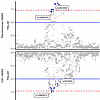 Figure 6
Colocalization of Pseudomonas relative abundance and coronary arterial calcification associations. Regional Miami plot showing the associations with Pseudomonas relative abundance (top panel) and with coronary arterial calcification (bottom panel) in the chr10:43094712-45093012 (hg38) locus (x axis) represented as –log(P value) on the y axis. There is strong evidence of colocalization (PP4 = 0.77). The 95% credible set SNPs are highlighted in blue. Lead SNPs in the signals from each GWAS are labeled with their rs IDs (rs2624692 and rs10899970).
The ROBO1 signal, associated with Clostridia relative abundance, is associated in the PheWAS with diverticulosis and diverticulitis (P = 1.09 × 10⁻⁵) and visual disturbances (P = 1.33 × 10⁻⁵). In addition, the lead SNP in the ABCC1 locus associated with Bacilli relative abundance was associated with testicular cancer (P = 2.33 × 10⁻⁵). This signal is also associated with plasma cysteinyl glycine disulfide levels, a metabolite in the glutathione pathway (26).
Postinfection induction of Cxcl12 in mouse bladder tissue. To provide an initial characterization of CXCL12 in the setting of UTI, we induced UTIs with E. coli strain UTI89GFP (27) in C57BL/6 mice. Neither Cxcl12 nor its receptor, Cxcr4, was expressed at baseline and at 8 hours postinfection. However, we observed induction of Cxcl12 and Cxcr4 in mouse bladders 12–24 hours after infection. Cxcl12 was expressed in smooth muscle layers, where anti–smooth muscle actin immunofluorescence was seen, while Cxcr4 was expressed in cells in the urothelium, marked by anti–cytokeratin-5 immunofluorescence (Figure 7).
 Figure 7
Increased Cxcl12 and Cxcr4 expression after UTI in mouse bladder. Cxcl12 and Cxcr4 RNA were induced in mouse bladder tissue at 12 hours (B and E) and more strongly at 24 hours (C and F) after UPEC infection, but not at 0 hour (A and D), as seen by chromogenic in situ hybridization (RNAscope). Composite images of consecutive sections from 24 hours postinfection bladder tissue suggest that Cxcl12 RNA (G) localizes mainly to stromal and muscle cell layers, and to a much lesser degree to the urothelium, as marked by smooth muscle actin and cytokeratin 5 immunofluorescence (H), respectively. Images shown are representative of 3 mice per time point.


