
Research ArticleEndocrinologyMetabolismNeuroscience
Open Access |  10.1172/jci.insight.198707
Hypothalamic insulin resistance in type 2 diabetes is localized to the posterior hypothalamus
Hideyoshi Kaga,1 Akitoshi Ogawa,2 Takahiro Osada,2 Mai Kiya,1 Satoshi Oka,2 Yusuke Adachi,2 Mengping Yu,2 Shota Sakamoto,3 Saori Kakehi,3 Toshiki Kogai,1 Tsubasa Tajima,1 Hitoshi Naito,1 Naoaki Ito,1 Satoshi Kadowaki,1 Yuya Nishida,1 Ryuzo Kawamori,1,3 Seiki Konishi,2 Hirotaka Watada,1,3 and Yoshifumi Tamura1,3
1Department of Metabolism & Endocrinology,
2Department of Neurophysiology, and
3Sportology Center, Juntendo University Graduate School of Medicine, Tokyo, Japan.
Address correspondence to: Hideyoshi Kaga, Department of Metabolism & Endocrinology, Juntendo University Graduate School of Medicine, 2-1-1 Hongo, Bunkyo-ku, Tokyo 113-8421, Japan. Email: hkaga@juntendo.ac.jp. Or to: Takahiro Osada, Department of Neurophysiology, Juntendo University Graduate School of Medicine, 2-1-1 Hongo, Bunkyo-ku, Tokyo 113-8421, Japan. Phone: 81.3.3813.3111; Email: tosada@juntendo.ac.jp.
Find articles by Kaga, H. in: PubMed | Google Scholar
1Department of Metabolism & Endocrinology,
2Department of Neurophysiology, and
3Sportology Center, Juntendo University Graduate School of Medicine, Tokyo, Japan.
Address correspondence to: Hideyoshi Kaga, Department of Metabolism & Endocrinology, Juntendo University Graduate School of Medicine, 2-1-1 Hongo, Bunkyo-ku, Tokyo 113-8421, Japan. Email: hkaga@juntendo.ac.jp. Or to: Takahiro Osada, Department of Neurophysiology, Juntendo University Graduate School of Medicine, 2-1-1 Hongo, Bunkyo-ku, Tokyo 113-8421, Japan. Phone: 81.3.3813.3111; Email: tosada@juntendo.ac.jp.
Find articles by Ogawa, A. in: PubMed | Google Scholar
1Department of Metabolism & Endocrinology,
2Department of Neurophysiology, and
3Sportology Center, Juntendo University Graduate School of Medicine, Tokyo, Japan.
Address correspondence to: Hideyoshi Kaga, Department of Metabolism & Endocrinology, Juntendo University Graduate School of Medicine, 2-1-1 Hongo, Bunkyo-ku, Tokyo 113-8421, Japan. Email: hkaga@juntendo.ac.jp. Or to: Takahiro Osada, Department of Neurophysiology, Juntendo University Graduate School of Medicine, 2-1-1 Hongo, Bunkyo-ku, Tokyo 113-8421, Japan. Phone: 81.3.3813.3111; Email: tosada@juntendo.ac.jp.
Find articles by Osada, T. in: PubMed | Google Scholar
1Department of Metabolism & Endocrinology,
2Department of Neurophysiology, and
3Sportology Center, Juntendo University Graduate School of Medicine, Tokyo, Japan.
Address correspondence to: Hideyoshi Kaga, Department of Metabolism & Endocrinology, Juntendo University Graduate School of Medicine, 2-1-1 Hongo, Bunkyo-ku, Tokyo 113-8421, Japan. Email: hkaga@juntendo.ac.jp. Or to: Takahiro Osada, Department of Neurophysiology, Juntendo University Graduate School of Medicine, 2-1-1 Hongo, Bunkyo-ku, Tokyo 113-8421, Japan. Phone: 81.3.3813.3111; Email: tosada@juntendo.ac.jp.
Find articles by Kiya, M. in: PubMed | Google Scholar
1Department of Metabolism & Endocrinology,
2Department of Neurophysiology, and
3Sportology Center, Juntendo University Graduate School of Medicine, Tokyo, Japan.
Address correspondence to: Hideyoshi Kaga, Department of Metabolism & Endocrinology, Juntendo University Graduate School of Medicine, 2-1-1 Hongo, Bunkyo-ku, Tokyo 113-8421, Japan. Email: hkaga@juntendo.ac.jp. Or to: Takahiro Osada, Department of Neurophysiology, Juntendo University Graduate School of Medicine, 2-1-1 Hongo, Bunkyo-ku, Tokyo 113-8421, Japan. Phone: 81.3.3813.3111; Email: tosada@juntendo.ac.jp.
Find articles by Oka, S. in: PubMed | Google Scholar
1Department of Metabolism & Endocrinology,
2Department of Neurophysiology, and
3Sportology Center, Juntendo University Graduate School of Medicine, Tokyo, Japan.
Address correspondence to: Hideyoshi Kaga, Department of Metabolism & Endocrinology, Juntendo University Graduate School of Medicine, 2-1-1 Hongo, Bunkyo-ku, Tokyo 113-8421, Japan. Email: hkaga@juntendo.ac.jp. Or to: Takahiro Osada, Department of Neurophysiology, Juntendo University Graduate School of Medicine, 2-1-1 Hongo, Bunkyo-ku, Tokyo 113-8421, Japan. Phone: 81.3.3813.3111; Email: tosada@juntendo.ac.jp.
Find articles by Adachi, Y. in: PubMed | Google Scholar
1Department of Metabolism & Endocrinology,
2Department of Neurophysiology, and
3Sportology Center, Juntendo University Graduate School of Medicine, Tokyo, Japan.
Address correspondence to: Hideyoshi Kaga, Department of Metabolism & Endocrinology, Juntendo University Graduate School of Medicine, 2-1-1 Hongo, Bunkyo-ku, Tokyo 113-8421, Japan. Email: hkaga@juntendo.ac.jp. Or to: Takahiro Osada, Department of Neurophysiology, Juntendo University Graduate School of Medicine, 2-1-1 Hongo, Bunkyo-ku, Tokyo 113-8421, Japan. Phone: 81.3.3813.3111; Email: tosada@juntendo.ac.jp.
Find articles by Yu, M. in: PubMed | Google Scholar
1Department of Metabolism & Endocrinology,
2Department of Neurophysiology, and
3Sportology Center, Juntendo University Graduate School of Medicine, Tokyo, Japan.
Address correspondence to: Hideyoshi Kaga, Department of Metabolism & Endocrinology, Juntendo University Graduate School of Medicine, 2-1-1 Hongo, Bunkyo-ku, Tokyo 113-8421, Japan. Email: hkaga@juntendo.ac.jp. Or to: Takahiro Osada, Department of Neurophysiology, Juntendo University Graduate School of Medicine, 2-1-1 Hongo, Bunkyo-ku, Tokyo 113-8421, Japan. Phone: 81.3.3813.3111; Email: tosada@juntendo.ac.jp.
Find articles by Sakamoto, S. in: PubMed | Google Scholar
1Department of Metabolism & Endocrinology,
2Department of Neurophysiology, and
3Sportology Center, Juntendo University Graduate School of Medicine, Tokyo, Japan.
Address correspondence to: Hideyoshi Kaga, Department of Metabolism & Endocrinology, Juntendo University Graduate School of Medicine, 2-1-1 Hongo, Bunkyo-ku, Tokyo 113-8421, Japan. Email: hkaga@juntendo.ac.jp. Or to: Takahiro Osada, Department of Neurophysiology, Juntendo University Graduate School of Medicine, 2-1-1 Hongo, Bunkyo-ku, Tokyo 113-8421, Japan. Phone: 81.3.3813.3111; Email: tosada@juntendo.ac.jp.
Find articles by Kakehi, S. in: PubMed | Google Scholar
1Department of Metabolism & Endocrinology,
2Department of Neurophysiology, and
3Sportology Center, Juntendo University Graduate School of Medicine, Tokyo, Japan.
Address correspondence to: Hideyoshi Kaga, Department of Metabolism & Endocrinology, Juntendo University Graduate School of Medicine, 2-1-1 Hongo, Bunkyo-ku, Tokyo 113-8421, Japan. Email: hkaga@juntendo.ac.jp. Or to: Takahiro Osada, Department of Neurophysiology, Juntendo University Graduate School of Medicine, 2-1-1 Hongo, Bunkyo-ku, Tokyo 113-8421, Japan. Phone: 81.3.3813.3111; Email: tosada@juntendo.ac.jp.
Find articles by Kogai, T. in: PubMed | Google Scholar
1Department of Metabolism & Endocrinology,
2Department of Neurophysiology, and
3Sportology Center, Juntendo University Graduate School of Medicine, Tokyo, Japan.
Address correspondence to: Hideyoshi Kaga, Department of Metabolism & Endocrinology, Juntendo University Graduate School of Medicine, 2-1-1 Hongo, Bunkyo-ku, Tokyo 113-8421, Japan. Email: hkaga@juntendo.ac.jp. Or to: Takahiro Osada, Department of Neurophysiology, Juntendo University Graduate School of Medicine, 2-1-1 Hongo, Bunkyo-ku, Tokyo 113-8421, Japan. Phone: 81.3.3813.3111; Email: tosada@juntendo.ac.jp.
Find articles by Tajima, T. in: PubMed | Google Scholar
1Department of Metabolism & Endocrinology,
2Department of Neurophysiology, and
3Sportology Center, Juntendo University Graduate School of Medicine, Tokyo, Japan.
Address correspondence to: Hideyoshi Kaga, Department of Metabolism & Endocrinology, Juntendo University Graduate School of Medicine, 2-1-1 Hongo, Bunkyo-ku, Tokyo 113-8421, Japan. Email: hkaga@juntendo.ac.jp. Or to: Takahiro Osada, Department of Neurophysiology, Juntendo University Graduate School of Medicine, 2-1-1 Hongo, Bunkyo-ku, Tokyo 113-8421, Japan. Phone: 81.3.3813.3111; Email: tosada@juntendo.ac.jp.
Find articles by Naito, H. in: PubMed | Google Scholar
1Department of Metabolism & Endocrinology,
2Department of Neurophysiology, and
3Sportology Center, Juntendo University Graduate School of Medicine, Tokyo, Japan.
Address correspondence to: Hideyoshi Kaga, Department of Metabolism & Endocrinology, Juntendo University Graduate School of Medicine, 2-1-1 Hongo, Bunkyo-ku, Tokyo 113-8421, Japan. Email: hkaga@juntendo.ac.jp. Or to: Takahiro Osada, Department of Neurophysiology, Juntendo University Graduate School of Medicine, 2-1-1 Hongo, Bunkyo-ku, Tokyo 113-8421, Japan. Phone: 81.3.3813.3111; Email: tosada@juntendo.ac.jp.
Find articles by Ito, N. in: PubMed | Google Scholar
1Department of Metabolism & Endocrinology,
2Department of Neurophysiology, and
3Sportology Center, Juntendo University Graduate School of Medicine, Tokyo, Japan.
Address correspondence to: Hideyoshi Kaga, Department of Metabolism & Endocrinology, Juntendo University Graduate School of Medicine, 2-1-1 Hongo, Bunkyo-ku, Tokyo 113-8421, Japan. Email: hkaga@juntendo.ac.jp. Or to: Takahiro Osada, Department of Neurophysiology, Juntendo University Graduate School of Medicine, 2-1-1 Hongo, Bunkyo-ku, Tokyo 113-8421, Japan. Phone: 81.3.3813.3111; Email: tosada@juntendo.ac.jp.
Find articles by Kadowaki, S. in: PubMed | Google Scholar
1Department of Metabolism & Endocrinology,
2Department of Neurophysiology, and
3Sportology Center, Juntendo University Graduate School of Medicine, Tokyo, Japan.
Address correspondence to: Hideyoshi Kaga, Department of Metabolism & Endocrinology, Juntendo University Graduate School of Medicine, 2-1-1 Hongo, Bunkyo-ku, Tokyo 113-8421, Japan. Email: hkaga@juntendo.ac.jp. Or to: Takahiro Osada, Department of Neurophysiology, Juntendo University Graduate School of Medicine, 2-1-1 Hongo, Bunkyo-ku, Tokyo 113-8421, Japan. Phone: 81.3.3813.3111; Email: tosada@juntendo.ac.jp.
Find articles by Nishida, Y. in: PubMed | Google Scholar
1Department of Metabolism & Endocrinology,
2Department of Neurophysiology, and
3Sportology Center, Juntendo University Graduate School of Medicine, Tokyo, Japan.
Address correspondence to: Hideyoshi Kaga, Department of Metabolism & Endocrinology, Juntendo University Graduate School of Medicine, 2-1-1 Hongo, Bunkyo-ku, Tokyo 113-8421, Japan. Email: hkaga@juntendo.ac.jp. Or to: Takahiro Osada, Department of Neurophysiology, Juntendo University Graduate School of Medicine, 2-1-1 Hongo, Bunkyo-ku, Tokyo 113-8421, Japan. Phone: 81.3.3813.3111; Email: tosada@juntendo.ac.jp.
Find articles by Kawamori, R. in: PubMed | Google Scholar
1Department of Metabolism & Endocrinology,
2Department of Neurophysiology, and
3Sportology Center, Juntendo University Graduate School of Medicine, Tokyo, Japan.
Address correspondence to: Hideyoshi Kaga, Department of Metabolism & Endocrinology, Juntendo University Graduate School of Medicine, 2-1-1 Hongo, Bunkyo-ku, Tokyo 113-8421, Japan. Email: hkaga@juntendo.ac.jp. Or to: Takahiro Osada, Department of Neurophysiology, Juntendo University Graduate School of Medicine, 2-1-1 Hongo, Bunkyo-ku, Tokyo 113-8421, Japan. Phone: 81.3.3813.3111; Email: tosada@juntendo.ac.jp.
Find articles by Konishi, S. in: PubMed | Google Scholar
1Department of Metabolism & Endocrinology,
2Department of Neurophysiology, and
3Sportology Center, Juntendo University Graduate School of Medicine, Tokyo, Japan.
Address correspondence to: Hideyoshi Kaga, Department of Metabolism & Endocrinology, Juntendo University Graduate School of Medicine, 2-1-1 Hongo, Bunkyo-ku, Tokyo 113-8421, Japan. Email: hkaga@juntendo.ac.jp. Or to: Takahiro Osada, Department of Neurophysiology, Juntendo University Graduate School of Medicine, 2-1-1 Hongo, Bunkyo-ku, Tokyo 113-8421, Japan. Phone: 81.3.3813.3111; Email: tosada@juntendo.ac.jp.
Find articles by Watada, H. in: PubMed | Google Scholar
1Department of Metabolism & Endocrinology,
2Department of Neurophysiology, and
3Sportology Center, Juntendo University Graduate School of Medicine, Tokyo, Japan.
Address correspondence to: Hideyoshi Kaga, Department of Metabolism & Endocrinology, Juntendo University Graduate School of Medicine, 2-1-1 Hongo, Bunkyo-ku, Tokyo 113-8421, Japan. Email: hkaga@juntendo.ac.jp. Or to: Takahiro Osada, Department of Neurophysiology, Juntendo University Graduate School of Medicine, 2-1-1 Hongo, Bunkyo-ku, Tokyo 113-8421, Japan. Phone: 81.3.3813.3111; Email: tosada@juntendo.ac.jp.
Find articles by Tamura, Y. in: PubMed | Google Scholar
Published June 8, 2026 - More info
JCI Insight. 2026;11(11):e198707. https://doi.org/10.1172/jci.insight.198707.
© 2026 Kaga et al. This work is licensed under the Creative Commons Attribution 4.0 International License. To view a copy of this license, visit http://creativecommons.org/licenses/by/4.0/.
Received: August 12, 2025; Accepted: April 15, 2026

-
Results
Study 1 — functional assessment of hypothalamic insulin response in middle-aged adults. To investigate the differences in the insulin response in the brain between individuals with T2D and those without diabetes, we conducted a fMRI study (study 1) involving middle-aged participants. Table 1 lists the characteristics of study participants in the control and T2D groups. We initially enrolled 47 participants who underwent baseline anthropometric measurements (height, weight, BMI, and body fat percentage) and initiated the MRI protocol with intranasal insulin administration and blood sampling. Of these, 6 participants were excluded owing to inability to complete MRI scanning related to obesity or claustrophobia, severe fold-over artifacts, or excessive head motion during image acquisition. Consequently, a total of 41 participants were included in the final analyses, comprising 20 healthy individuals acting as controls and 21 persons with T2D. The mean duration of diabetes in the T2D group was 10.4 ± 7.7 years. Among the 21 individuals in the T2D group, 19 were on metformin, 12 on SGLT2 inhibitors, 6 on GLP-1 receptor agonists, 10 on DPP-4 inhibitors, 1 on sulfonylureas, 3 on glinides, 2 on α-glucosidase inhibitors, and 5 were receiving insulin therapy. The mean age of participants was 50 years. BMI, body fat percentage, fasting glucose levels, and fasting insulin levels were significantly higher in the T2D group (Table 1). HbA1c levels were 5.24% ± 0.25% in the control group and 6.88% ± 1.13% in the T2D group [t(20.843) = –6.32, P < 0.001]. Additionally, the T2D group exhibited significantly higher triglyceride and lower high-density lipoprotein cholesterol levels. Free fatty acid (FFA), high-molecular-weight adiponectin, C-reactive protein, and physical activity levels were similar between the groups. Leptin and glucagon levels were significantly elevated in patients with T2D. Regarding the surrogate markers of peripheral and adipose tissue insulin sensitivity, both the homeostasis model assessment of insulin resistance index and adipose tissue insulin resistance index were significantly higher in the T2D group, indicating reduced peripheral and adipose tissue insulin sensitivity than in the control group.
Effects of intranasal insulin on plasma glucose, insulin, C-peptide, and FFA levels. We performed continuous blood oxygen level–dependent (BOLD) fMRI scanning from −15 to 30 minutes relative to intranasal insulin administration (Figure 1). Blood glucose, insulin, C-peptide, and FFA concentrations before and after insulin administration are shown in Figure 2, A–D. Time-course changes were analyzed using linear mixed-effects models with group, time, and their interaction as fixed effects and subject as a random effect. Significant main effects of group were observed for all 4 measures, with higher overall levels in individuals with T2D compared with participants acting as controls (all P < 0.01). A significant main effect of time was detected for serum insulin, C-peptide, and FFA concentrations (all P < 0.001), whereas the effect of time on plasma glucose did not reach statistical significance (P = 0.057). Specifically, serum insulin levels significantly increased following intranasal insulin administration, whereas C-peptide and FFA concentrations significantly decreased over time. No significant group-by-time interactions were observed for any of the metabolic variables (all P > 0.10). Collectively, these findings indicate that intranasal insulin induced modest time-dependent hormonal and lipid metabolic changes without significantly altering plasma glucose levels and that the magnitude and temporal patterns of these responses were comparable between the T2D and control groups during the first 30 minutes following administration.
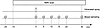 Figure 1
Timeline of the functional MRI protocol. Continuous BOLD fMRI scanning was performed from −15 to 30 minutes relative to intranasal insulin administration (as marked at 0 minutes). The first 15 minutes (−15 to 0 minutes) served as the baseline acquisition period, after which 160 IU of insulin was delivered intranasally while scanning continued without interruption. Peripheral blood samples for glucose, insulin, C-peptide, and free fatty acid assays were drawn at −20, 0, 5, 10, 15, 20, and 30 minutes and later aligned with the fMRI time series for statistical modeling.
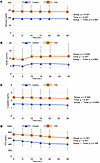 Figure 2
Peripheral metabolic responses to intranasal insulin. Plasma glucose (A), serum insulin (B), C-peptide (C), and free fatty acid (FFA) concentrations (D) measured before and after intranasal insulin administration in participants acting as controls and individuals with T2D. Data are expressed as mean ± SD for the control group (triangles) and the type 2 diabetes (T2D) group (rectangles). P values indicate the main effects of group and time and the group-by-time interaction derived from linear mixed-effects models.
Effects of intranasal insulin on the MRI signal of the hypothalamic subregions. MRI signal changes after nasal insulin administration are shown in Figure 3. Our primary analysis focused on functional hypothalamic subregions implicated in metabolic regulation. These subregions were selected from subdivisions defined a priori based on our previous resting-state functional connectivity parcellation (10–13). For the present study, we examined 5 medial subregions and 1 lateral region: the posterior hypothalamic nucleus (PH), the arcuate nucleus of the hypothalamus (ARC), the dorsomedial nucleus of the hypothalamus (DMH), the paraventricular nucleus of the hypothalamus (PVH), the ventromedial nucleus of the hypothalamus (VMH), and the lateral hypothalamic area (LHA) (Figure 3A). Among these regions, rapid signal suppression was observed only in the PH in the control group, whereas this response was not observed in the T2D group (Figure 3B). This group difference in the PH signal change at 5 minutes was statistically significant (t = 2.86, P = 0.0067, unpaired t test) and survived Bonferroni correction for 6 comparisons (corrected significance threshold, P < 0.0083 [0.05/6]). This finding highlights the region- and time-specific nature of central insulin responsiveness and suggests that the early-phase response is impaired in T2D. In contrast, no significant group differences were observed in the remaining 5 regions (LHA, ARC, DMH, PVH, and VMH) during either the early phase or the entire 30-minute observation period (Figure 3, C–G). Consistent with the region of interest–based (ROI-based) findings, a voxel-wise comparison at 5 minutes demonstrated that the group difference was primarily localized to the posterior hypothalamus (Figure 3H). Because the LHA is relatively large, we additionally conducted an exploratory analysis subdividing the LHA into anterior, tuberal, and posterior portions (LHAa, LHAt, and LHAp) (Supplemental Figure 1A; supplemental material available online with this article; https://doi.org/10.1172/jci.insight.198707DS1). In this subregional analysis, modest signal suppression was observed in the control group within the LHAp at 5 and 10 minutes, whereas no such response was observed in the T2D group (Supplemental Figure 1, B–D).
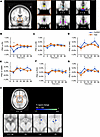 Figure 3
Time courses of hypothalamic BOLD signals following intranasal insulin administration. (A) Coronal slice displaying the predefined hypothalamic regions of interest: posterior hypothalamus (PH, yellow), dorsomedial hypothalamus (DMH, yellow-green), paraventricular nucleus (PVH, cyan), arcuate nucleus (ARC, dark blue), ventromedial hypothalamus (VMH, red), and lateral hypothalamic area (LHA, pink). (B–G) Percentage of signal change (PSC; mean ± SEM) from 0 to 30 minutes relative to intranasal insulin administration for the control group (triangles) and the type 2 diabetes (T2D) group (rectangles): (B) PH, (C) LHA, (D) ARC, (E) DMH, (F) PVH, and (G) VMH. ** P < 0.01 T2D versus control at the corresponding time point. (H) Statistical map of voxel-wise group difference (threshold, t = 1.7).
To confirm the robustness of this primary PH finding, we performed two sensitivity analyses focusing on the 5-minute PH response. First, to minimize potential spatial distortion due to spatial normalization, we inversely transformed the Montreal Neurological Institute–defined (MNI-defined) PH ROI into each participant’s native space and reextracted the fMRI signals. This native-space analysis yielded consistent results, showing significantly greater signal suppression in participants acting as controls than in those with T2D (Supplemental Figure 2A). Second, to ensure independence from the functional connectivity-based parcellation scheme, we repeated the analysis using an anatomically defined PH mask derived from a high-resolution structural atlas (14). This analysis likewise confirmed the significant group difference (Supplemental Figure 2B). Together, these analyses demonstrate that the observed PH functional impairment in T2D is robust and not attributable to spatial normalization artifacts or ROI definition.
To verify that the early PH signal suppression was insulin-specific rather than a nonspecific effect of nasal administration, we evaluated the PH signal in an independent healthy cohort (n = 7) that received intranasal distilled water. Distilled water did not induce comparable PH signal suppression. A direct comparison at 5 minutes showed significantly greater PH suppression in the insulin-treated control group than in the water-treated cohort (t = 2.10, P = 0.046, unpaired t test) (Supplemental Figure 3).
Finally, within the T2D group, we performed stratified analyses comparing participants with T2D who were taking SGLT2 inhibitors (n = 12) and those with T2D who were not receiving these agents. No significant differences in hypothalamic MRI signal changes were observed between these subgroups, and no PH signal suppression was detected in either subgroup (t = –0.974, P = 0.342, unpaired t test), suggesting that SGLT2 inhibitor use did not drive the observed group differences.
Association between hypothalamic signal changes and metabolic parameters. To further investigate the relationship between insulin-induced hypothalamic signal changes and metabolic characteristics, multiple regression analyses were performed focusing on the primary functional finding (i.e., PH signal change at 5 minutes). As shown in Table 2, no statistically significant associations were observed between PH signal changes at 5 minutes and any metabolic parameters after adjustment for glycemic status (T2D vs. control). Testing of group-by-metabolic parameter interaction terms in full models also yielded no significant interactions. Additionally, exploratory analyses of the LHAp responses are presented in Supplemental Table 1. LHAp signal changes at 5 minutes were positively associated with fasting plasma glucose and HbA1c levels. Similarly, LHAp signal changes at 10 minutes were positively associated with fasting plasma glucose.
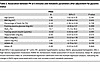 Table 2
Association between PH at 5 minutes and metabolic parameters after adjustment for glycemic status
Study 2 — gray matter volume in the posterior hypothalamus is decreased in individuals with diabetes. To assess whether the structural alterations in the hypothalamus were accompanied by the functional differences observed in study 1, we analyzed brain MRI data from another cohort of older adults. The second cohort (study 2) (15) comprised persons with and without diabetes, allowing us to examine differences in hypothalamic gray matter volume. The total number of participants in this cohort was 1,629. Of these, 1,609 individuals with available gray matter volume data were included in this analysis. Among them, 209 were classified into the diabetes group and 1,400 into the nondiabetes group. The baseline characteristics of these participants are presented in Supplemental Table 2. In addition, detailed information on glucose-lowering medications used by participants with diabetes in the study 2 cohort is provided in Supplemental Table 3. Compared with the nondiabetes group, the diabetes group was significantly older, had a lower proportion of women, higher BMI and body fat percentage, and a lower skeletal muscle mass index. The prevalence of hypertension, dyslipidemia, and ischemic heart disease was also higher in the diabetes group. However, there were no significant differences in the prevalence of cerebrovascular disease, cognitive function, physical activity, or dietary intake. The mean ± SD fasting plasma glucose and HbA1c levels in the diabetes group were 130.6 ± 23.3 mg/dL and 6.9% ± 0.7%, respectively.
While nucleus-level subregion analysis was emphasized in study 1, the 0.3 T MRI used in study 2 did not permit that level of resolution. Therefore, for regional analysis, the hypothalamus was divided into 3 anatomically defined regions: the anterior (aHT), tuberal (tHT), and posterior (pHT) hypothalamus. Notably, the pHT corresponds anatomically to the PH and LHAp regions evaluated in study 1. An analysis of covariance adjusted for age and sex revealed that gray matter volume in the hypothalamus was significantly lower in the diabetes group compared with that in the nondiabetes group across all 3 regions (Figure 4, A and B). Among these, the reduction in pHT was more pronounced in the diabetes group [F(1,1604) = 6.788, P = 0.009], compared with tHT (F = 5.269, P = 0.022) and aHT (F = 4.378, P = 0.037) groups, indicating that the posterior hypothalamus may be more sensitive to diabetes-related changes in gray matter volume (Figure 4B), corresponding to the functional deficits identified in study 1. In a supplementary sex-stratified analysis, a significant reduction in pHT volume was observed in male participants (F = 4.752, P = 0.030), whereas no statistically significant differences were detected in female participants (F = 2.177, P = 0.140). However, the number of women with diabetes was relatively small, limiting statistical power to detect sex-specific effects. Furthermore, to determine whether the functional impairment observed in study 1 was accompanied by macroscopic structural atrophy, we additionally performed volumetric analyses in the study 1 cohort using the same macroscopic segmentation scheme. As shown in Supplemental Figure 4A, no statistically significant differences in the gray matter volume of the pHT (or other regions) were observed between the T2D and control groups in this middle-aged cohort. Notably, when applying 3-region segmentation to the fMRI data from study 1, only the posterior hypothalamus showed a significant difference in signal change between the T2D and control groups (Supplemental Figure 4B), suggesting a functional correlation with the structural vulnerability observed in study 2.
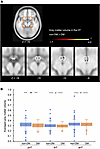 Figure 4
Hypothalamic gray matter volume in the Bunkyo Health Study cohort (study 2). (A) Axial T1-weighted slice showing the hypothalamus and its 3 anatomical subdivisions: anterior, tuberal, and posterior. (B) Box plots comparing gray matter volume in each subdivision between the nondiabetes group (non-DM, blue) and the diabetes group (DM, orange). Each box represents the interquartile range (IQR), the horizontal lines within boxes indicate the median, and the whiskers extend to the minimum and maximum values within 1.5×IQR. Data points beyond the whiskers are plotted individually as outliers. The cross marks (×) represent the mean. Group differences were tested with a t test (DM vs. non-DM). *P < 0.05, **P < 0.01.
Figure 4Hypothalamic gray matter volume in the Bunkyo Health Study cohort (study 2). (A) Axial T1-weighted slice showing the hypothalamus and its 3 anatomical subdivisions: anterior, tuberal, and posterior. (B) Box plots comparing gray matter volume in each subdivision between the nondiabetes group (non-DM, blue) and the diabetes group (DM, orange). Each box represents the interquartile range (IQR), the horizontal lines within boxes indicate the median, and the whiskers extend to the minimum and maximum values within 1.5×IQR. Data points beyond the whiskers are plotted individually as outliers. The cross marks (×) represent the mean. Group differences were tested with a t test (DM vs. non-DM). *P < 0.05, **P < 0.01.


