
Research ArticleCardiologyCell biologyNeuroscience
Open Access |  10.1172/jci.insight.197721
D801N in ATP1A3-encoded Na/K-ATPase alpha 3 causes cardiac arrhythmogenesis through sodium-calcium exchanger–mediated calcium overload
Minu-Tshyeto K. Bidzimou,1 Padmapriya Muralidharan,1 Zhushan Zhang,2 Danyal Raza,1 Daniel Needs,3 Bo Sun,2 Robin M. Perelli,1 Mary E. Moya-Mendez,2 P.K. Rakesh Manivannan,1 Arsen S. Hunanyan,4 Abbigail Helfer,3 Christine Q. Simmons,5 Alfred L. George Jr.,5 Donald M. Bers,6 Nenad Bursac,3 Mohamad A. Mikati,4,7 and Andrew P. Landstrom1,2
1Department of Cell Biology and
2Department of Pediatrics, Division of Cardiology, Duke University School of Medicine, Durham, North Carolina, USA.
3Department of Biomedical Engineering and
4Division of Pediatric Neurology and Developmental Medicine, Department of Pediatrics, Duke University, Durham, North Carolina, USA.
5Department of Pharmacology, Northwestern University Feinberg School of Medicine, Chicago, Illinois, USA.
6Department of Pharmacology, University of California Davis, Davis, California, USA.
7Department of Neurobiology, Duke University, Durham, North Carolina, USA.
Address correspondence to: Andrew P. Landstrom, Duke University Medical Center, Box 2652, Durham, North Carolina, 27710, USA. Phone: 919.684.3028; Email: andrew.landstrom@duke.edu.
Find articles by Bidzimou, M. in: PubMed | Google Scholar
1Department of Cell Biology and
2Department of Pediatrics, Division of Cardiology, Duke University School of Medicine, Durham, North Carolina, USA.
3Department of Biomedical Engineering and
4Division of Pediatric Neurology and Developmental Medicine, Department of Pediatrics, Duke University, Durham, North Carolina, USA.
5Department of Pharmacology, Northwestern University Feinberg School of Medicine, Chicago, Illinois, USA.
6Department of Pharmacology, University of California Davis, Davis, California, USA.
7Department of Neurobiology, Duke University, Durham, North Carolina, USA.
Address correspondence to: Andrew P. Landstrom, Duke University Medical Center, Box 2652, Durham, North Carolina, 27710, USA. Phone: 919.684.3028; Email: andrew.landstrom@duke.edu.
Find articles by Muralidharan, P. in: PubMed | Google Scholar
1Department of Cell Biology and
2Department of Pediatrics, Division of Cardiology, Duke University School of Medicine, Durham, North Carolina, USA.
3Department of Biomedical Engineering and
4Division of Pediatric Neurology and Developmental Medicine, Department of Pediatrics, Duke University, Durham, North Carolina, USA.
5Department of Pharmacology, Northwestern University Feinberg School of Medicine, Chicago, Illinois, USA.
6Department of Pharmacology, University of California Davis, Davis, California, USA.
7Department of Neurobiology, Duke University, Durham, North Carolina, USA.
Address correspondence to: Andrew P. Landstrom, Duke University Medical Center, Box 2652, Durham, North Carolina, 27710, USA. Phone: 919.684.3028; Email: andrew.landstrom@duke.edu.
Find articles by Zhang, Z. in: PubMed | Google Scholar
1Department of Cell Biology and
2Department of Pediatrics, Division of Cardiology, Duke University School of Medicine, Durham, North Carolina, USA.
3Department of Biomedical Engineering and
4Division of Pediatric Neurology and Developmental Medicine, Department of Pediatrics, Duke University, Durham, North Carolina, USA.
5Department of Pharmacology, Northwestern University Feinberg School of Medicine, Chicago, Illinois, USA.
6Department of Pharmacology, University of California Davis, Davis, California, USA.
7Department of Neurobiology, Duke University, Durham, North Carolina, USA.
Address correspondence to: Andrew P. Landstrom, Duke University Medical Center, Box 2652, Durham, North Carolina, 27710, USA. Phone: 919.684.3028; Email: andrew.landstrom@duke.edu.
Find articles by Raza, D. in: PubMed | Google Scholar
1Department of Cell Biology and
2Department of Pediatrics, Division of Cardiology, Duke University School of Medicine, Durham, North Carolina, USA.
3Department of Biomedical Engineering and
4Division of Pediatric Neurology and Developmental Medicine, Department of Pediatrics, Duke University, Durham, North Carolina, USA.
5Department of Pharmacology, Northwestern University Feinberg School of Medicine, Chicago, Illinois, USA.
6Department of Pharmacology, University of California Davis, Davis, California, USA.
7Department of Neurobiology, Duke University, Durham, North Carolina, USA.
Address correspondence to: Andrew P. Landstrom, Duke University Medical Center, Box 2652, Durham, North Carolina, 27710, USA. Phone: 919.684.3028; Email: andrew.landstrom@duke.edu.
Find articles by Needs, D. in: PubMed | Google Scholar
1Department of Cell Biology and
2Department of Pediatrics, Division of Cardiology, Duke University School of Medicine, Durham, North Carolina, USA.
3Department of Biomedical Engineering and
4Division of Pediatric Neurology and Developmental Medicine, Department of Pediatrics, Duke University, Durham, North Carolina, USA.
5Department of Pharmacology, Northwestern University Feinberg School of Medicine, Chicago, Illinois, USA.
6Department of Pharmacology, University of California Davis, Davis, California, USA.
7Department of Neurobiology, Duke University, Durham, North Carolina, USA.
Address correspondence to: Andrew P. Landstrom, Duke University Medical Center, Box 2652, Durham, North Carolina, 27710, USA. Phone: 919.684.3028; Email: andrew.landstrom@duke.edu.
Find articles by Sun, B. in: PubMed | Google Scholar
1Department of Cell Biology and
2Department of Pediatrics, Division of Cardiology, Duke University School of Medicine, Durham, North Carolina, USA.
3Department of Biomedical Engineering and
4Division of Pediatric Neurology and Developmental Medicine, Department of Pediatrics, Duke University, Durham, North Carolina, USA.
5Department of Pharmacology, Northwestern University Feinberg School of Medicine, Chicago, Illinois, USA.
6Department of Pharmacology, University of California Davis, Davis, California, USA.
7Department of Neurobiology, Duke University, Durham, North Carolina, USA.
Address correspondence to: Andrew P. Landstrom, Duke University Medical Center, Box 2652, Durham, North Carolina, 27710, USA. Phone: 919.684.3028; Email: andrew.landstrom@duke.edu.
Find articles by Perelli, R. in: PubMed | Google Scholar
1Department of Cell Biology and
2Department of Pediatrics, Division of Cardiology, Duke University School of Medicine, Durham, North Carolina, USA.
3Department of Biomedical Engineering and
4Division of Pediatric Neurology and Developmental Medicine, Department of Pediatrics, Duke University, Durham, North Carolina, USA.
5Department of Pharmacology, Northwestern University Feinberg School of Medicine, Chicago, Illinois, USA.
6Department of Pharmacology, University of California Davis, Davis, California, USA.
7Department of Neurobiology, Duke University, Durham, North Carolina, USA.
Address correspondence to: Andrew P. Landstrom, Duke University Medical Center, Box 2652, Durham, North Carolina, 27710, USA. Phone: 919.684.3028; Email: andrew.landstrom@duke.edu.
Find articles by Moya-Mendez, M. in: PubMed | Google Scholar
1Department of Cell Biology and
2Department of Pediatrics, Division of Cardiology, Duke University School of Medicine, Durham, North Carolina, USA.
3Department of Biomedical Engineering and
4Division of Pediatric Neurology and Developmental Medicine, Department of Pediatrics, Duke University, Durham, North Carolina, USA.
5Department of Pharmacology, Northwestern University Feinberg School of Medicine, Chicago, Illinois, USA.
6Department of Pharmacology, University of California Davis, Davis, California, USA.
7Department of Neurobiology, Duke University, Durham, North Carolina, USA.
Address correspondence to: Andrew P. Landstrom, Duke University Medical Center, Box 2652, Durham, North Carolina, 27710, USA. Phone: 919.684.3028; Email: andrew.landstrom@duke.edu.
Find articles by Manivannan, P. in: PubMed | Google Scholar
1Department of Cell Biology and
2Department of Pediatrics, Division of Cardiology, Duke University School of Medicine, Durham, North Carolina, USA.
3Department of Biomedical Engineering and
4Division of Pediatric Neurology and Developmental Medicine, Department of Pediatrics, Duke University, Durham, North Carolina, USA.
5Department of Pharmacology, Northwestern University Feinberg School of Medicine, Chicago, Illinois, USA.
6Department of Pharmacology, University of California Davis, Davis, California, USA.
7Department of Neurobiology, Duke University, Durham, North Carolina, USA.
Address correspondence to: Andrew P. Landstrom, Duke University Medical Center, Box 2652, Durham, North Carolina, 27710, USA. Phone: 919.684.3028; Email: andrew.landstrom@duke.edu.
Find articles by Hunanyan, A. in: PubMed | Google Scholar
1Department of Cell Biology and
2Department of Pediatrics, Division of Cardiology, Duke University School of Medicine, Durham, North Carolina, USA.
3Department of Biomedical Engineering and
4Division of Pediatric Neurology and Developmental Medicine, Department of Pediatrics, Duke University, Durham, North Carolina, USA.
5Department of Pharmacology, Northwestern University Feinberg School of Medicine, Chicago, Illinois, USA.
6Department of Pharmacology, University of California Davis, Davis, California, USA.
7Department of Neurobiology, Duke University, Durham, North Carolina, USA.
Address correspondence to: Andrew P. Landstrom, Duke University Medical Center, Box 2652, Durham, North Carolina, 27710, USA. Phone: 919.684.3028; Email: andrew.landstrom@duke.edu.
Find articles by Helfer, A. in: PubMed | Google Scholar
1Department of Cell Biology and
2Department of Pediatrics, Division of Cardiology, Duke University School of Medicine, Durham, North Carolina, USA.
3Department of Biomedical Engineering and
4Division of Pediatric Neurology and Developmental Medicine, Department of Pediatrics, Duke University, Durham, North Carolina, USA.
5Department of Pharmacology, Northwestern University Feinberg School of Medicine, Chicago, Illinois, USA.
6Department of Pharmacology, University of California Davis, Davis, California, USA.
7Department of Neurobiology, Duke University, Durham, North Carolina, USA.
Address correspondence to: Andrew P. Landstrom, Duke University Medical Center, Box 2652, Durham, North Carolina, 27710, USA. Phone: 919.684.3028; Email: andrew.landstrom@duke.edu.
Find articles by Simmons, C. in: PubMed | Google Scholar
1Department of Cell Biology and
2Department of Pediatrics, Division of Cardiology, Duke University School of Medicine, Durham, North Carolina, USA.
3Department of Biomedical Engineering and
4Division of Pediatric Neurology and Developmental Medicine, Department of Pediatrics, Duke University, Durham, North Carolina, USA.
5Department of Pharmacology, Northwestern University Feinberg School of Medicine, Chicago, Illinois, USA.
6Department of Pharmacology, University of California Davis, Davis, California, USA.
7Department of Neurobiology, Duke University, Durham, North Carolina, USA.
Address correspondence to: Andrew P. Landstrom, Duke University Medical Center, Box 2652, Durham, North Carolina, 27710, USA. Phone: 919.684.3028; Email: andrew.landstrom@duke.edu.
Find articles by
George, A.
in:
PubMed
|
Google Scholar
|

1Department of Cell Biology and
2Department of Pediatrics, Division of Cardiology, Duke University School of Medicine, Durham, North Carolina, USA.
3Department of Biomedical Engineering and
4Division of Pediatric Neurology and Developmental Medicine, Department of Pediatrics, Duke University, Durham, North Carolina, USA.
5Department of Pharmacology, Northwestern University Feinberg School of Medicine, Chicago, Illinois, USA.
6Department of Pharmacology, University of California Davis, Davis, California, USA.
7Department of Neurobiology, Duke University, Durham, North Carolina, USA.
Address correspondence to: Andrew P. Landstrom, Duke University Medical Center, Box 2652, Durham, North Carolina, 27710, USA. Phone: 919.684.3028; Email: andrew.landstrom@duke.edu.
Find articles by
Bers, D.
in:
PubMed
|
Google Scholar
|
1Department of Cell Biology and
2Department of Pediatrics, Division of Cardiology, Duke University School of Medicine, Durham, North Carolina, USA.
3Department of Biomedical Engineering and
4Division of Pediatric Neurology and Developmental Medicine, Department of Pediatrics, Duke University, Durham, North Carolina, USA.
5Department of Pharmacology, Northwestern University Feinberg School of Medicine, Chicago, Illinois, USA.
6Department of Pharmacology, University of California Davis, Davis, California, USA.
7Department of Neurobiology, Duke University, Durham, North Carolina, USA.
Address correspondence to: Andrew P. Landstrom, Duke University Medical Center, Box 2652, Durham, North Carolina, 27710, USA. Phone: 919.684.3028; Email: andrew.landstrom@duke.edu.
Find articles by
Bursac, N.
in:
PubMed
|
Google Scholar
|
1Department of Cell Biology and
2Department of Pediatrics, Division of Cardiology, Duke University School of Medicine, Durham, North Carolina, USA.
3Department of Biomedical Engineering and
4Division of Pediatric Neurology and Developmental Medicine, Department of Pediatrics, Duke University, Durham, North Carolina, USA.
5Department of Pharmacology, Northwestern University Feinberg School of Medicine, Chicago, Illinois, USA.
6Department of Pharmacology, University of California Davis, Davis, California, USA.
7Department of Neurobiology, Duke University, Durham, North Carolina, USA.
Address correspondence to: Andrew P. Landstrom, Duke University Medical Center, Box 2652, Durham, North Carolina, 27710, USA. Phone: 919.684.3028; Email: andrew.landstrom@duke.edu.
Find articles by Mikati, M. in: PubMed | Google Scholar
1Department of Cell Biology and
2Department of Pediatrics, Division of Cardiology, Duke University School of Medicine, Durham, North Carolina, USA.
3Department of Biomedical Engineering and
4Division of Pediatric Neurology and Developmental Medicine, Department of Pediatrics, Duke University, Durham, North Carolina, USA.
5Department of Pharmacology, Northwestern University Feinberg School of Medicine, Chicago, Illinois, USA.
6Department of Pharmacology, University of California Davis, Davis, California, USA.
7Department of Neurobiology, Duke University, Durham, North Carolina, USA.
Address correspondence to: Andrew P. Landstrom, Duke University Medical Center, Box 2652, Durham, North Carolina, 27710, USA. Phone: 919.684.3028; Email: andrew.landstrom@duke.edu.
Find articles by Landstrom, A. in: PubMed | Google Scholar
Published April 8, 2026 - More info
JCI Insight. 2026;11(7):e197721. https://doi.org/10.1172/jci.insight.197721.
© 2026 Bidzimou et al. This work is licensed under the Creative Commons Attribution 4.0 International License. To view a copy of this license, visit http://creativecommons.org/licenses/by/4.0/.
Received: July 22, 2025; Accepted: February 10, 2026

-
Results
ATP1A3-D801N has lower NKA function. To begin investigating the role of missense variants in ATP1A3 and short QT development, we first mapped the location of the 3 most common variants in ATP1A3 within the protein structure. We have previously found that the D801N, E815K, and the G947R variants in ATP1A3 are associated with short QT on ECG (18). We mapped these 3 variants to the atomic-level structure of human ATP1A3 and categorized them based on their degree of penetrance, with D801N having high penetrance for short QT. We found that all 3 variants localize to the K+ binding pocket of ATP1A3 (Figure 1A). Since previous evidence has shown that the D801N variant lacks significant ATPase activity (20), we next tested the functional effect of this variant in vitro. HEK293T cells natively express ATP1A3 (21), and overexpression of ATP1A — as well as exposure to ouabain, a selective inhibitor of ATP1A3 — are both toxic to these cells (22). While overexpression of WT ATP1A3 caused cell death, we found that overexpression of ATP1A3-D801N had normal survival. In the presence of ouabain, cell survival was rescued in the setting of overexpression of a ATP1A3 mutant that renders it ouabain resistant; however, ouabain resistant ATP1A3-D801N failed to rescue survival (Supplemental Figure 1, more details in the Supplemental Results; supplemental material available online with this article; https://doi.org/10.1172/jci.insight.197721DS1). These findings suggest that D801N strongly impairs ATP1A3 function.
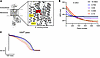 Figure 1
ATP1A3-D801N decreases NKA function and is predicted to decrease cardiomyocyte depolarization time. (A) Variant mapping of the 3 most QTc penetrant missenses among patients with AHC. Crystal structure of the human ATP1A3 is shown with the D801, E815, and G947 residues highlighted. Residues in yellow have 10%–20% penetrance of SQTc while residues in red have a penetrance higher than 50% (D801N, 68.57%; E815K, 19.05%; G947R, 12.50%). (B and C) In silico ToR-ORd model of human cardiomyocyte predicting APD as a function of pace number under different NKA functional states.
Using established transcriptional data, we found that ATP1A3 comprises 26.3% of the total ATP1A transcript levels in healthy human myocardium (Supplemental Figures 2 and 3). Conversely, RNA-seq conducted in 3-day-old (P3) and 3-month-old mice found that Atp1a3 transcripts contribute less than 1% of Atp1a in WT murine hearts (Supplemental Figure 4). We found a similar low relative abundance of Atp1a3 among other in vivo experimental models. Atp1a3 transcripts contribute 2% of total Atp1a in rat and sheep hearts (Supplemental Figures 5 and 6), atp1a3 is not expressed in zebrafish heart, and there are no orthologs of ATP1A3 in either Caenorhabditis elegans or drosophila melanogaster (Supplemental Results). These findings suggest that human myocardium, unlike commonly used experimental animal models, expresses substantial ATP1A3 and may be uniquely susceptible to the functional effect of the D801N variant. We next employed an in silico model of human cardiomyocyte electrophysiology, the Tomek-Rodriguez (ToR-ORd) model, to evaluate the effect of decreased NKA function (23). In line with our previous findings suggesting that the D801N variant shortens the QT interval and APD (18), we found that reducing NKA function (by 25%) was associated with shorter APD (Figure 1, B and C). This model also predicted more depolarized RMP as expected for reduced NKA function (Supplemental Figure 7). Overall, these results suggest that loss of proper ATP1A3 function in human myocardium is associated with APD shortening and RMP depolarization.
ATP1A3-D801N is associated with faster cardiac myocyte repolarization and DADs. To determine the mechanism of ATP1A3-D801N–mediated alterations in cardiac repolarization and arrhythmogenesis, we leveraged 2 iPSC lines from D801N+ AHC probands with short QTc (male iPSCD801N and female iPSCD801N-2) (18). Each patient-derived line was compared with a corresponding control: an isogenic WT was used as a control for the male iPSCD801N line and an unrelated healthy male WT line for the female iPSCD801N-2 (iPSCcWT and iPSCWT-2, respectively) (18). Using immunofluorescence, we found that expression of ATP1A3 colocalized with the NCX1 in both iPSC-CMsWT and in iPSC-CMsD801N (Figure 2A and Supplemental Figure 8). Expression of ATP1A1, ATP1A2, ATP1A3, and ATP1B1 in iPSC-CMs were confirmed by Western blot in iPSC-CMsWT and iPSC-CMsD801N (Figure 2B). We recently demonstrated that iPSC-CMsD801N exhibit a shortened APD, depolarized RMP, and DADs by single-cell patch clamp recording (18). We employed a genetically encoded fluorescence voltage sensor (Arclight) to evaluate cellular membrane depolarizations (Figure 2C). Live cell imaging of Arclight transduced iPSC-CMs revealed significantly shorter repolarization time and the presence of DADs in CMs differentiated from both D801N lines compared with respective controls (Figure 2, D–H, and Supplemental Figure 9). Application of ouabain to iPSC-CMWT-2 was associated with shortening of APD50, APD90, and more depolarized maximum diastolic potential (MDP) compared with vehicle treatment, all of which were similar to action potential kinetics of iPSC-CMsD801N (Supplemental Figure 10) (18). Together, these findings demonstrate that D801N does not alter expression or trafficking of ATP1A3 to the membrane, yet it is associated with shortened APD and DAD generation.
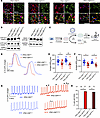 Figure 2
iPSC-CMD801N have shortened APD and delayed afterdepolarizations. (A) Representative images of iPSC-CMs immunofluorescence: ATP1A3 (green), NCX1 (red), and DAPI (blue). (B) Western blots of ATP1A1-3, ATP1B1, and GAPDH expression in iPSC-CMsWT and iPSC-CMsD801N. (C) Schematic of experimental approach for iPSC-CMs using whole cell patch clamp or a genetically encoded fluorescent voltage sensor (Arclight), packaged in lentivirus (LV). (D) Representative fluorescence tracing of Arclight. (E and F) Fluorescence change duration at 50% and 90% from baseline (representing APD50 and APD90, respectively). For iPSC-CM^cWT, iPSC-CM^D801N, iPSC-CM^WT-2, iPSC-CM^D801N-2, n = 19, 21, 22, and 13, respectively. (G) Representative tracings of iPSC-CMs spontaneous oscillations in Arclight transduced iPSC-CMs. In spontaneously fluorescing cells, arrows identify irregularly triggered fluorescence indicative of delayed afterdepolarizations (DADs). (H) Bar graph quantifying percent cells with DADs. Live cell experiments were statistically analyzed with a hierarchical approach. Fischer’s exact test was conducted on H. E and F were statistically tested with a hierarchical approach.*P < 0.05, **P < 0.01.
iPSC-CMD801N have Ca2+ miniwaves, greater SR Ca2+ store levels, and higher cytosolic Ca2+ levels. Ion transport coupling between outward NKA and inward NCX1 currents allow the cell to repolarize after each depolarization, and changes in NKA function and [Na+]i can affect NCX1-mediated Ca2+ flux (13). To explore the influence of NKA on Ca2+ dynamics in our cellular model, we conducted live cell imaging of Cal-520–loaded iPSC-CMs. We observed that iPSC-CMsD801N have similar Ca2+ transient amplitudes and similar transient resolution time (tau) when compared with iPSC-CMsWT (Figure 3, A–C, and Supplemental Figure 11). We also found that iPSC-CMsD801N are predisposed to the generation of miniwaves, which manifest as small, truncated Ca2+ transients, and are a known cellular mechanism of triggered arrhythmias (24). Conversely, iPSC-CMsWT demonstrated no miniwaves (Figure 3C and Supplemental Figure 12). We next measured SR Ca2+ store levels with the application of 10 mM caffeine and found higher SR Ca2+ store levels in iPSC-CMsD801N compared with iPSC-CMsWT (Figure 3, D and E). Using Fura-2 with prepacing of cardiomyocytes at 0.5 Hz, we found higher basal levels of [Ca2+]i in iPSC-CMsD801N compared with controls (Figure 3F), which was in close agreement with our in silico model showing that lower NKA function were associated with higher [Ca2+]i and Ca2+ stores (Supplemental Figure 13).
![iPSC-CMD801N have miniwaves, higher SR [Ca2+] store content, and higher [Ca](//df6sxcketz7bb.cloudfront.net/manuscripts/197000/197721/small/jci.insight.197721.f3.gif "iPSC-CMD801N have miniwaves, higher SR [Ca2+] store content, and higher [Ca2+]i.") Figure 3
Figure 3iPSC-CMD801N have miniwaves, higher SR [Ca2+] store content, and higher [Ca2+]i. (A) Representative Ca2+ transients of Cal-520 loaded iPSC-CMsWT and iPSC-CMsD801N paced at 0.5 Hz. Black arrows indicate miniwaves. (B) Quantification of transient fluorescence amplitude. (C) Bar graph demonstrating percent cells with miniwaves. Fisher’s exact test. (D) Representative trace of Cal-520 fluorescence upon application of 10 mM caffeine as a measure of sarcoplasmic reticulum (SR) Ca2+ load. (E) SR store fluorescence amplitude. For iPSC-CM^cWT, iPSC-CM^D801N, iPSC-CM^WT-2, iPSC-CM^D801N-2, n = 43, 27, 31, and 29, respectively. (F) Diastolic fura-2 ratio after 0.5Hz pacing. For iPSC-CM^cWT, iPSC-CM^D801N, iPSC-CM^WT-2, iPSC-CM^D801N-2, n = 133, 156, 87, and 53, respectively. Black dots represent experimental means. Live cell experiments were statistically analyzed with a nested approach. Fischer’s exact test was conducted on C. *P < 0.05, **P < 0.01.
To determine whether elevated SR Ca2+ content was associated with greater Ca2+ leak from the SR, we explored RyR2-mediated leak by measuring Ca2+ sparks with confocal live cell imaging. We found that iPSC-CMsD801N had comparable spark frequency compared with controls (Supplemental Figure 14, A and B). Furthermore, while sparks from iPSC-CMsD801N cells had higher amplitude, all other Ca2+ spark parameters, such as spark width and duration, were similar to iPSC-CMsWT (Supplemental Figure 14, C–E). The higher Ca2+ sparks amplitude would tend to promote propagating Ca2+ waves and limit the rise in SR Ca2+ content. When normalized to SR Ca2+ store levels, which is positively associated with SR Ca2+ leak levels, we found that iPSC-CMsD801N had similar normalized Ca2+ leak compared with control cells (Supplemental Figure 14, F and G). This suggests that the prevalence of miniwaves in D801N myocytes is due to increased SR Ca2+ content rather than a fundamental alteration in RyR2 gating. Overall, we found that iPSC-CMsD801N have higher levels of Ca2+ within the cytosol, as well as the SR, and are predisposed to Ca2+ miniwaves when compared with iPSC-CMsWT.
iPSC-CMD801N exhibit greater NCX1 Ca2+ influx at positive membrane potentials. We further investigated the link between ATP1A3-D801N and Ca2+ overload. Given our findings of increased [Ca2+]i (likely driven by a rise in [Na+]i), we hypothesized that NCX1 function is altered, thus loading iPSC-CMsD801N with intracellular Ca2+ in the setting of a reduced [Na+] gradient. In silico simulations show how lower NKA function increases [Na+]i (Figure 4A) and Ca2+ influx (Supplemental Figure 15). We calculated NCX1 Ca2+ efflux using the tau decay of Ca2+ extrusion after maximal SR store Ca2+ release and found that iPSC-CMD801N had slowed Ca2+ efflux than iPSC-CMcWT (Supplemental Figure 16 and 17). That is consistent with the elevated [Na+]i despite the elevated [Ca2+]i release (Figure 3, D and E). SERCA activity during [Ca2+]i decline was higher in iPSC-CMD801N cells compared with control (Supplemental Figure 18), which reflects the higher intracellular and SR Ca2+ levels and an increase in SERCA versus NCX dominance in cytosolic Ca2+ removal SERCA. The iPSC-CMsD801N had comparable NCX1 expression with iPSC-CMsWT by Western blot (Supplemental Figure 19), suggesting that the altered NCX function is due to the altered conditions, rather than NCX1 protein expression level. To further test this finding in vitro, we measured NCX1 current as a function of membrane potential under more controlled [Ca2+]i and [Na+]i conditions. In iPSC-CMD801N-2, inward INCX (Ca2+ efflux) was similar to iPSC-CMsWT when cells were held at negative membrane potentials (18). Conversely, outward INCX at positive membrane potentials was higher in iPSC-CMD801N-2 compared with iPSC-CMWT-2, reflecting greater Ca2+ influx during depolarized membrane potentials (Figure 4, B–D). Although the Ca2+ flux toward new steady state can be contributed by other compensatory mechanisms, we wanted to evaluate the NCX1 specific contribution. To accomplish this, we calculated the driving force of NCX1 flux in D801N and WT cardiomyocytes (25, 26) and found higher Ca influx in D801N (Figure 4, E and F).
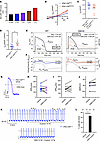 Figure 4
iPSC-CMD801N have greater NCX1 Ca2+ influx at positive membrane potential. (A) In silico ToR-ORd human cardiomyocyte model; graph illustrates [Na+]i as a function of NKA functional states after 1,000 paces. (B) IV curve of INCX in iPSC-CMWT-2 and iPSC-CMD801N-2. (C) INCX current of iPSC-CMWT-2 and iPSC-CMD801N-2 at their respective maximum diastolic potential. (D) INCX current of iPSC-CMWT-2 and iPSC-CMD801N-2 at +80mV. (E and F) Graphs illustrating changes in ENa/Ca during the action potential of WT and D801N cardiomyocytes. NCX mediated Ca2+ influx is thermodynamically favored when Em > ENa/Ca and NCX-mediated Ca2+ efflux is favored when Em < ENa/Ca. (G) AP trace of iPSC-CMWT-2 treated with vehicle and with 1 × 10⁻⁵ M ORM10103 + 1 × 10⁻⁷ M ouabain. (H–J) Action potential duration at 50% repolarization (APD50), 90% repolarization (APD90), and maximum diastolic potential (MDP) of vehicle treated and ouabain + ORM10103–treated iPSC-CMWT-2. (K and L) Ouabain-mediated DAD rescue by cotreatment with ORM-10103. Arrows indicate delayed afterdepolarizations (DAD) events). Results were statistically analyzed with a Mann-Whitney U test or Wilcoxon matched-pairs test. Fischer’s exact test was conducted on K. *P < 0.05, **P < 0.01.
To test whether Ca2+ influx can be modulated to be a net efflux and consequently alter APD, we used ORM-10103, a small molecule that preferentially inhibits NCX1 Ca2+ influx (27). After pretreatment with ouabain to partially inhibit NKA (and raise [Na+]i), treatment of iPSC-CMWT-2 with ORM-10103 normalized the APD and MDP comparable with vehicle-treated iPSC-CMWT-2 parameters (Figure 4, G–J). We also observed that ORM-10103 prevented ouabain-induced DADs in iPSC-CMWT-2 (Figure 4, K and L). Taken together, we conclude that ATP1A3-D801N promotes NCX1-mediated Ca2+ influx at positive membrane potentials, limiting net NCX Ca2+ efflux, and that inhibition of NCX1-mediated Ca2+ influx normalizes APD shortening associated with ATP1A3 inhibition and prevents DAD generation.
Lower NKA function promotes faster L-type Ca2+ channel inactivation. To determine the biophysical mechanism of shortened APD, we hypothesized that phase 2 of the action potential is shorter in iPSC-CMsD801N because of Ca2+-dependent inactivation (CDI) of the L-type Ca2+ channel (LTCC). In silico simulations suggest that lower NKA function was associated with a very slight increase in peak ICa,L, accelerated inactivation and a negative shift in steady state LTCC availability (Figure 5, A and B). Additionally, we found that lower NKA activity was associated with faster IKr inactivation but with lower peak current, suggesting a compensatory response to shortened APD rather than the driving effect (Supplemental Figure 20). In vitro voltage-clamp of iPSC-CMD801N-2 had a trend toward faster inactivation compared with control, with similar peak current amplitudes (Figure 5, C–E). However, this interpretation is complicated by the residual outward currents present in our relatively physiological solutions. Thus, our ATP1A3-D801N cardiomyocytes may have faster ICa,L inactivation.
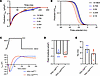 Figure 5
Lower NKA functional states lead to faster L-type Ca2+ channel inactivation. (A and B) In silico TOr-ORd human cardiomyocyte model using decreasing NKA functional states after 1,000 paces. Peak LTCC current (A) and calculated LTCC steady state inactivation (B). (C–E) Patch clamp recordings. (C) Current density raw trace of iPSC-CMWT-2 and iPSC-CMD801N-2 using a 1-step activation protocol. (D) Bar graph illustrating current density per cell. (E) Bar graph illustrating tau of decay per cell. A Mann-Whitney U test was conducted, and no statistical difference was found.
Inhibiting NCX1 Ca2+ influx with ORM-10103 rescues APD and prevents DADs in iPSC-CMD801N. We tested the feasibility of rescuing the shortened APD and DAD generation in iPSC-CMsD801N using outward-biased INCX inhibition. Using Arclight-transduced cardiac myocytes, we measured APD50 and APD90 in vehicle-treated and ORM-10103–treated cardiomyocytes. We found that ORM-10103 increased APD50 and APD90 in iPSC-CMsD801N but had no effect on APD in iPSC-CMsWT (Figure 6, A–C). This is consistent with the idea that there is relatively little outward INCX at normal [Na+]i levels (13). We also observed that ORM-10103 suppressed DADs in iPSC-CMsD801N (Figure 6D). In summary, we found that inhibition of NCX1-mediated Ca2+ influx with ORM-10103 rescued APD and prevented DADs in the D801N iPSC-CM models, which suggests a potentially new therapeutic approach to shortened QTc in ATP1A3-D801N (Figure 7).
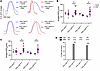 Figure 6
NCX1 Ca2+ influx inhibition with ORM-10103 rescues APD and prevents DADs in iPSC-CMsD801N. Rescue of APD and DADs with ORM-10103 on Arclight transduced cardiomyocytes. (A) Representative fluorescence tracing of vehicle and ORM-10103–treated cells. (B and C) Fluorescence change duration at 50% and 90% from baseline representing APD50 and APD90, respectively. (D) Percent cells with DADs when treated with vehicle or 1 × 10⁻⁵ M ORM-10103. Black dots represent experimental means. Results were statistically analyzed with a hierarchical test. Fischer’s exact test was conducted on D. Panels B and C were statistically analyzed with a hierarchical test. *P < 0.05, **P < 0.01.
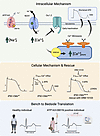 Figure 7
Cellular mechanism of ATP1A3-D801N. Expression of ATP1A3-D801N leads to a decrease in NCX1 mediated Ca2+ efflux. This causes a buildup of intracellular [Ca2+]i and SR store, favoring miniwaves and delayed afterdepolarizations (DADs). In the setting of Ca2+ overload, Cav1.2 rapidly inactivates which shortens phase 2 and leads to a shorter action potential (APD). Inhibition of NCX1-mediated Ca2+ influx with ORM-10103 rescues both APD and DADs in iPSC-CMsD801N, suggesting that NCX1 can be modulated in patients with ATP1A3-D801N to increase ventricular repolarization time and decrease arrhythmic risk.
![iPSC-CMD801N have miniwaves, higher SR [Ca2+] store content, and higher [Ca](http://df6sxcketz7bb.cloudfront.net/manuscripts/197000/197721/small/jci.insight.197721.f3.gif "iPSC-CMD801N have miniwaves, higher SR [Ca2+] store content, and higher [Ca2+]i.")


