
Go to The Journal of Clinical Investigation
  • About
  • Editors
  • Consulting Editors
  • For authors
  • Publication ethics
  • Publication alerts by email
  • Transfers
  • Advertising
  • Job board
  • Contact
  • Physician-Scientist Development
  • Current issue
  • Past issues
  • By specialty
    • COVID-19
    • Cardiology
    • Immunology
    • Metabolism
    • Nephrology
    • Oncology
    • Pulmonology
    • All ...
  • Videos
  • Collections
    • In-Press Preview
    • Resource and Technical Advances
    • Clinical Research and Public Health
    • Research Letters
    • Editorials
    • Perspectives
    • Physician-Scientist Development
    • Reviews
    • Top read articles

  • Current issue
  • Past issues
  • Specialties
  • In-Press Preview
  • Resource and Technical Advances
  • Clinical Research and Public Health
  • Research Letters
  • Editorials
  • Perspectives
  • Physician-Scientist Development
  • Reviews
  • Top read articles
  • About
  • Editors
  • Consulting Editors
  • For authors
  • Publication ethics
  • Publication alerts by email
  • Transfers
  • Advertising
  • Job board
  • Contact
D801N in ATP1A3-encoded Na/K-ATPase alpha 3 causes cardiac arrhythmogenesis through sodium-calcium exchanger–mediated calcium overload
Minu-Tshyeto K. Bidzimou, Padmapriya Muralidharan, Zhushan Zhang, Danyal Raza, Daniel Needs, Bo Sun, Robin M. Perelli, Mary E. Moya-Mendez, P.K. Rakesh Manivannan, Arsen S. Hunanyan, Abbigail Helfer, Christine Q. Simmons, Alfred L. George Jr., Donald M. Bers, Nenad Bursac, Mohamad A. Mikati, Andrew P. Landstrom
View: Text | PDF
Research Article Cardiology Cell biology Neuroscience

D801N in ATP1A3-encoded Na/K-ATPase alpha 3 causes cardiac arrhythmogenesis through sodium-calcium exchanger–mediated calcium overload

  • Text
  • PDF
Abstract

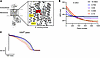
Short QT syndrome is a heritable arrhythmia disorder linked to sudden cardiac death. We recently identified that individuals with alternating hemiplegia of childhood (AHC), a rare neurodevelopmental disorder, can exhibit shortened corrected QT intervals and elevated risk for ventricular fibrillation. This is especially true for patients with AHC heterozygous for the recurrent ATP1A3-D801N variant, though the underlying cardiac mechanism remains unclear. We hypothesized that the D801N missense impairs Na+/K+-ATPase function, causing Ca2+ overload, shortened action potential duration (APD), and arrhythmias. Using in silico modeling and patient-derived induced pluripotent stem cell cardiomyocytes (iPSC-CMsD801N), we observed shorter APD, elevated intracellular and sarcoplasmic reticulum Ca2+ levels, and delayed afterdepolarizations (DADs) compared with WT. Additionally, increased Ca²+ influx via the Na+/Ca2+ exchanger (NCX1) during depolarization was observed in iPSC-CMsD801N. Simulations and in vitro experiments suggest that reduced ATPase function accelerated inactivation of L-type Ca2+ channels. Pharmacologic inhibition of NCX1 with ORM-10103 normalized APD and reduced DADs. These findings support a Ca2+-mediated mechanism for arrhythmogenesis in ATP1A3-D801N carriers and identify NCX1 as a potential therapeutic target.

Authors

Minu-Tshyeto K. Bidzimou, Padmapriya Muralidharan, Zhushan Zhang, Danyal Raza, Daniel Needs, Bo Sun, Robin M. Perelli, Mary E. Moya-Mendez, P.K. Rakesh Manivannan, Arsen S. Hunanyan, Abbigail Helfer, Christine Q. Simmons, Alfred L. George Jr., Donald M. Bers, Nenad Bursac, Mohamad A. Mikati, Andrew P. Landstrom

×

Supporting data values - Download (1.63 MB)

No preview available for this file type: xlsx
Use the download link to access the file.
Advertisement

Copyright © 2026 American Society for Clinical Investigation
ISSN 2379-3708

Sign up for email alerts