
Abstract
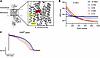
Short QT syndrome is a heritable arrhythmia disorder linked to sudden cardiac death. We recently identified that individuals with alternating hemiplegia of childhood (AHC), a rare neurodevelopmental disorder, can exhibit shortened corrected QT intervals and elevated risk for ventricular fibrillation. This is especially true for patients with AHC heterozygous for the recurrent ATP1A3-D801N variant, though the underlying cardiac mechanism remains unclear. We hypothesized that the D801N missense impairs Na+/K+-ATPase function, causing Ca2+ overload, shortened action potential duration (APD), and arrhythmias. Using in silico modeling and patient-derived induced pluripotent stem cell cardiomyocytes (iPSC-CMsD801N), we observed shorter APD, elevated intracellular and sarcoplasmic reticulum Ca2+ levels, and delayed afterdepolarizations (DADs) compared with WT. Additionally, increased Ca²+ influx via the Na+/Ca2+ exchanger (NCX1) during depolarization was observed in iPSC-CMsD801N. Simulations and in vitro experiments suggest that reduced ATPase function accelerated inactivation of L-type Ca2+ channels. Pharmacologic inhibition of NCX1 with ORM-10103 normalized APD and reduced DADs. These findings support a Ca2+-mediated mechanism for arrhythmogenesis in ATP1A3-D801N carriers and identify NCX1 as a potential therapeutic target.
Authors
Minu-Tshyeto K. Bidzimou, Padmapriya Muralidharan, Zhushan Zhang, Danyal Raza, Daniel Needs, Bo Sun, Robin M. Perelli, Mary E. Moya-Mendez, P.K. Rakesh Manivannan, Arsen S. Hunanyan, Abbigail Helfer, Christine Q. Simmons, Alfred L. George Jr., Donald M. Bers, Nenad Bursac, Mohamad A. Mikati, Andrew P. Landstrom
This file is in Adobe Acrobat (PDF) format. If you have not installed and configured the Adobe Acrobat Reader on your system.
Having trouble reading a PDF?
PDFs are designed to be printed out and read, but if you prefer to read them online, you may find it easier if you increase the view size to 125%.
Having trouble saving a PDF?
Many versions of the free Acrobat Reader do not allow Save. You must instead save the PDF from the JCI Online page you downloaded it from. PC users: Right-click on the Download link and choose the option that says something like "Save Link As...". Mac users should hold the mouse button down on the link to get these same options.
Having trouble printing a PDF?
- Try printing one page at a time or to a newer printer.
- Try saving the file to disk before printing rather than opening it "on the fly." This requires that you configure your browser to "Save" rather than "Launch Application" for the file type "application/pdf", and can usually be done in the "Helper Applications" options.
- Make sure you are using the latest version of Adobe's Acrobat Reader.


