
Research ArticleCell biologyNeuroscience
Open Access |  10.1172/jci.insight.177999
Neurofilament accumulation disrupts autophagy in giant axonal neuropathy
Jean-Michel Paumier,1 James Zewe,1 Chiranjit Panja,1 Melissa R. Pergande,1 Meghana Venkatesan,1 Eitan Israeli,1 Shikha Prasad,1 Natasha Snider,2 Jeffrey N. Savas,1 and Puneet Opal1,3
1Davee Department of Neurology, Feinberg School of Medicine, Northwestern University, Chicago, Illinois, USA.
2Department of Cell Biology and Physiology, School of Medicine, University of North Carolina at Chapel Hill, North Carolina, USA.
3Department of Cell and Molecular Biology, Northwestern University, Chicago, Illinois, USA.
Address correspondence to: Puneet Opal, Director, Denning Ataxia Center, Davee Department of Neurology, and Department of Cell and Molecular Biology, Northwestern University Feinberg School of Medicine, 303 East Chicago Avenue, Chicago, Illinois, 60611, USA. Phone: 312.503.4699; Email: p-opal@northwestern.edu.
Find articles by Paumier, J. in: PubMed | Google Scholar
1Davee Department of Neurology, Feinberg School of Medicine, Northwestern University, Chicago, Illinois, USA.
2Department of Cell Biology and Physiology, School of Medicine, University of North Carolina at Chapel Hill, North Carolina, USA.
3Department of Cell and Molecular Biology, Northwestern University, Chicago, Illinois, USA.
Address correspondence to: Puneet Opal, Director, Denning Ataxia Center, Davee Department of Neurology, and Department of Cell and Molecular Biology, Northwestern University Feinberg School of Medicine, 303 East Chicago Avenue, Chicago, Illinois, 60611, USA. Phone: 312.503.4699; Email: p-opal@northwestern.edu.
Find articles by Zewe, J. in: PubMed | Google Scholar
1Davee Department of Neurology, Feinberg School of Medicine, Northwestern University, Chicago, Illinois, USA.
2Department of Cell Biology and Physiology, School of Medicine, University of North Carolina at Chapel Hill, North Carolina, USA.
3Department of Cell and Molecular Biology, Northwestern University, Chicago, Illinois, USA.
Address correspondence to: Puneet Opal, Director, Denning Ataxia Center, Davee Department of Neurology, and Department of Cell and Molecular Biology, Northwestern University Feinberg School of Medicine, 303 East Chicago Avenue, Chicago, Illinois, 60611, USA. Phone: 312.503.4699; Email: p-opal@northwestern.edu.
Find articles by Panja, C. in: PubMed | Google Scholar
1Davee Department of Neurology, Feinberg School of Medicine, Northwestern University, Chicago, Illinois, USA.
2Department of Cell Biology and Physiology, School of Medicine, University of North Carolina at Chapel Hill, North Carolina, USA.
3Department of Cell and Molecular Biology, Northwestern University, Chicago, Illinois, USA.
Address correspondence to: Puneet Opal, Director, Denning Ataxia Center, Davee Department of Neurology, and Department of Cell and Molecular Biology, Northwestern University Feinberg School of Medicine, 303 East Chicago Avenue, Chicago, Illinois, 60611, USA. Phone: 312.503.4699; Email: p-opal@northwestern.edu.
Find articles by Pergande, M. in: PubMed | Google Scholar
1Davee Department of Neurology, Feinberg School of Medicine, Northwestern University, Chicago, Illinois, USA.
2Department of Cell Biology and Physiology, School of Medicine, University of North Carolina at Chapel Hill, North Carolina, USA.
3Department of Cell and Molecular Biology, Northwestern University, Chicago, Illinois, USA.
Address correspondence to: Puneet Opal, Director, Denning Ataxia Center, Davee Department of Neurology, and Department of Cell and Molecular Biology, Northwestern University Feinberg School of Medicine, 303 East Chicago Avenue, Chicago, Illinois, 60611, USA. Phone: 312.503.4699; Email: p-opal@northwestern.edu.
Find articles by Venkatesan, M. in: PubMed | Google Scholar
1Davee Department of Neurology, Feinberg School of Medicine, Northwestern University, Chicago, Illinois, USA.
2Department of Cell Biology and Physiology, School of Medicine, University of North Carolina at Chapel Hill, North Carolina, USA.
3Department of Cell and Molecular Biology, Northwestern University, Chicago, Illinois, USA.
Address correspondence to: Puneet Opal, Director, Denning Ataxia Center, Davee Department of Neurology, and Department of Cell and Molecular Biology, Northwestern University Feinberg School of Medicine, 303 East Chicago Avenue, Chicago, Illinois, 60611, USA. Phone: 312.503.4699; Email: p-opal@northwestern.edu.
Find articles by Israeli, E. in: PubMed | Google Scholar
1Davee Department of Neurology, Feinberg School of Medicine, Northwestern University, Chicago, Illinois, USA.
2Department of Cell Biology and Physiology, School of Medicine, University of North Carolina at Chapel Hill, North Carolina, USA.
3Department of Cell and Molecular Biology, Northwestern University, Chicago, Illinois, USA.
Address correspondence to: Puneet Opal, Director, Denning Ataxia Center, Davee Department of Neurology, and Department of Cell and Molecular Biology, Northwestern University Feinberg School of Medicine, 303 East Chicago Avenue, Chicago, Illinois, 60611, USA. Phone: 312.503.4699; Email: p-opal@northwestern.edu.
Find articles by Prasad, S. in: PubMed | Google Scholar
1Davee Department of Neurology, Feinberg School of Medicine, Northwestern University, Chicago, Illinois, USA.
2Department of Cell Biology and Physiology, School of Medicine, University of North Carolina at Chapel Hill, North Carolina, USA.
3Department of Cell and Molecular Biology, Northwestern University, Chicago, Illinois, USA.
Address correspondence to: Puneet Opal, Director, Denning Ataxia Center, Davee Department of Neurology, and Department of Cell and Molecular Biology, Northwestern University Feinberg School of Medicine, 303 East Chicago Avenue, Chicago, Illinois, 60611, USA. Phone: 312.503.4699; Email: p-opal@northwestern.edu.
Find articles by Snider, N. in: PubMed | Google Scholar
1Davee Department of Neurology, Feinberg School of Medicine, Northwestern University, Chicago, Illinois, USA.
2Department of Cell Biology and Physiology, School of Medicine, University of North Carolina at Chapel Hill, North Carolina, USA.
3Department of Cell and Molecular Biology, Northwestern University, Chicago, Illinois, USA.
Address correspondence to: Puneet Opal, Director, Denning Ataxia Center, Davee Department of Neurology, and Department of Cell and Molecular Biology, Northwestern University Feinberg School of Medicine, 303 East Chicago Avenue, Chicago, Illinois, 60611, USA. Phone: 312.503.4699; Email: p-opal@northwestern.edu.
Find articles by Savas, J. in: PubMed | Google Scholar
1Davee Department of Neurology, Feinberg School of Medicine, Northwestern University, Chicago, Illinois, USA.
2Department of Cell Biology and Physiology, School of Medicine, University of North Carolina at Chapel Hill, North Carolina, USA.
3Department of Cell and Molecular Biology, Northwestern University, Chicago, Illinois, USA.
Address correspondence to: Puneet Opal, Director, Denning Ataxia Center, Davee Department of Neurology, and Department of Cell and Molecular Biology, Northwestern University Feinberg School of Medicine, 303 East Chicago Avenue, Chicago, Illinois, 60611, USA. Phone: 312.503.4699; Email: p-opal@northwestern.edu.
Find articles by Opal, P. in: PubMed | Google Scholar
Published March 10, 2025 - More info
JCI Insight. 2025;10(5):e177999. https://doi.org/10.1172/jci.insight.177999.
© 2025 Paumier et al. This work is licensed under the Creative Commons Attribution 4.0 International License. To view a copy of this license, visit http://creativecommons.org/licenses/by/4.0/.
Received: November 28, 2023; Accepted: January 22, 2025

-
Results
Proteomic analysis of mouse dorsal root ganglia with gigaxonin silenced. Gan-null mice recapitulate the neurofilament aggregates in neurons and the IF aggregates in other cell types, but because of their small size, they do not manifest overt signs of the disease until they are very old (9, 18–20). Therefore, we developed a primary neuronal culture model using dorsal root ganglia (DRG) neurons (9), which are affected early in the disease course and display severe neuropathology. DRG neurons isolated from Gan-null mice demonstrated progressive NF accumulation starting from as early as 2 days in vitro, both in the cell soma and neurites (Figure 1A). The GAN phenotype is equally well reproduced in wild-type (WT) neurons using lentiviral delivery of small hairpin RNA–based (shRNA-based) RNAi to reduce gigaxonin expression. The degree of knockdown achieved is approximately 90% (9). Neurons lacking gigaxonin degenerate, as evidenced by axonal fragmentation after an additional 8–9 days in culture (Figure 1, B and C).
 Figure 1
Dorsal root ganglia (DRG) neurons model the hallmark pathology of giant axonal neuropathy (GAN). (A) Representative fluorescence microscopy images of DRG neurons from WT and Gan-null mice stained for neurofilament light (NFL) after 2, 4, and 7 days in vitro (DIV). Arrowheads denote NFL aggregation in the soma of Gan-null DRG neurons. Note that NFL aggregates are already present after 2 DIV. (B) The GAN phenotype can be recapitulated by lentiviral delivery of shRNA targeting the Gan gene. Scale bars: 30 μm (A and B). All insets are shown at ×3 magnification. After 12 DIV, axonal fragmentation, a sign of neurodegeneration, occurs in Gan-silenced DRG neurons, as denoted by arrowheads; large aggregate shown in zoom. (C) Quantification of axonal fragmentation was accomplished using Fiji’s measurement tool, reported here as the means of 3 independent experiments ± SEM. ***P < 0.001 by 2-tailed, unpaired Student’s t test.
To gain insight into the molecular consequences of loss of gigaxonin function, we performed quantitative proteomics with stable isotope labeling using amino acids in cell culture (SILAC) (21). We quantified 3,507 proteins in DRG cultures (shScr) and Gan-knockdown cells (shGan) under the same experimental conditions (Figure 2A). Of these, 149 proteins had significantly altered fold change, with a false discovery rate–adjusted (FDR-adjusted) P value of less than 0.05 (62 elevated and 87 reduced; see Supplemental Table 1; supplemental material available online with this article; https://doi.org/10.1172/jci.insight.177999DS1). As expected, the IF proteins (NFL, NFM, and peripherin) were among those that were most significantly elevated.
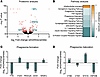 Figure 2
Mass spectrometry–based proteomic analysis of dorsal root ganglia (DRG) cultures silenced for gigaxonin. (A) Volcano plot showing the distribution of measured proteins extracted from DRG cultures in which Gan was silenced using shRNA (shGan). (B) Plot showing top-ranked altered pathways in GAN where pathway activation (change in z score) is shown (orange represents upregulation and blue represents downregulation). (C and D) Plots showing altered proteins for the phagosome formation and phagosome maturation pathways. *P < 0.05, **P < 0.001, ***P < 0.0001; adjusted P values from 2-tailed, unpaired Student’s t test. NFL, neurofilament light; NFM, neurofilament medium; PRFN, peripherin.
Ingenuity Pathway Analysis (IPA) identified altered biological functions in Gan-silenced DRG cultures (Figure 2B). Several signaling pathways were dysregulated, but only 1 was hyperactivated: PPARα/RXRα, which regulates cell growth, differentiation, and metabolism. Since signaling pathways participate in multiple cellular functions, it was difficult to discern which specific deficits might result. We noticed, however, that phagosome formation and maturation, 2 key aspects of autophagy (22), were downregulated. Among the downregulated proteins involved in these functions were Fyn, which plays a role in autophagy by AMPK phosphorylation; PIK3C2A, whose knockdown decreases autophagy and the maturation of endocytic vesicles (23); and Sos1, whose deletion has been related to accumulation of phagosomes and lysosomal bodies (24) (Figure 2C). There were also genes in these autophagy pathways that were upregulated, perhaps in compensation, such as Itga7, which participates in phagocytosis (25), and Wasf2, which is involved in autophagosome and trafficking to lysosomes in human immune cells (26). Two upregulated proteins in the phagosome maturation category (Figure 2D) were cathepsin B (Ctsb), whose deletion impairs autophagy and lysosomal recycling (27), and syntaxin 1A (Stx1A), which regulates vesicle fusion and trafficking (28); among the downregulated proteins were cathepsin H (Ctsh), which is also involved in vesicle fusion and trafficking (29), and VPS33B, which is involved in endosomal recycling and late endosomal-lysosomal fusion events (30, 31). Several of the other dysregulated pathways, most notably PPARα/RXRα, ERK/MAPK, IL-7, semaphorin, and GPCR signaling, are also central to autophagic regulation (32–35). The overall impression is thus of a severely dysregulated autophagic system. Our proteomic results are also supported by a recent publication describing the role of gigaxonin in autophagosome production through Atg16L1 turnover regulation (36).
NF aggregates alter the spatial distribution, abundance, and morphology of autophagic organelles. The autophagic process involves the formation of vesicles around substrates; these vesicles mature into autophagosomes that fuse with lysosomes, where the substrate is ultimately degraded (37). These steps require the free movement of autophagic organelles, a process that we hypothesized would be particularly compromised in neurons by the space-occupying NF aggregates. Therefore, we stained cells for LC3, a small polypeptide that recruits substrates and is a specific marker for autophagosomes (38). NFs were delineated by staining for NFL, a protein that forms the backbone of the NF heteropolymer (16). In Gan-null DRG neurons, the autophagosomes were not uniformly distributed throughout the cytoplasm, as they would normally be, but were now more abundant at the perimeters of the aggregates (Figure 3A).
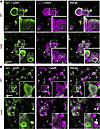 Figure 3
Neurofilament aggregates alter autophagosome spatial distribution. (A) Representative fluorescence images of DRG neurons from WT or Gan-null mice costained for the cytoskeleton marker neurofilament light (NFL) and the autophagosome marker LC3. Autophagosomes are excluded from neurofilament aggregates, and LC3 puncta are found at the periphery of the aggregates (white arrowhead). (B) WT or Gan-null mouse DRG neurons costained for the cytoskeletal marker NFL and the lysosomal marker LAMP-1. Two phenotypes are observed in Gan-null DRG neurons with neurofilament aggregates: lysosomes are either excluded (circular dotted line) or colocalized with neurofilament aggregates (arrowhead). Scale bars: 30 μm. Insets are shown at ×3 magnification. Representative images from 3 independent experiments.
Next, we determined the location of lysosomes using immunofluorescence microscopy. NFs were visualized as before by staining for NFL, while lysosomes were visualized by staining for LAMP-1, which constitutes approximately 50% of the lysosomal membrane (16, 39) (Figure 3B). Neurons showed either exclusion of LAMP-1 staining from NF aggregates, or they showed a colocalization. We surmised that these 2 patterns reflect the status of different lysosomal populations or their membranous fragments. Indeed, there is a growing body of literature on lysosome heterogeneity, both in different cell types and within the same cell (40–42). This heterogeneity involves gradations in the acidity of the interiors of these lysosomes and their repertoire of luminal cathepsins and proteases (27, 40).
To follow up on these observations, we stained additional lysosomal components, both across the membrane and within the lumen. For the former, we evaluated the distribution of mucolipin-1, a calcium channel protein and member of the transient receptor potential cation channel mucolipin subfamily (43, 44), and vacuolar ATPase, which is a protein essential for lysosomal acidification that pumps protons into the lumen (45, 46). Both of these colocalized with NF aggregates (Figure 4A). To study intraluminal proteins, we stained for 2 lysosomal proteases: cathepsin B and cathepsin D (47). Cathepsin B was typically found in aggregates, whereas cathepsin D was typically excluded from them, reminiscent of the 2 staining patterns of LAMP-1 and consistent with lysosomal heterogeneity (Figure 4B). It is also worth noting that cathepsin D, which requires a more acidic pH for its activity (pH 4.5–5), is seen in the discrete intact lysosomes, while cathepsin B, which is active at a less acidic pH (pH 5–6), appears to be more closely packed within the NF aggregates (27).
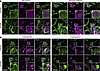 Figure 4
Spatial distribution of lysosomes is altered by neurofilament aggregates in GAN DRG neurons. Representative fluorescence images of DRG neurons silenced for gigaxonin (shGan) and control neurons (shScr) costained for NFL and (A) mucolipin-1 and vacuolar ATPase or (B) cathepsin B and cathepsin D. While cathepsin D is excluded from neurofilament aggregates, the 3 other lysosomal proteins colocalize with aggregates in shGan cells from mouse DRG. Scale bars: 30 μm. Insets are shown at ×3 magnification. Arrowheads highlight lysosomal proteins clumped in NFL aggregates in the shGan condition.
We next tracked intact lysosomes in living DRG neurons with LysoTracker, a cell-permeable dye that stains the acidic compartment of lysosomes across a range of pH levels (48). Since we wished to correlate lysosomal distribution with NF aggregates, we also infected cells with a lentivirus expressing GFP-tagged NFL. LysoTracker staining tended to be absent from regions with aggregates, suggesting that intact lysosomes are spatially excluded from NF accumulations (Figure 5A). The amount and intensity of lysosomal staining with LysoTracker was greater in shGan cells compared with controls (Figure 5, A and B), likely because the lysosomes also tended to be larger (Figure 5C).
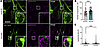 Figure 5
Lysosomal changes in GAN. (A) Representative live-imaging fluorescence images of control and shGan cells from mouse DRG transduced with NFL-GFP tagged lentivirus and treated with red LysoTracker to visualize lysosomes. Expression of the NFL-GFP construct in shGan cells from mouse DRG neurons allowed neurofilament aggregate visualization in living cells. Scale bar: 30 μm. Insets are shown at ×3 magnification. (B and C) shGan induces an increase in the number of lysosomes and the surface area covered by these organelles. Note that as observed after NFL and LAMP-1 costaining, LysoTracker dye is also mainly excluded from neurofilament aggregates (circular dotted line). Quantitative data are presented as mean ± SEM. ***P < 0.001 by 2-tailed, unpaired Student’s t test. Representative images from 3 independent experiments.
Transmission electron microscopy revealed a greater abundance of autophagic organelles at different stages of maturation in Gan-null DRG neurons; these included large autophagic vacuoles, multilamellar bodies, and immature autophagosomes (Figure 6). The electron-dense lysosomes tended to decorate the perimeter of the aggregates. These data demonstrate that NF aggregates influence the distribution of autophagic organelles.
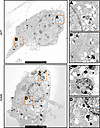 Figure 6
GAN is associated with abnormal autophagic organelles. Transmission electronic microscopy microphotographs of control and Gan-null DRG neurons showing the presence of a variety of autophagic organelles, including large autophagic vacuoles, dark dense lysosomes (open arrowheads), multilamellar bodies, and immature autophagosomes (filled arrowheads). Scale bars: 5 μm. Insets are shown at ×3.5 magnification.
Lysosomal acidity and autophagic flux are dysregulated in GAN. To address lysosomal function, we evaluated lysosomal pH, which is crucial to the ability to degrade substrates. We used LysoSensor, a sensitive dye designed specifically for this purpose (37). Gan-silenced DRG cultures displayed a significant reduction in LysoSensor signal intensity within LysoTracker-defined compartments (Figure 7A). These results suggest that lysosomes in GAN are defective at maintaining a robust acidic internal environment, which would translate into a reduction in autophagic flux. To test this possibility, we performed live-cell imaging using an mRFP-GFP tandem–tagged LC3. This protein is incorporated into the membrane of autophagic vacuoles, exhibiting a punctate signal within cells. It fluoresces from fluorophores as autophagosomes mature before fusing with the lysosome; after fusion, the GFP fluorescence (which is pH sensitive) is lost in the acidic lysosomal milieu, while the mRFP fluorescence (not pH sensitive) persists until LC3 is fully degraded, providing a quantifiable readout for fusion delay or lysosomal dysfunction (38). Neurons lacking gigaxonin showed a significantly greater GFP fluorescence signal within RFP-positive vesicles (Figure 7B). These autophagic organelles were larger in Gan-null DRG neurons than in controls. Moreover, we observed a decrease in the GFP/RFP ratio, suggesting that not only is the GFP not quenched, but the RFP-LC3 is also not degraded.
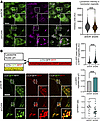 Figure 7
Lysosomal acidity and function are dysregulated in GAN. (A) Representative live-imaging microphotographs of control and shGan silenced DRG cells treated with a combination of red LysoTracker to visualize lysosomes and green LysoSensor to evaluate pH changes. Mean intensity of LysoSensor (pH-sensitive probe) is decreased in lysosomes from shGan cultures, suggesting the lysosomal milieu is less acidic in the GAN condition. (B) Representative live-imaging microphotographs of control or shGan DRG cells transduced with the sensor LC3-GFP-RFP. Individual panels are presented for GFP, RFP, and merged signals. The construct shown above is composed of an RFP pH-resistant tag, a GFP pH-sensitive tag, and LC3 that targets the tags to nascent autophagosomes. After fusion with lysosomes, autophagolysosomes are formed and the GFP signal is quenched due to the acidic milieu provided by lysosomes, converting the fluorescence signal from yellow to red. Gigaxonin reduction is associated with enhanced GFP fluorescence signal within RFP-positive vesicles; an increase in the size of autophagic organelles; and a decrease in the GFP/RFP ratio. Quantitative data are presented as mean ± SEM. ***P < 0.001 by 2-tailed, unpaired Student’s t test. Scale bars: 30 μm. Insets are shown at ×3 magnification.
To further assess the functional status of autophagy, we evaluated the levels of p62 (also known as SQSTM1), an autophagic receptor that recruits cargo to be degraded and is itself degraded by autophagy (38). By both immunostaining and Western blotting, p62 levels were significantly greater in Gan-silenced DRG neurons (Figure 8, A and B). We also observed a reduction in both isoforms of LC3 in Gan-null DRG neurons involved in autophagy; (Figure 8B; LC-I is the inactive form, while LC3-II is an activated lipidated form of LC-1, which is recruited to the membranes of autophagosomes to promote autophagy) (38).
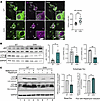 Figure 8
Autophagic flux is dysregulated in GAN. (A) The autophagic receptor p62 is increased in Gan-null DRG cultures. Representative fluorescence images of control and Gan-null DRG neurons costained for p62 and NFL, with mean intensity quantified. Scale bar: 30 μm. Insets are shown at ×3 magnification. (B) Western blots show an increase in p62 and a reduction in LC3 isoforms LC3-I and LC3-II; quantified in adjacent histograms. (C) Autophagic flux is downregulated in Gan-null DRG cultures. DRG neurons from WT and Gan-null mice were treated with vehicle, bafilomycin A1, rapamycin, and both drugs as shown. Basal autophagic flux was calculated as the difference between the levels of LC3-II expression (normalized to GAPDH as a loading control) in the bafilomycin A1 treatment in each experimental condition compared to its levels treated with vehicle control. Autophagic flux under rapamycin stimulation is shown alongside. Autophagic flux induced by rapamycin was calculated as the difference between the levels of normalized LC-II expression in the combination rapamycin and bafilomycin A1 treatment and those treated with rapamycin alone. n = 3, with sample Western blot of 1 representative experiment shown. The LC3 blot is shown at short and long exposure to clearly display bands. Quantitative data are presented as mean ± SEM. *P < 0.05, **P < 0.01, ***P < 0.001 by 2-tailed, unpaired Student’s t test.
Since autophagic processes are dynamic and cannot be monitored simply by the steady-state levels of autophagic markers (49–52), we performed additional biochemical experiments. For these experiments we used bafilomycin A1, a drug that prevents the fusion of autophagosomes with lysosomes and leads to the accumulation of autophagosomes. This leads to an increase in LC-II levels, which indicates the degree of basal autophagic flux (as it shows the amount of LC-II that would normally be degraded by the lysosomes). Gan-null DRG neurons showed lower basal autophagic flux than WT neurons (Figure 8C). We also assayed for autophagic flux in the presence of rapamycin, which inhibits mTOR and induces autophagy by promoting autophagosome formation. Under these conditions, Gan-null DRG neurons showed a considerable increase in autophagic flux compared even with WT neurons, suggesting that autophagic stimulation could well prove neuroprotective (Figure 8C).
TFEB localizes to NF aggregates in GAN. Autophagy is dependent on the activity of TFEB (53–55), a key transcriptional regulator of autophagy, whose activity is highly dependent on its subcellular location. Under conditions of cellular stress, TFEB translocates to the nucleus to drive the coordinated lysosomal expression and regulation (CLEAR) network of genes responsible for autophagy and lysosomal biogenesis (56). When phosphorylated, TFEB is bound to the cytoplasmic chaperone 14-3-3 proteins, a family of acidic phosphoproteins (28–33 kDa in size) that serve as adapters regulating a number of signaling pathways. Intriguingly, IFs, including NFs, are known to recruit these proteins in a phosphorylation-dependent manner (57). For these reasons, we decided to look for both TFEB and 14-3-3 localization in Gan-silenced DRG neurons.
After costaining TFEB and NFL, we found that TFEB was enriched in cytoplasmic NF aggregates when Gan was silenced (Figure 9, A and B). Moreover, we found significantly less TFEB in the nucleus of Gan-null cells (~33% less than WT). We also found that 14-3-3 proteins coaggregate with NFL in Gan-silenced DRG neurons (Figure 9C).
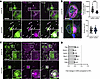 Figure 9
Neurofilament aggregates recruit TFEB and impair its nuclear translocation. (A) Representative fluorescence images of control and shGan cells from DRG neurons costained for NFL and TFEB showing colocalization of transcription factor EB (TFEB) to neurofilaments (arrowhead). Scale bar: 30 μm. (B) Higher-magnification pictures showing decreased TFEB localization in the nuclear compartment in shGan cells. Accompanying plots show that TFEB has decreased intensity, and that nuclear size is similar between control and shGan cells. Quantitative data are presented as mean ± SEM. ***P < 0.001 by 2-tailed, unpaired Student’s t test. (C) Immunofluorescence images of control and shGan cells from mouse DRG costained for NFL and 14-3-3. Neurofilament aggregates recruit 14-3-3 (arrowhead). Scale bars: 30 μm. Insets are shown at ×3 magnification. Representative images from 3 independent experiments. (D) qRT-PCR analysis of Gan-null DRG neurons reveals downregulation of several TFEB targets: TFEB itself, mucolipin-1, LAMP-1, Beclin-1, and cathepsins B and D. Data represent fold change in Gan-null DRG neurons of the respective gene compared with WT and normalized to the expression level of GAPDH in 3 independent experiments plotted as mean ± SEM. *P < 0.05, **P < 0.01 by 2-tailed, unpaired Student’s t test.
Because less TFEB is in the nucleus of shGan cells from DRG culture, we next tested for its transcriptional activity. To test for this, we performed quantitative RT-PCR, evaluating a few notable targets of TFEB (56); these include TFEB itself (as part of a positive feedback loop), Beclin-1, a scaffold protein crucial for recruitment of autophagy machinery to the autophagosome, and the lysosomal proteins LAMP-1, mucolipin-1, and cathepsins B and D. These TFEB-regulated transcripts were significantly reduced, in line with the functional compromise of TFEB activity (Figure 9D).


