
Research ArticleImmunologyNeuroscience
Open Access |  10.1172/jci.insight.199679
Cellular immune endophenotypes separating early and late-onset myasthenia gravis
Jakob Theorell,1,2 Nicolas Ruffin,3 Andrew Fower,4 Chiara Sorini,3 Philip Ambrose,4 Valentina Damato,5 Lahiru Handunnetthi,6,7 Isabel Leite,4 Sarosh R. Irani,4,8 Susanna Brauner,2,3 Adam E. Handel,4 and Fredrik Piehl2,3
1Department of Medicine Huddinge, Karolinska Institutet, Stockholm, Sweden.
2Department of Neurology, Karolinska University Hospital, Stockholm, Sweden.
3Department of Clinical Neuroscience, Karolinska Institutet, and Center for Molecular Medicine, Karolinska University Hospital, Stockholm, Sweden.
4Nuffield Department of Clinical Neurosciences, University of Oxford, Oxford, United Kingdom.
5Department of Neuroscience and Psychology, University of Florence, Florence, Italy.
6Centre for Human Genetics, and
7Department Psychiatry, University of Oxford, Oxford, United Kingdom.
8Department of Neuroscience, Mayo Clinic Florida, Jacksonville, Florida, USA.
Address correspondence to: Jakob Theorell, Center for Infectious Medicine, Department of Medicine Huddinge, Karolinska Institutet, CIM/ANA Futura, Alfred Nobles Allé 8B, 141 52 Huddinge, Karolinska Institutet, Stockholm, Sweden. Email: Jakob.theorell@ki.se.
Find articles by Theorell, J. in: PubMed | Google Scholar
1Department of Medicine Huddinge, Karolinska Institutet, Stockholm, Sweden.
2Department of Neurology, Karolinska University Hospital, Stockholm, Sweden.
3Department of Clinical Neuroscience, Karolinska Institutet, and Center for Molecular Medicine, Karolinska University Hospital, Stockholm, Sweden.
4Nuffield Department of Clinical Neurosciences, University of Oxford, Oxford, United Kingdom.
5Department of Neuroscience and Psychology, University of Florence, Florence, Italy.
6Centre for Human Genetics, and
7Department Psychiatry, University of Oxford, Oxford, United Kingdom.
8Department of Neuroscience, Mayo Clinic Florida, Jacksonville, Florida, USA.
Address correspondence to: Jakob Theorell, Center for Infectious Medicine, Department of Medicine Huddinge, Karolinska Institutet, CIM/ANA Futura, Alfred Nobles Allé 8B, 141 52 Huddinge, Karolinska Institutet, Stockholm, Sweden. Email: Jakob.theorell@ki.se.
Find articles by
Ruffin, N.
in:
PubMed
|
Google Scholar
|

1Department of Medicine Huddinge, Karolinska Institutet, Stockholm, Sweden.
2Department of Neurology, Karolinska University Hospital, Stockholm, Sweden.
3Department of Clinical Neuroscience, Karolinska Institutet, and Center for Molecular Medicine, Karolinska University Hospital, Stockholm, Sweden.
4Nuffield Department of Clinical Neurosciences, University of Oxford, Oxford, United Kingdom.
5Department of Neuroscience and Psychology, University of Florence, Florence, Italy.
6Centre for Human Genetics, and
7Department Psychiatry, University of Oxford, Oxford, United Kingdom.
8Department of Neuroscience, Mayo Clinic Florida, Jacksonville, Florida, USA.
Address correspondence to: Jakob Theorell, Center for Infectious Medicine, Department of Medicine Huddinge, Karolinska Institutet, CIM/ANA Futura, Alfred Nobles Allé 8B, 141 52 Huddinge, Karolinska Institutet, Stockholm, Sweden. Email: Jakob.theorell@ki.se.
Find articles by Fower, A. in: PubMed | Google Scholar
1Department of Medicine Huddinge, Karolinska Institutet, Stockholm, Sweden.
2Department of Neurology, Karolinska University Hospital, Stockholm, Sweden.
3Department of Clinical Neuroscience, Karolinska Institutet, and Center for Molecular Medicine, Karolinska University Hospital, Stockholm, Sweden.
4Nuffield Department of Clinical Neurosciences, University of Oxford, Oxford, United Kingdom.
5Department of Neuroscience and Psychology, University of Florence, Florence, Italy.
6Centre for Human Genetics, and
7Department Psychiatry, University of Oxford, Oxford, United Kingdom.
8Department of Neuroscience, Mayo Clinic Florida, Jacksonville, Florida, USA.
Address correspondence to: Jakob Theorell, Center for Infectious Medicine, Department of Medicine Huddinge, Karolinska Institutet, CIM/ANA Futura, Alfred Nobles Allé 8B, 141 52 Huddinge, Karolinska Institutet, Stockholm, Sweden. Email: Jakob.theorell@ki.se.
Find articles by Sorini, C. in: PubMed | Google Scholar
1Department of Medicine Huddinge, Karolinska Institutet, Stockholm, Sweden.
2Department of Neurology, Karolinska University Hospital, Stockholm, Sweden.
3Department of Clinical Neuroscience, Karolinska Institutet, and Center for Molecular Medicine, Karolinska University Hospital, Stockholm, Sweden.
4Nuffield Department of Clinical Neurosciences, University of Oxford, Oxford, United Kingdom.
5Department of Neuroscience and Psychology, University of Florence, Florence, Italy.
6Centre for Human Genetics, and
7Department Psychiatry, University of Oxford, Oxford, United Kingdom.
8Department of Neuroscience, Mayo Clinic Florida, Jacksonville, Florida, USA.
Address correspondence to: Jakob Theorell, Center for Infectious Medicine, Department of Medicine Huddinge, Karolinska Institutet, CIM/ANA Futura, Alfred Nobles Allé 8B, 141 52 Huddinge, Karolinska Institutet, Stockholm, Sweden. Email: Jakob.theorell@ki.se.
Find articles by Ambrose, P. in: PubMed | Google Scholar
1Department of Medicine Huddinge, Karolinska Institutet, Stockholm, Sweden.
2Department of Neurology, Karolinska University Hospital, Stockholm, Sweden.
3Department of Clinical Neuroscience, Karolinska Institutet, and Center for Molecular Medicine, Karolinska University Hospital, Stockholm, Sweden.
4Nuffield Department of Clinical Neurosciences, University of Oxford, Oxford, United Kingdom.
5Department of Neuroscience and Psychology, University of Florence, Florence, Italy.
6Centre for Human Genetics, and
7Department Psychiatry, University of Oxford, Oxford, United Kingdom.
8Department of Neuroscience, Mayo Clinic Florida, Jacksonville, Florida, USA.
Address correspondence to: Jakob Theorell, Center for Infectious Medicine, Department of Medicine Huddinge, Karolinska Institutet, CIM/ANA Futura, Alfred Nobles Allé 8B, 141 52 Huddinge, Karolinska Institutet, Stockholm, Sweden. Email: Jakob.theorell@ki.se.
Find articles by Damato, V. in: PubMed | Google Scholar
1Department of Medicine Huddinge, Karolinska Institutet, Stockholm, Sweden.
2Department of Neurology, Karolinska University Hospital, Stockholm, Sweden.
3Department of Clinical Neuroscience, Karolinska Institutet, and Center for Molecular Medicine, Karolinska University Hospital, Stockholm, Sweden.
4Nuffield Department of Clinical Neurosciences, University of Oxford, Oxford, United Kingdom.
5Department of Neuroscience and Psychology, University of Florence, Florence, Italy.
6Centre for Human Genetics, and
7Department Psychiatry, University of Oxford, Oxford, United Kingdom.
8Department of Neuroscience, Mayo Clinic Florida, Jacksonville, Florida, USA.
Address correspondence to: Jakob Theorell, Center for Infectious Medicine, Department of Medicine Huddinge, Karolinska Institutet, CIM/ANA Futura, Alfred Nobles Allé 8B, 141 52 Huddinge, Karolinska Institutet, Stockholm, Sweden. Email: Jakob.theorell@ki.se.
Find articles by Handunnetthi, L. in: PubMed | Google Scholar
1Department of Medicine Huddinge, Karolinska Institutet, Stockholm, Sweden.
2Department of Neurology, Karolinska University Hospital, Stockholm, Sweden.
3Department of Clinical Neuroscience, Karolinska Institutet, and Center for Molecular Medicine, Karolinska University Hospital, Stockholm, Sweden.
4Nuffield Department of Clinical Neurosciences, University of Oxford, Oxford, United Kingdom.
5Department of Neuroscience and Psychology, University of Florence, Florence, Italy.
6Centre for Human Genetics, and
7Department Psychiatry, University of Oxford, Oxford, United Kingdom.
8Department of Neuroscience, Mayo Clinic Florida, Jacksonville, Florida, USA.
Address correspondence to: Jakob Theorell, Center for Infectious Medicine, Department of Medicine Huddinge, Karolinska Institutet, CIM/ANA Futura, Alfred Nobles Allé 8B, 141 52 Huddinge, Karolinska Institutet, Stockholm, Sweden. Email: Jakob.theorell@ki.se.
Find articles by Leite, I. in: PubMed | Google Scholar
1Department of Medicine Huddinge, Karolinska Institutet, Stockholm, Sweden.
2Department of Neurology, Karolinska University Hospital, Stockholm, Sweden.
3Department of Clinical Neuroscience, Karolinska Institutet, and Center for Molecular Medicine, Karolinska University Hospital, Stockholm, Sweden.
4Nuffield Department of Clinical Neurosciences, University of Oxford, Oxford, United Kingdom.
5Department of Neuroscience and Psychology, University of Florence, Florence, Italy.
6Centre for Human Genetics, and
7Department Psychiatry, University of Oxford, Oxford, United Kingdom.
8Department of Neuroscience, Mayo Clinic Florida, Jacksonville, Florida, USA.
Address correspondence to: Jakob Theorell, Center for Infectious Medicine, Department of Medicine Huddinge, Karolinska Institutet, CIM/ANA Futura, Alfred Nobles Allé 8B, 141 52 Huddinge, Karolinska Institutet, Stockholm, Sweden. Email: Jakob.theorell@ki.se.
Find articles by
Irani, S.
in:
PubMed
|
Google Scholar
|
1Department of Medicine Huddinge, Karolinska Institutet, Stockholm, Sweden.
2Department of Neurology, Karolinska University Hospital, Stockholm, Sweden.
3Department of Clinical Neuroscience, Karolinska Institutet, and Center for Molecular Medicine, Karolinska University Hospital, Stockholm, Sweden.
4Nuffield Department of Clinical Neurosciences, University of Oxford, Oxford, United Kingdom.
5Department of Neuroscience and Psychology, University of Florence, Florence, Italy.
6Centre for Human Genetics, and
7Department Psychiatry, University of Oxford, Oxford, United Kingdom.
8Department of Neuroscience, Mayo Clinic Florida, Jacksonville, Florida, USA.
Address correspondence to: Jakob Theorell, Center for Infectious Medicine, Department of Medicine Huddinge, Karolinska Institutet, CIM/ANA Futura, Alfred Nobles Allé 8B, 141 52 Huddinge, Karolinska Institutet, Stockholm, Sweden. Email: Jakob.theorell@ki.se.
Find articles by Brauner, S. in: PubMed | Google Scholar
1Department of Medicine Huddinge, Karolinska Institutet, Stockholm, Sweden.
2Department of Neurology, Karolinska University Hospital, Stockholm, Sweden.
3Department of Clinical Neuroscience, Karolinska Institutet, and Center for Molecular Medicine, Karolinska University Hospital, Stockholm, Sweden.
4Nuffield Department of Clinical Neurosciences, University of Oxford, Oxford, United Kingdom.
5Department of Neuroscience and Psychology, University of Florence, Florence, Italy.
6Centre for Human Genetics, and
7Department Psychiatry, University of Oxford, Oxford, United Kingdom.
8Department of Neuroscience, Mayo Clinic Florida, Jacksonville, Florida, USA.
Address correspondence to: Jakob Theorell, Center for Infectious Medicine, Department of Medicine Huddinge, Karolinska Institutet, CIM/ANA Futura, Alfred Nobles Allé 8B, 141 52 Huddinge, Karolinska Institutet, Stockholm, Sweden. Email: Jakob.theorell@ki.se.
Find articles by Handel, A. in: PubMed | Google Scholar
1Department of Medicine Huddinge, Karolinska Institutet, Stockholm, Sweden.
2Department of Neurology, Karolinska University Hospital, Stockholm, Sweden.
3Department of Clinical Neuroscience, Karolinska Institutet, and Center for Molecular Medicine, Karolinska University Hospital, Stockholm, Sweden.
4Nuffield Department of Clinical Neurosciences, University of Oxford, Oxford, United Kingdom.
5Department of Neuroscience and Psychology, University of Florence, Florence, Italy.
6Centre for Human Genetics, and
7Department Psychiatry, University of Oxford, Oxford, United Kingdom.
8Department of Neuroscience, Mayo Clinic Florida, Jacksonville, Florida, USA.
Address correspondence to: Jakob Theorell, Center for Infectious Medicine, Department of Medicine Huddinge, Karolinska Institutet, CIM/ANA Futura, Alfred Nobles Allé 8B, 141 52 Huddinge, Karolinska Institutet, Stockholm, Sweden. Email: Jakob.theorell@ki.se.
Find articles by
Piehl, F.
in:
PubMed
|
Google Scholar
|
Published November 27, 2025 - More info
JCI Insight. 2026;11(1):e199679. https://doi.org/10.1172/jci.insight.199679.
© 2025 Theorell et al. This work is licensed under the Creative Commons Attribution 4.0 International License. To view a copy of this license, visit http://creativecommons.org/licenses/by/4.0/.
Received: August 28, 2025; Accepted: November 13, 2025

-
Results
Study cohorts. To ensure the robustness of our findings, we studied 2 independent cohorts of patients with EOMG or LOMG (Table 1). The UK discovery cohort consisted of 28 patients with untreated AChR-positive MG, 12 patients with thymic hyperplasia-associated EOMG (sampled prior to thymectomy but categorized and selected for the study after the procedure), and 16 patients with LOMG. Samples from patients with ages close to 50 years were preferentially selected, and attempts were made to balance the sex ratio, to diminish the bias of the in-built age and sex differences between the patient subgroups on the results. In addition, matched thymic samples were available for 10 patients (9 EOMG and 1 LOMG). Age-matched samples from 20 healthy controls were included (Table 1). Deep spectral cytometry was performed, delineating B cells/CD4+ T cells/CD8+ T cells/γδ T cells, and NK cells/innate lymphoid cells (ILC), respectively (Supplemental Table 1; supplemental material available online with this article; https://doi.org/10.1172/jci.insight.199679DS1).
The Swedish (SE) validation cohort consisted of 8 patients with EOMG and 6 patients with LOMG whose data were collected between 2014 and 2020. All had symptomatic generalized MG at sampling with no ongoing immunomodulation, except 1 patient with LOMG who had received a course of intravenous immunoglobulin 4 weeks before sampling (Table 1). Five SE patients with EOMG had received thymectomy 2–20 years prior but experienced MG worsening at the time of sampling. Samples underwent a single-cell multiomics analysis, including CITE-Seq of 9 surface markers, whole transcriptome, and B and T cell receptor sequencing.
In addition, samples from 5 patients (3 UK and 2 SE), considered of uncertain MG subtype, were analyzed exploratively. These patients were either younger than 50 years of age but lacked thymic hyperplasia upon pathology examination, or 50 years of age and non-thymectomized. Furthermore, matched pre- and post-thymectomy PBMCs were available for 2 patients; these are shown in figures but not included in statistical analyses.
Main cell subsets and supervised identification of discriminating populations. In order to find immunocellular endophenotypes discriminating the MG subsets, we first investigated differences in major cell populations in the 2 cohorts by a combination of conventional and Euclidean neighbor-enhanced gating (UK cohort, Supplemental Figures 1–3; SE cohort, Supplemental Figure 4). None of the major populations differed significantly, neither when comparing patient groups, nor with their age-matched controls (Figure 1, A and B). Next, the main cell populations were gated into subpopulations in the 2 cohorts (Supplemental Figure 1), revealing a differential abundance of some populations in the UK cohort (Supplemental Figure 5, A and B). After validation in the SE cohort, the remaining findings were lower percentages of naive as well as CD161+CD8+ T cells in patients with LOMG compared with patients with EOMG and age-matched controls (Supplemental Figure 5, A and C). However, the capacity to discriminate EOMG and LOMG at the level of individual patients was unsatisfactory (Supplemental Figure 5, D and E). To increase the discriminative capacity, we therefore designed and employed a supervised differential abundance-directed cell-selection method, related to previously published methods (17) but generalized to 3 groups. In total, 5% of ILC, 8% of CD4+ T cells and B cells, 10% of NK cells, 20% of CD8+ T cells, and 29% of γδ T cells from the UK cohort data were identified as potentially differentially abundant between the EOMG, LOMG, and control groups. These were further clustered into 61 subclusters (Figure 1C). Through neighbor-based cluster label transfer in a Euclidean space of common markers for the 2 cohorts, 11 of these candidate clusters were also identified in the SE cohort data in sufficient numbers (>50 cells) to allow for statistical inference (Figure 1D). Next, the frequency of these 11 remaining clusters was compared between the EOMG and LOMG groups, between the EOMG or LOMG groups and controls in the UK cohort, and between the EOMG and LOMG groups in the SE cohort. A cluster was selected if significantly different in all 3 comparisons (Figure 1E).
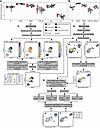 Figure 1
Overarching cell-type frequencies and overview of supervised clustering workflow. (A and B) Individual frequencies of the overarching cell types in the UK (A) and SE (B) cohorts. No differences reached significance after adjustment for multiple comparisons. (C–E) Supervised clustering workflow. In this case, CD8+ T cells are used as an example, but the workflow is identical for all cell types.
Identification of 2 CD8+ T cell and 1 NK cell cluster as robustly differentially abundant. As expected for any method prone to overfitting, most clusters identified with the abundance-supervised method were significant only in 1 or 2 comparisons. However, 3 clusters (CD8T#33, CD8T#34, and NK#49) differed in all 3 comparisons (Figure 2, A and B, and Table 2). In the UK and SE cohorts, respectively, these clusters comprised 9% and 16% (CD8T#33) and 3% and 2% (CD8T#34) of all CD8+ T cells and 6% and 8% (NK#49) of total NK cells (Table 2). In line with the results of the initial manual gating analysis (Supplemental Figure 5), no distinct B cell or CD4+ T cell populations differed, whereas the frequency of the 2 CD8+ T cell populations was a discriminating factor between MG subsets and controls. Both CD8+ T clusters were smaller in the LOMG group (i.e., LOMGlo) as compared with the EOMG group and controls. These 2 CD8+ T cell populations could be distinguished with a few markers; the naive CD8T#33 cluster by CCR7 positivity alone, and CD8T#34 by being CD45RAloCD7loCD161+ (Figure 2C, Table 2, and Supplemental Figure 6).
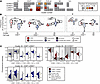 Figure 2
Identification and characterization of significantly different cell populations. (A) Overview of analyzed clusters and their respective significance in the iterative process. Dark red indicates significance in all 3 tests, which was the selection criterion for discriminatory clusters. Gray indicates that less than 50 cells were present in the SE data, so no comparisons were made. For all clusters where the significance was restricted to 1 or 2 populations, these came from the UK cohort. (B) Individual frequencies of the identified significantly different cell populations in the UK and SE cohorts. Mann-Whitney U tests were 1-sided for all comparisons, given that the cell populations were preidentified as over- or underrepresented in EOMG or LOMG compared with the other groups. *P = 0.05–0.005, **P = 0.005–0.0005, and ***P < 0.0005. As clusters have only been selected if all 3 independent comparisons had 1-tailed P values lower than 0.05, the false-positive error rate is 1/8,000, and with only 11 comparisons in total, no further adjustment for multiple comparisons was therefore included. (C) Selected surface markers defining the individual clusters in the UK dataset. The gray fields indicate gates that are sufficient to identify the significant cluster.
In addition, a cluster of NK cells, NK#49, was reduced in frequency in the EOMG group compared with the LOMG group and age-matched controls (i.e., EOMGlo). This cluster displayed a canonical, highly differentiated NK cell phenotype and could be distinguished from other NK cells by a combination of CD16, CD57, NKp30, CD2, and NKC2C (Figure 2C, Table 2, and Supplemental Figure 6). Thus, based on a 3-way comparison in the UK cohort replicated in the SE cohorts, we uncovered 3 differentially abundant cell populations.
Whole transcriptomic and T cell receptor profiling. The SE cohort was used for in-depth transcriptomic characterization of the 3 identified cell populations. First, expression of the 3 top genes in each population validated a corresponding transcriptomic signal for the imputed surface proteins (Figure 3A). SingleR was applied to annotate known cell types (18), indicating that CD8T#33 comprised naive CD8+ T cells (93%), CD8T#34 mucosa-associated invariant T (MAIT) cells (87%), and NK#49 conventional CD56dim NK cells (91%) (Figure 3B). To further characterize the latter, inhibitory killer Ig-like receptor (KIR) gene expression patterns were selectively analyzed, showing expression of KIR2DL1, KIR3DL1, KIR3DL2, and KIR2DL3, and low KIR2DL4 and KIR3DL3 expression, indicating a highly differentiated status (Supplemental Figure 7).
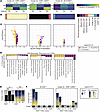 Figure 3
Characterization of significant cell populations. (A) Heatmaps indicating fraction of cells expressing genes among the top differentially expressed proteins for each of the 3 significant populations. Row 1 shows all cells apart from the population of interest and row 2 the population of interest. The 3 top proteins with a corresponding gene were selected for this analysis (the CD45RA isoform of CD45 not being useful in this context). (B) SingleR analysis identifying cluster 33 as naive CD8+ T cells, cluster 34 as MAIT cells, and cluster 49 as mature conventional NK cells. (C) Volcano plots indicating differentially expressed genes within the 3 cell subsets. (D) Top MGI mammalian phenotype terms associated with the top up- and downregulated genes for the respective cell populations. The length of the column is relative to the fraction of the total number of up- or downregulated genes for the cell subsets associated with the term. (E) Clonality and TCR Vβ chain family usage for the T cell populations. The first subfigure shows the distribution of clonality and TCR Vβ families for all CD8+ T cells, followed by columns for clusters 33 and 34. *P = 0.05–0.005, **P = 0.005–0.0005, and ***P < 0.0005. (F) Clonality and TCR Vβ split by MAIT TCRα chain usage. The first subfigure shows the distribution for all CD8+ T cells, whereas the second shows cluster 34. Color codes are the same as for E.
Next, compared with their corresponding cell types, differentially regulated genes for each of the clusters were identified (19): 401 upregulated, 370 downregulated for CD8T#33; 31 upregulated, 72 downregulated for CD8T#34; and 13 upregulated, 25 downregulated for NK#49 (Figure 3C and Supplemental Table 2). In a gene ontology analysis using EnrichR (20), cluster CD8T#33 was associated with T cell subset defects, CD8T#34 with broader hematopoietic defects, and NK#49 with B cell differentiation and decidual NK cells (Figure 3D and Table 2) (21).
As expected, T cell receptor (TCR) characteristics of the naive CD8T#33 cluster revealed a lower rate of clonality compared with the whole CD8+ T cell population (adjusted Fisher′s exact test P < 0.00001), whereas CD8T#34 did not (adjusted Fisher′s exact test P = 1) but displayed an increase of TCR-Vβ6 and reduction of TCR-Vβ7 (adjusted Fisher′s exact test P < 0.00001 in each case; Figure 3E and Table 2). Further, CD8T#34 TCR-α gene usage confirmed enrichment of MAIT cells (TCR-Vα7.2 and TCR-Jα33 in 26% of cells vs. 0.4% in the entire CD8+ T cell population; adjusted Fisher’s exact test P < 0.00001, Figure 3F and Table 2), with the most common prominent TCR-α phenotype being nonclonal MAIT cells expressing TCR-Vβ6 (11% of cells in CD8T#34 vs. 0.005% in the entire CD8+ T cell population; Fisher′s exact test P < 0.00001, Figure 3F and Table 2). In contrast, when comparing EOMG and LOMG in the SE cohort, the overall B cell receptor heavy gene mutation rates and TCR-beta gene V-family usage and clonality did not differ noticeably (data not shown).
Relation to thymic pathology and capacity to discriminate MG subgroup membership. Given the role of thymic hyperplasia in EOMG, we next investigated relationships between blood and thymic lymphocyte NK cells and the NK#49 cluster and thymic hyperplasia in a subcohort of 10 patients with paired samples available. There was a significant correlation between the NK#49 populations in the 2 compartments (Spearman’s ρ 0.83, P = 0.006, Figure 4A and Table 2), which, however, was not present for the total NK cell population (Spearman′s ρ 0.33, P = 0.34, Figure 4B). There was also a trend toward a negative correlation between the grade of hyperplasia and the logarithmic relative size of NK#49 in blood and thymic cell pools (Pearson′s correlation coefficients –0.59 and –0.66, respectively, adjusted P value 0.1 for both, Figure 4C and Table 2), which was considerably less pronounced for the entire NK cell population (Pearson′s correlation coefficients –0.42 and –0.41, adjusted P values 0.32 and 0.32, for logarithmic percentages of blood and thymic cells, respectively, Figure 4C). These findings point to a potential protective role for NK#49 in the control of thymic hyperplasia. Interestingly, the LOMG group showed a wide distribution of this subset, with partial overlap with the EOMG group.
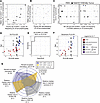 Figure 4
Thymic cell correlations and patient group discrimination. (A and B) Frequency of cluster 49 cells (A) and all other NK cells (B) in blood (y axes) as a function of the same cell population frequencies in thymus. Black dots indicate cluster 49 frequencies, whereas gray dots are the frequencies of NK cells after subtraction of cluster 49. (C) Frequency of cluster 49 in PBMCs and thymic cells from patients with EOMG in the UK cohort correlated to the grade of histopathological thymic hyperplasia. Colors have the same meaning as in A and B. (D) Partial least squares discriminant analysis based on the frequency of the 3 identified clusters, separating the patient populations in the UK cohort. Model generated only with the EOMG and LOMG myasthenia groups; post-thymectomy samples and control groups are merely displayed. (E) ROC curve based on the PLS-DA for the UK data. (F) The SE patient data displayed on the UK PLS-DA model, with the separation threshold inherited from the UK data. (G) Spider plot summing up some of the characteristics of the 3 identified discriminatory clusters. “Parent population” refers to all CD8+ T cells for clusters 33 and 34 and all NK cells for cluster 49.
Finally, we explored the capacity of the per-donor frequency of the differentially abundant clusters to correctly assign MG subgroup membership, using the UK cohort for training and the SE cohort for validation. Using partial least squares discriminant analysis, the optimally EOMG-LOMG separating vector based on the frequency of the 3 clusters was identified. This vector was influenced 35% by the frequency of cluster CD8T#33, 56% by CD8T#34, and 9% by NK#49 (Table 2 and Figure 4G). When it was used for classification of the UK cohort, 10 of 12 EOMG and 16 of 16 LOMG samples could be correctly classified (specificity of 100% and sensitivity of 83% for EOMG) (Figure 4, D and E). When the same vector and threshold was used for validation in the SE cohort, 8 of 8 EOMG and 5 of 6 LOMG samples were correctly classified (specificity 83%, sensitivity 100% for EOMG) (Figure 4F). Predicting whether a control individual was younger or older than 50 using the same vector and threshold was less successful (sensitivity 100% but specificity only 60% for young controls), indicating that the variance in the identified population frequencies is not only explained by age differences. Notably, 6 of 7 of the post-thymectomy EOMG samples and 2 of 3 and 2 of 2 of the uncertain cases in the UK and SE cohorts, respectively, were categorized as EOMG with this method. The single UK post-thymectomy EOMG sample that was wrongly categorized was slightly above the threshold and had moved 2% of the PLS-DA range from its pre-thymectomy value (Figure 4D). In summary, the identified cell populations (summarized in Figure 4G) differentiate EOMG and LOMG with reasonable sensitivity and specificity without consideration of any other distinguishing factors.


