
Abstract
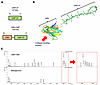
C-type natriuretic peptide (CNP) is known to promote chondrocyte proliferation and bone formation; however, CNP’s extremely short half-life necessitates continuous intravascular administration to achieve bone-lengthening effects. Vosoritide, a CNP analog designed for resistance to neutral endopeptidase, allows for once-daily administration. Nonetheless, it distributes systemically rather than localizing to target tissues, which may result in adverse effects such as hypotension. To enhance local drug delivery and therapeutic efficacy, we developed a potentially novel synthetic protein by fusing a collagen-binding domain (CBD) to CNP, termed CBD-CNP. This fusion protein exhibited stability under heat conditions and retained the collagen-binding ability and bioactivity as CNP. CBD-CNP localized to articular cartilage in fetal murine tibiae and promoted bone elongation. Spatial transcriptomic analysis revealed that the upregulation of chondromodulin expression may contribute to its therapeutic effects. Treatment of CBD-CNP mixed with collagen powder to a fracture site of a mouse model increased bone mineral content and bone volume compared with CNP-22. Intraarticular injection of CBD-CNP to a mouse model of knee osteoarthritis suppressed subchondral bone thickening. By addressing the limitations of CNP’s rapid degeneration, CBD-CNP leverages its collagen-binding capacity to achieve targeted, sustained delivery in collagen-rich tissues, offering a promising strategy for enhancing chondrogenesis and osteogenesis.
Authors
Kenta Hirai, Kenta Sawamura, Ryusaku Esaki, Ryusuke Sawada, Yuka Okusha, Eriko Aoyama, Hiroki Saito, Kentaro Uchida, Takehiko Mima, Satoshi Kubota, Hirokazu Tsukahara, Shiro Imagama, Masaki Matsushita, Osamu Matsushita, Yasuyuki Hosono
This file is in Adobe Acrobat (PDF) format. If you have not installed and configured the Adobe Acrobat Reader on your system.
Having trouble reading a PDF?
PDFs are designed to be printed out and read, but if you prefer to read them online, you may find it easier if you increase the view size to 125%.
Having trouble saving a PDF?
Many versions of the free Acrobat Reader do not allow Save. You must instead save the PDF from the JCI Online page you downloaded it from. PC users: Right-click on the Download link and choose the option that says something like "Save Link As...". Mac users should hold the mouse button down on the link to get these same options.
Having trouble printing a PDF?
- Try printing one page at a time or to a newer printer.
- Try saving the file to disk before printing rather than opening it "on the fly." This requires that you configure your browser to "Save" rather than "Launch Application" for the file type "application/pdf", and can usually be done in the "Helper Applications" options.
- Make sure you are using the latest version of Adobe's Acrobat Reader.


