
Abstract
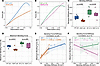
Amyotrophic lateral sclerosis (ALS) is a progressive motor neuron disease. Emerging evidence suggests manifestations beyond the neuromuscular system. Bone alterations are part of the ALS clinical picture; it remains unclear whether they are secondary to muscle denervation or due to an autonomous process. We investigated skeletal involvement in the SOD1(G93A) mouse model at presymptomatic (P45) and symptomatic (P110) stages through biomechanical and transcriptomic approaches. Three-point bending revealed significant reductions in femoral rigidity and maximum bending force in SOD1 mutants at P45, indicating early structural deficits. Micro-CT analysis demonstrated reduced trabecular bone mineral density and thickness at P45, with progressive trabecular loss and cortical thinning by P110. Histological examination revealed marked osteoblast loss at P45, suggesting impaired bone formation as the primary early mechanism. Transcriptomics of bulk bone and cultured osteoblasts from P45 mice identified dysregulation of bone differentiation, including downregulation of osteoblast differentiation genes and upregulation of negative regulators of ossification and increased cell senescence signatures. Unfolded protein response was upregulated in SOD1 osteoblasts. Immunohistochemistry confirmed the senescence phenotype with increased p16Ink4a level in SOD1 osteoblasts. These findings suggest that bone deterioration precedes overt motor symptoms and is linked to osteoblast premature senescence.
Authors
Burak Özkan, Jan-Moritz Ramge, Diana Wiesner, Jelena Scekic-Zahirovic, Stefano Antonucci, Sandra Nungeß, Dorothea Gebauer, Anita Ignatius, Jochen H. Weishaupt, Melanie Haffner-Luntzer, Francesco Roselli
This file is in Adobe Acrobat (PDF) format. If you have not installed and configured the Adobe Acrobat Reader on your system.
Having trouble reading a PDF?
PDFs are designed to be printed out and read, but if you prefer to read them online, you may find it easier if you increase the view size to 125%.
Having trouble saving a PDF?
Many versions of the free Acrobat Reader do not allow Save. You must instead save the PDF from the JCI Online page you downloaded it from. PC users: Right-click on the Download link and choose the option that says something like "Save Link As...". Mac users should hold the mouse button down on the link to get these same options.
Having trouble printing a PDF?
- Try printing one page at a time or to a newer printer.
- Try saving the file to disk before printing rather than opening it "on the fly." This requires that you configure your browser to "Save" rather than "Launch Application" for the file type "application/pdf", and can usually be done in the "Helper Applications" options.
- Make sure you are using the latest version of Adobe's Acrobat Reader.


