
Research ArticleAIDS/HIVInfectious diseaseVirology
Open Access |  10.1172/jci.insight.197308
Viral reservoir characteristics in lymphoid tissues of HIV-1 elite controllers
Samantha K. Marzi,1 Chloé M. Naasz,1 Leah Carrere,1 Carmen Gasca Capote,2 Isabelle C. Roseto,1 Ce Gao,1 Matthias Cavassini,3 Andrea Mastrangelo,4 Mathias Lichterfeld,1 Matthieu Perreau,4 and Xu G. Yu1
1Ragon Institute of MGB, MIT and Harvard and Infectious Disease Division, Brigham and Women’s Hospital, Boston, Massachusetts, USA.
2Instituto de Biomedicina de Sevilla and Spanish National Research Council, Seville, Spain.
3Division of Infectious Diseases and
4Division of Immunology and Allergy, Universite de Lausanne and Centre Hospitalier Universitaire Vaudois, Lausanne, Switzerland.
Address correspondence to: Xu Yu, Professor of Medicine, Ragon Institute of MGH, MIT and Harvard, 600 Main St., Cambridge, Massachusetts 02139, USA. Phone: 857.268.7004; Email: xyu@mgh.harvard.edu.
Authorship note: SKM and CMN are co–first authors.
Find articles by Marzi, S. in: PubMed | Google Scholar
1Ragon Institute of MGB, MIT and Harvard and Infectious Disease Division, Brigham and Women’s Hospital, Boston, Massachusetts, USA.
2Instituto de Biomedicina de Sevilla and Spanish National Research Council, Seville, Spain.
3Division of Infectious Diseases and
4Division of Immunology and Allergy, Universite de Lausanne and Centre Hospitalier Universitaire Vaudois, Lausanne, Switzerland.
Address correspondence to: Xu Yu, Professor of Medicine, Ragon Institute of MGH, MIT and Harvard, 600 Main St., Cambridge, Massachusetts 02139, USA. Phone: 857.268.7004; Email: xyu@mgh.harvard.edu.
Authorship note: SKM and CMN are co–first authors.
Find articles by Naasz, C. in: PubMed | Google Scholar
1Ragon Institute of MGB, MIT and Harvard and Infectious Disease Division, Brigham and Women’s Hospital, Boston, Massachusetts, USA.
2Instituto de Biomedicina de Sevilla and Spanish National Research Council, Seville, Spain.
3Division of Infectious Diseases and
4Division of Immunology and Allergy, Universite de Lausanne and Centre Hospitalier Universitaire Vaudois, Lausanne, Switzerland.
Address correspondence to: Xu Yu, Professor of Medicine, Ragon Institute of MGH, MIT and Harvard, 600 Main St., Cambridge, Massachusetts 02139, USA. Phone: 857.268.7004; Email: xyu@mgh.harvard.edu.
Authorship note: SKM and CMN are co–first authors.
Find articles by Carrere, L. in: PubMed | Google Scholar
1Ragon Institute of MGB, MIT and Harvard and Infectious Disease Division, Brigham and Women’s Hospital, Boston, Massachusetts, USA.
2Instituto de Biomedicina de Sevilla and Spanish National Research Council, Seville, Spain.
3Division of Infectious Diseases and
4Division of Immunology and Allergy, Universite de Lausanne and Centre Hospitalier Universitaire Vaudois, Lausanne, Switzerland.
Address correspondence to: Xu Yu, Professor of Medicine, Ragon Institute of MGH, MIT and Harvard, 600 Main St., Cambridge, Massachusetts 02139, USA. Phone: 857.268.7004; Email: xyu@mgh.harvard.edu.
Authorship note: SKM and CMN are co–first authors.
Find articles by Capote, C. in: PubMed | Google Scholar
1Ragon Institute of MGB, MIT and Harvard and Infectious Disease Division, Brigham and Women’s Hospital, Boston, Massachusetts, USA.
2Instituto de Biomedicina de Sevilla and Spanish National Research Council, Seville, Spain.
3Division of Infectious Diseases and
4Division of Immunology and Allergy, Universite de Lausanne and Centre Hospitalier Universitaire Vaudois, Lausanne, Switzerland.
Address correspondence to: Xu Yu, Professor of Medicine, Ragon Institute of MGH, MIT and Harvard, 600 Main St., Cambridge, Massachusetts 02139, USA. Phone: 857.268.7004; Email: xyu@mgh.harvard.edu.
Authorship note: SKM and CMN are co–first authors.
Find articles by Roseto, I. in: PubMed | Google Scholar
1Ragon Institute of MGB, MIT and Harvard and Infectious Disease Division, Brigham and Women’s Hospital, Boston, Massachusetts, USA.
2Instituto de Biomedicina de Sevilla and Spanish National Research Council, Seville, Spain.
3Division of Infectious Diseases and
4Division of Immunology and Allergy, Universite de Lausanne and Centre Hospitalier Universitaire Vaudois, Lausanne, Switzerland.
Address correspondence to: Xu Yu, Professor of Medicine, Ragon Institute of MGH, MIT and Harvard, 600 Main St., Cambridge, Massachusetts 02139, USA. Phone: 857.268.7004; Email: xyu@mgh.harvard.edu.
Authorship note: SKM and CMN are co–first authors.
Find articles by
Gao, C.
in:
PubMed
|
Google Scholar
|

1Ragon Institute of MGB, MIT and Harvard and Infectious Disease Division, Brigham and Women’s Hospital, Boston, Massachusetts, USA.
2Instituto de Biomedicina de Sevilla and Spanish National Research Council, Seville, Spain.
3Division of Infectious Diseases and
4Division of Immunology and Allergy, Universite de Lausanne and Centre Hospitalier Universitaire Vaudois, Lausanne, Switzerland.
Address correspondence to: Xu Yu, Professor of Medicine, Ragon Institute of MGH, MIT and Harvard, 600 Main St., Cambridge, Massachusetts 02139, USA. Phone: 857.268.7004; Email: xyu@mgh.harvard.edu.
Authorship note: SKM and CMN are co–first authors.
Find articles by Cavassini, M. in: PubMed | Google Scholar
1Ragon Institute of MGB, MIT and Harvard and Infectious Disease Division, Brigham and Women’s Hospital, Boston, Massachusetts, USA.
2Instituto de Biomedicina de Sevilla and Spanish National Research Council, Seville, Spain.
3Division of Infectious Diseases and
4Division of Immunology and Allergy, Universite de Lausanne and Centre Hospitalier Universitaire Vaudois, Lausanne, Switzerland.
Address correspondence to: Xu Yu, Professor of Medicine, Ragon Institute of MGH, MIT and Harvard, 600 Main St., Cambridge, Massachusetts 02139, USA. Phone: 857.268.7004; Email: xyu@mgh.harvard.edu.
Authorship note: SKM and CMN are co–first authors.
Find articles by Mastrangelo, A. in: PubMed | Google Scholar
1Ragon Institute of MGB, MIT and Harvard and Infectious Disease Division, Brigham and Women’s Hospital, Boston, Massachusetts, USA.
2Instituto de Biomedicina de Sevilla and Spanish National Research Council, Seville, Spain.
3Division of Infectious Diseases and
4Division of Immunology and Allergy, Universite de Lausanne and Centre Hospitalier Universitaire Vaudois, Lausanne, Switzerland.
Address correspondence to: Xu Yu, Professor of Medicine, Ragon Institute of MGH, MIT and Harvard, 600 Main St., Cambridge, Massachusetts 02139, USA. Phone: 857.268.7004; Email: xyu@mgh.harvard.edu.
Authorship note: SKM and CMN are co–first authors.
Find articles by Lichterfeld, M. in: PubMed | Google Scholar
1Ragon Institute of MGB, MIT and Harvard and Infectious Disease Division, Brigham and Women’s Hospital, Boston, Massachusetts, USA.
2Instituto de Biomedicina de Sevilla and Spanish National Research Council, Seville, Spain.
3Division of Infectious Diseases and
4Division of Immunology and Allergy, Universite de Lausanne and Centre Hospitalier Universitaire Vaudois, Lausanne, Switzerland.
Address correspondence to: Xu Yu, Professor of Medicine, Ragon Institute of MGH, MIT and Harvard, 600 Main St., Cambridge, Massachusetts 02139, USA. Phone: 857.268.7004; Email: xyu@mgh.harvard.edu.
Authorship note: SKM and CMN are co–first authors.
Find articles by Perreau, M. in: PubMed | Google Scholar
1Ragon Institute of MGB, MIT and Harvard and Infectious Disease Division, Brigham and Women’s Hospital, Boston, Massachusetts, USA.
2Instituto de Biomedicina de Sevilla and Spanish National Research Council, Seville, Spain.
3Division of Infectious Diseases and
4Division of Immunology and Allergy, Universite de Lausanne and Centre Hospitalier Universitaire Vaudois, Lausanne, Switzerland.
Address correspondence to: Xu Yu, Professor of Medicine, Ragon Institute of MGH, MIT and Harvard, 600 Main St., Cambridge, Massachusetts 02139, USA. Phone: 857.268.7004; Email: xyu@mgh.harvard.edu.
Authorship note: SKM and CMN are co–first authors.
Find articles by Yu, X. in: PubMed | Google Scholar
Published October 28, 2025 - More info
JCI Insight. 2025;10(23):e197308. https://doi.org/10.1172/jci.insight.197308.
© 2025 Marzi et al. This work is licensed under the Creative Commons Attribution 4.0 International License. To view a copy of this license, visit http://creativecommons.org/licenses/by/4.0/.
Received: June 27, 2025; Accepted: October 14, 2025

-
Results
Study participants. We focused our analysis on 2 ECs who were identified at the Lausanne University Hospital and followed over time. The first participant is female and was diagnosed with HIV-1 in 1992 at the age of 31. She never received ART and has maintained undetectable viremia since diagnosis, except for a single transient viral load of 148 copies/mL in 1996 (Figure 1A). Paired PBMC and inguinal LNMC samples were collected in 2013 and 2023, 21 and 31 years after diagnosis, respectively. Participant 1 has the protective HLA B*57 allele, and isolated viral sequences were classified as being clade A1 (Supplemental Table 1; supplemental material available online with this article; https://doi.org/10.1172/jci.insight.197308DS1). The second participant is also female and was diagnosed with HIV-1 in 2011, at the age of 44. She has also never been treated and has maintained undetectable viremia since diagnosis (Figure 1B). Paired PBMC and inguinal LNMC samples were collected in 2015 (4 years after diagnosis), and additional PBMC samples were collected in 2024 (13 years after diagnosis). Participant 2 also possesses the protective HLA B*57 allele, and isolated proviral sequences were classified as clade K (Supplemental Table 1). In both study participants, HIV-1 acquisition had likely occurred via sexual transmission.
 Figure 1
CD4+ T cell count and viral loads in the 2 ECs under investigation. (A and B) Graphs of viral loads and CD4+ T cell counts for Participant 1 (A) and Participant 2 (B). Open circles indicate RNA viral loads below the level of detection for the assay. Arrows indicate the time points at which the samples were collected.
Quantitative evolution of intact proviruses. To characterize the proviral reservoir landscape within the 2 types of tissues, we used near full-length individual proviral sequencing (FLIP-Seq) (22) and matched integration site and proviral sequencing (MIP-Seq) (23) assays. These techniques allow for the identification of both genome-intact and defective proviruses with their corresponding chromosomal locations at single-genome resolution.
In the PBMC sample collected 21 years after diagnosis from Participant 1, 13 of the total 122 proviruses detected in 13 million cells were identified as genome-intact. At the same time point in the LNMC sample, only 2 of the 75 total proviruses detected in 14 million cells were genome intact, corresponding to a 7-fold smaller intact reservoir in the LNMC sample. Thirty-one years after diagnosis, 5 intact proviruses of 27 total proviruses were detected in 16 million PBMCs, consistent with a 3-fold decline (from 1.01 copies/million PBMCs to 0.32 copies/million PBMCs) relative to the initial sample. In the lymph node sample collected 31 years after diagnosis, not a single intact provirus was detected out of 13 total proviruses in 18 million cells assayed, indicating at least a 10-fold lower frequency of intact proviruses in the lymph node compared with the contemporaneous blood sample and at least a 5-fold lower frequency of intact proviruses compared with the initial lymph node sample collected 10 years earlier (Figure 2, A and B, and Supplemental Table 2).
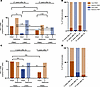 Figure 2
Quantification of the proviral reservoirs. (A and C) Relative frequencies of intact and defective HIV-1 proviral sequences per million cells in PBMC and LNMC samples of Participant 1 (A) and Participant 2 (C) across time points. “Dx” denotes diagnosis. Horizontal bars indicate calculated fold changes between sample types. (B and D) Percentages of intact and defective HIV-1 proviral sequences out of the total number of proviral sequences detected in PBMC and LNMC samples of Participant 1 (B) and Participant 2 (D) across time points.
For Participant 2, we detected 68 intact proviruses out of 128 total proviruses in 7 million PBMCs from a sample collected 4 years after diagnosis, reflecting a relative frequency of 9.22 genome-intact proviruses per million PBMCs. In the LNMC sample from the same time point, 10 intact proviruses were detected out of 67 total proviruses in 9 million analyzed cells (1.14 genome-intact proviruses/million cells), consistent with an approximately 8-fold lower frequency of intact proviruses in LNMCs relative to PBMCs. At the subsequent analysis time point 9 years later, we detected 9 intact proviruses out of 132 proviruses in a total of 18 million PBMCs analyzed (0.49 intact copies/million), consistent with a reduction by approximately 18-fold relative to the initial analysis time point (Figure 2, C and D, and Supplemental Table 2).
Clonality and integration site analysis. To better characterize the proviral reservoir cell composition, we utilized integration site loop amplification (24) to identify chromosomal locations of individual genome-intact proviruses, as described in our prior work (23). In PBMC samples collected from Participant 1 at 21 years after diagnosis, we detected 2 large clusters of sequence-identical intact proviruses, one of which was integrated into pericentromeric satellite DNA on Chromosome 12 and the other into pericentromeric satellite DNA on the upper arm of Chromosome 22. Genic chromosomal locations were only observed for 2 of the 13 individual genome-intact proviruses. Only 2 intact proviruses were detected in the lymph node at this same time point, and both of these were a part of the large clone integrated into satellite DNA on Chromosome 12 that was also detected in the PBMC sample. In the second time point collected 10 years later, the same clone in satellite DNA on Chromosome 12 was detected again in PBMCs, highlighting the ability of this clone to persist over 10 years. At the same time, we observed 3 clonal genome-intact proviruses integrated in a pericentromeric nongenic region in Chromosome 21; one member of this clone was also originally detected in the first time point. All intact proviruses detected at this time point were in nongenic locations. No intact proviruses were detected in the LNMC samples at all in this second time point (Figure 3, A and B, and Supplemental Table 3A). Defective proviruses were detected across both time points and tissue compartments, and they were primarily integrated into genic regions of the genome. Only 1 large clone of proviruses with a large deletion at the 3’ LTR end of the proviral genome was located in a nongenic region on Chromosome X, and this clone was detected in both the PBMC and LNMC samples collected at the first time point (Figure 3A).
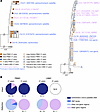 Figure 3
Integration site profile of proviruses detected in participant 1. (A) Phylogenetic trees of intact proviruses and defective proviruses with their integration sites. Clonality is indicated by a black box surrounding the sequence symbols. HXB2 is the HIV-1 reference sequence. Integration site locations are reported from the T2T reference human genome according to the UCSC human genome browser and NCBI RefSeq. Genic versus nongenic locations are indicated by text highlight color. (B) Pie charts showing the proportions of intact and defective HIV-1 sequences located in genic, centromeric/satellite, ZNF family, or other nongenic DNA regions in PBMC and LNMC across time points. There were no intact sequences identified in the 31-year time point, so it is labeled as not detectable (N.D.).
In Participant 2’s PBMC sample collected 4 years after diagnosis, we detected 4 different clones of reservoir cells with intact proviruses. Three of them, including the largest one, were integrated in the pericentromeric noncoding regions of Chromosome 10 and Chromosome 16, and in the nongenic region of Chromosome X. The second largest clone was integrated into the FNBP1 gene on Chromosome 9; this gene encodes for a protein involved in activating the focal adhesion kinase (FAK) and may promote cancer cell survival through activation of the PI3K/AKT/mTOR pathway (25). In the LNMC sample of the same time point, all but 1 intact provirus was detected in the pericentromeric region of Chromosome 10, the same chromosomal location (Chr10: 42427651) that made up the largest clone in the PBMC sample. At the second time point, 13 years after diagnosis, 2 more intact proviruses were detected within the clone integrated in Chromosome 10, consistent with clonal persistence over 9 years of viral control. Furthermore, at the second time point, an additional intact proviral clone was detected in the centromeric region of Chromosome 22. Interestingly, the large clone located in the FNBP1 gene on Chromosome 9 did not persist in the second time point at our level of detection (from 15 sequences in 7 million PBMCs 4 years after diagnosis to 0 sequences in 18 million PBMCs 13 years after diagnosis) (Figure 4A). Consistent with Participant 1 and other previously characterized ECs, the majority of defective proviruses detected were integrated into genic locations along the genome. In particular, several clones of proviruses with large deletions were detected, which were integrated in the NIBAN1 gene on Chromosome 1, the CYTH1 gene on Chromosome 17, and the STIM2 gene on Chromosome 4 (Figure 4, A and B, and Supplemental Table 3B). Persistence of defective proviruses in genic regions suggests that these proviruses are under limited immune selection pressure, presumably because sequence defects in HIV-1 proviruses reduce vulnerability to host immune recognition mechanisms.
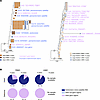 Figure 4
Integration site profile of proviruses detected in participant 2. (A) Phylogenetic trees of intact proviruses and defective proviruses with their integration sites. Clonality is indicated by a black box surrounding the sequence symbols. HXB2 is the HIV-1 reference sequence. Integration site locations are reported from the T2T reference human genome according to the UCSC human genome browser and NCBI RefSeq. Genic versus nongenic locations are indicated by text highlight color. (B) Pie charts showing the proportions of intact and defective HIV-1 sequences located in genic, centromeric/satellite, or other nongenic DNA regions in PBMC and LNMC across time points. It should be noted that there was no LNMC sample available for the 13-year time point.
HLA and CTL escape mutations. Since viral mutational escape in CTL epitopes has been previously reported in ECs (26, 27), we investigated the sequence diversification in HLA-B*57 epitopes of intact proviruses to infer immune selection pressure by cytotoxic T cells. In Participant 1, three of the 12 HLA-B*57 restricted epitopes displayed mutations previously linked to CTL immune escape (ISPRTLNAW, TSTLQEQIGW, KAAFDLSFF).This included the A146P mutation preceding the immunodominant ISW9 (ISPRTLNAW) gag epitope, which was detected in all genome-intact proviruses and has been linked to inhibiting CTL epitope processing, as it prevents proper peptide trimming by aminopeptidase I (28) (Supplemental Table 4A). The immunodominant TW10 (TSTLQEQIGW) gag epitope displayed a glycine (G) to arginine (R) switch at position 9; however, the canonical CTL escape mutation T3N G9A/E (29) was not detected. No sequence variation was detected in the immunodominant KF11 (KAFSPEVIPMF) gag epitope. The majority of CTL epitopes restricted by alternative HLA class I alleles displayed WT sequences. This, combined with the absence of major canonical variants in the TW10 and KF11 epitopes, suggest that infected cells from blood and lymph nodes in Participant 1 remain largely susceptible to CTL-dependent immune pressure.
Participant 2 displayed very little sequence adaptation to CTL immune pressure. Of the 12 HLA-B*57 CTL escape epitopes, only 2 epitopes (QASQEVKNW, KAAFDLSFF) were found to contain variants (S3T N8G; A2G) that could reflect escape from T cell immunity (Supplemental Table 4B). However, the immunodominant TW10, KF11, and ISW9 epitopes did not contain any mutations at all. The majority of HLA-A*2 and HLA-A*30 and HLA-B*15, including the immunodominant HLA-A*2–restricted SL9 (SLYNTVATL) gag epitope, were WT or contained mutations that are not known to be linked to CTL escape. Thus, Participant 2 displays limited evidence for CTL-driven sequence evolution in proviral sequences from blood and lymph nodes.


