
Abstract
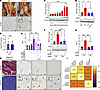
More than 1 in 4 men will undergo surgery for inguinal hernia, which is commonly associated with fibrotic degeneration of the lower abdominal muscle (LAM) in the groin region. Utilizing a male mouse model expressing the human aromatase gene (Aromhum), previous studies showed that locally produced estradiol acting via estrogen receptor α in LAM fibroblasts leads to fibrosis, myofiber atrophy, and hernia development. Here, we found that upregulation of progesterone receptor (PGR) in a LAM fibroblast population mediates this estrogenic effect. A PGR-selective progesterone antagonist in Aromhum mice decreased LAM fibrosis and atrophy, preventing hernia formation and stopping progression of existing hernias. Addition of progesterone to estradiol treatment was essential for early-onset development of LAM fibrosis and large hernias in wild-type mice, which was averted by a progesterone antagonist. Single-nuclei multiomics sequencing of herniated LAM revealed a unique population of Pgr-expressing fibroblasts that promotes fibrosis and myofiber atrophy through TGF-β2 signaling. Multiomics findings were validated in vivo in herniated LAM tissues of both mice and adult men. Our findings suggest an important and rare pathologic role of progesterone signaling in males and provide evidence for progesterone antagonists as a nonsurgical alternative for inguinal hernia management.
Authors
Tianming You, Mehrdad Zandigohar, Tanvi Potluri, Natalie Piehl, John S. Coon V, Elizabeth Baker, Maya Kafali, Yang Dai, Jonah J. Stulberg, David J. Escobar, Richard L. Lieber, Hong Zhao, Serdar E. Bulun
This file is in Adobe Acrobat (PDF) format. If you have not installed and configured the Adobe Acrobat Reader on your system.
Having trouble reading a PDF?
PDFs are designed to be printed out and read, but if you prefer to read them online, you may find it easier if you increase the view size to 125%.
Having trouble saving a PDF?
Many versions of the free Acrobat Reader do not allow Save. You must instead save the PDF from the JCI Online page you downloaded it from. PC users: Right-click on the Download link and choose the option that says something like "Save Link As...". Mac users should hold the mouse button down on the link to get these same options.
Having trouble printing a PDF?
- Try printing one page at a time or to a newer printer.
- Try saving the file to disk before printing rather than opening it "on the fly." This requires that you configure your browser to "Save" rather than "Launch Application" for the file type "application/pdf", and can usually be done in the "Helper Applications" options.
- Make sure you are using the latest version of Adobe's Acrobat Reader.


