
Clinical Research and Public HealthClinical ResearchInfectious disease
Open Access |  10.1172/jci.insight.192228
Virologic characteristics of SARS-CoV-2 infection across evolving Omicron subvariants
Julie Boucau,1 Owen T. Glover,1 Caitlin Marino,1 Gregory E. Edelstein,2 Manish C. Choudhary,2 Yijia Li,2,3 Brooke M. Leeman,2 Zahra Reynolds,4 Karry Su,4 Dessie Tien,4 Chase B. Mandell,4 Eliza Passell,4 Andrew Alexandrescu,4 Emory Abar,4 Mamadou Barry,4 Dibya Ghimire,4 Tammy D. Vyas,4 Jatin M. Vyas,4 Jacob E. Lemieux,4,5,6 Jonathan Z. Li,2,5 Mark J. Siedner,4,5,7 and Amy K. Barczak1,4,5
1Ragon Institute of Mass General Brigham, Cambridge, Massachusetts, USA.
2Brigham and Women’s Hospital, Boston, Massachusetts, USA.
3University of Pittsburgh Medical Center, Pittsburgh, Pennsylvania, USA.
4Massachusetts General Hospital, Boston, Massachusetts, USA.
5Harvard Medical School, Boston, Massachusetts, USA.
6Broad Institute, Cambridge, Massachusetts, USA.
7Africa Health Research Institute, KwaZulu-Natal, South Africa.
Address correspondence to: Amy K. Barczak, 600 Main Street, Cambridge, Massachusetts 02139, USA. Phone: 857.268.7143; Email: ABARCZAK@mgh.harvard.edu.
Authorship note: JEL, JZL, MJS, and AKB contributed equally to this work.
Find articles by
Boucau, J.
in:
PubMed
|
Google Scholar
|

1Ragon Institute of Mass General Brigham, Cambridge, Massachusetts, USA.
2Brigham and Women’s Hospital, Boston, Massachusetts, USA.
3University of Pittsburgh Medical Center, Pittsburgh, Pennsylvania, USA.
4Massachusetts General Hospital, Boston, Massachusetts, USA.
5Harvard Medical School, Boston, Massachusetts, USA.
6Broad Institute, Cambridge, Massachusetts, USA.
7Africa Health Research Institute, KwaZulu-Natal, South Africa.
Address correspondence to: Amy K. Barczak, 600 Main Street, Cambridge, Massachusetts 02139, USA. Phone: 857.268.7143; Email: ABARCZAK@mgh.harvard.edu.
Authorship note: JEL, JZL, MJS, and AKB contributed equally to this work.
Find articles by Glover, O. in: PubMed | Google Scholar
1Ragon Institute of Mass General Brigham, Cambridge, Massachusetts, USA.
2Brigham and Women’s Hospital, Boston, Massachusetts, USA.
3University of Pittsburgh Medical Center, Pittsburgh, Pennsylvania, USA.
4Massachusetts General Hospital, Boston, Massachusetts, USA.
5Harvard Medical School, Boston, Massachusetts, USA.
6Broad Institute, Cambridge, Massachusetts, USA.
7Africa Health Research Institute, KwaZulu-Natal, South Africa.
Address correspondence to: Amy K. Barczak, 600 Main Street, Cambridge, Massachusetts 02139, USA. Phone: 857.268.7143; Email: ABARCZAK@mgh.harvard.edu.
Authorship note: JEL, JZL, MJS, and AKB contributed equally to this work.
Find articles by Marino, C. in: PubMed | Google Scholar
1Ragon Institute of Mass General Brigham, Cambridge, Massachusetts, USA.
2Brigham and Women’s Hospital, Boston, Massachusetts, USA.
3University of Pittsburgh Medical Center, Pittsburgh, Pennsylvania, USA.
4Massachusetts General Hospital, Boston, Massachusetts, USA.
5Harvard Medical School, Boston, Massachusetts, USA.
6Broad Institute, Cambridge, Massachusetts, USA.
7Africa Health Research Institute, KwaZulu-Natal, South Africa.
Address correspondence to: Amy K. Barczak, 600 Main Street, Cambridge, Massachusetts 02139, USA. Phone: 857.268.7143; Email: ABARCZAK@mgh.harvard.edu.
Authorship note: JEL, JZL, MJS, and AKB contributed equally to this work.
Find articles by Edelstein, G. in: PubMed | Google Scholar
1Ragon Institute of Mass General Brigham, Cambridge, Massachusetts, USA.
2Brigham and Women’s Hospital, Boston, Massachusetts, USA.
3University of Pittsburgh Medical Center, Pittsburgh, Pennsylvania, USA.
4Massachusetts General Hospital, Boston, Massachusetts, USA.
5Harvard Medical School, Boston, Massachusetts, USA.
6Broad Institute, Cambridge, Massachusetts, USA.
7Africa Health Research Institute, KwaZulu-Natal, South Africa.
Address correspondence to: Amy K. Barczak, 600 Main Street, Cambridge, Massachusetts 02139, USA. Phone: 857.268.7143; Email: ABARCZAK@mgh.harvard.edu.
Authorship note: JEL, JZL, MJS, and AKB contributed equally to this work.
Find articles by
Choudhary, M.
in:
PubMed
|
Google Scholar
|
1Ragon Institute of Mass General Brigham, Cambridge, Massachusetts, USA.
2Brigham and Women’s Hospital, Boston, Massachusetts, USA.
3University of Pittsburgh Medical Center, Pittsburgh, Pennsylvania, USA.
4Massachusetts General Hospital, Boston, Massachusetts, USA.
5Harvard Medical School, Boston, Massachusetts, USA.
6Broad Institute, Cambridge, Massachusetts, USA.
7Africa Health Research Institute, KwaZulu-Natal, South Africa.
Address correspondence to: Amy K. Barczak, 600 Main Street, Cambridge, Massachusetts 02139, USA. Phone: 857.268.7143; Email: ABARCZAK@mgh.harvard.edu.
Authorship note: JEL, JZL, MJS, and AKB contributed equally to this work.
Find articles by
Li, Y.
in:
PubMed
|
Google Scholar
|
1Ragon Institute of Mass General Brigham, Cambridge, Massachusetts, USA.
2Brigham and Women’s Hospital, Boston, Massachusetts, USA.
3University of Pittsburgh Medical Center, Pittsburgh, Pennsylvania, USA.
4Massachusetts General Hospital, Boston, Massachusetts, USA.
5Harvard Medical School, Boston, Massachusetts, USA.
6Broad Institute, Cambridge, Massachusetts, USA.
7Africa Health Research Institute, KwaZulu-Natal, South Africa.
Address correspondence to: Amy K. Barczak, 600 Main Street, Cambridge, Massachusetts 02139, USA. Phone: 857.268.7143; Email: ABARCZAK@mgh.harvard.edu.
Authorship note: JEL, JZL, MJS, and AKB contributed equally to this work.
Find articles by Leeman, B. in: PubMed | Google Scholar
1Ragon Institute of Mass General Brigham, Cambridge, Massachusetts, USA.
2Brigham and Women’s Hospital, Boston, Massachusetts, USA.
3University of Pittsburgh Medical Center, Pittsburgh, Pennsylvania, USA.
4Massachusetts General Hospital, Boston, Massachusetts, USA.
5Harvard Medical School, Boston, Massachusetts, USA.
6Broad Institute, Cambridge, Massachusetts, USA.
7Africa Health Research Institute, KwaZulu-Natal, South Africa.
Address correspondence to: Amy K. Barczak, 600 Main Street, Cambridge, Massachusetts 02139, USA. Phone: 857.268.7143; Email: ABARCZAK@mgh.harvard.edu.
Authorship note: JEL, JZL, MJS, and AKB contributed equally to this work.
Find articles by
Reynolds, Z.
in:
PubMed
|
Google Scholar
|
1Ragon Institute of Mass General Brigham, Cambridge, Massachusetts, USA.
2Brigham and Women’s Hospital, Boston, Massachusetts, USA.
3University of Pittsburgh Medical Center, Pittsburgh, Pennsylvania, USA.
4Massachusetts General Hospital, Boston, Massachusetts, USA.
5Harvard Medical School, Boston, Massachusetts, USA.
6Broad Institute, Cambridge, Massachusetts, USA.
7Africa Health Research Institute, KwaZulu-Natal, South Africa.
Address correspondence to: Amy K. Barczak, 600 Main Street, Cambridge, Massachusetts 02139, USA. Phone: 857.268.7143; Email: ABARCZAK@mgh.harvard.edu.
Authorship note: JEL, JZL, MJS, and AKB contributed equally to this work.
Find articles by Su, K. in: PubMed | Google Scholar
1Ragon Institute of Mass General Brigham, Cambridge, Massachusetts, USA.
2Brigham and Women’s Hospital, Boston, Massachusetts, USA.
3University of Pittsburgh Medical Center, Pittsburgh, Pennsylvania, USA.
4Massachusetts General Hospital, Boston, Massachusetts, USA.
5Harvard Medical School, Boston, Massachusetts, USA.
6Broad Institute, Cambridge, Massachusetts, USA.
7Africa Health Research Institute, KwaZulu-Natal, South Africa.
Address correspondence to: Amy K. Barczak, 600 Main Street, Cambridge, Massachusetts 02139, USA. Phone: 857.268.7143; Email: ABARCZAK@mgh.harvard.edu.
Authorship note: JEL, JZL, MJS, and AKB contributed equally to this work.
Find articles by Tien, D. in: PubMed | Google Scholar
1Ragon Institute of Mass General Brigham, Cambridge, Massachusetts, USA.
2Brigham and Women’s Hospital, Boston, Massachusetts, USA.
3University of Pittsburgh Medical Center, Pittsburgh, Pennsylvania, USA.
4Massachusetts General Hospital, Boston, Massachusetts, USA.
5Harvard Medical School, Boston, Massachusetts, USA.
6Broad Institute, Cambridge, Massachusetts, USA.
7Africa Health Research Institute, KwaZulu-Natal, South Africa.
Address correspondence to: Amy K. Barczak, 600 Main Street, Cambridge, Massachusetts 02139, USA. Phone: 857.268.7143; Email: ABARCZAK@mgh.harvard.edu.
Authorship note: JEL, JZL, MJS, and AKB contributed equally to this work.
Find articles by Mandell, C. in: PubMed | Google Scholar
1Ragon Institute of Mass General Brigham, Cambridge, Massachusetts, USA.
2Brigham and Women’s Hospital, Boston, Massachusetts, USA.
3University of Pittsburgh Medical Center, Pittsburgh, Pennsylvania, USA.
4Massachusetts General Hospital, Boston, Massachusetts, USA.
5Harvard Medical School, Boston, Massachusetts, USA.
6Broad Institute, Cambridge, Massachusetts, USA.
7Africa Health Research Institute, KwaZulu-Natal, South Africa.
Address correspondence to: Amy K. Barczak, 600 Main Street, Cambridge, Massachusetts 02139, USA. Phone: 857.268.7143; Email: ABARCZAK@mgh.harvard.edu.
Authorship note: JEL, JZL, MJS, and AKB contributed equally to this work.
Find articles by Passell, E. in: PubMed | Google Scholar
1Ragon Institute of Mass General Brigham, Cambridge, Massachusetts, USA.
2Brigham and Women’s Hospital, Boston, Massachusetts, USA.
3University of Pittsburgh Medical Center, Pittsburgh, Pennsylvania, USA.
4Massachusetts General Hospital, Boston, Massachusetts, USA.
5Harvard Medical School, Boston, Massachusetts, USA.
6Broad Institute, Cambridge, Massachusetts, USA.
7Africa Health Research Institute, KwaZulu-Natal, South Africa.
Address correspondence to: Amy K. Barczak, 600 Main Street, Cambridge, Massachusetts 02139, USA. Phone: 857.268.7143; Email: ABARCZAK@mgh.harvard.edu.
Authorship note: JEL, JZL, MJS, and AKB contributed equally to this work.
Find articles by Alexandrescu, A. in: PubMed | Google Scholar
1Ragon Institute of Mass General Brigham, Cambridge, Massachusetts, USA.
2Brigham and Women’s Hospital, Boston, Massachusetts, USA.
3University of Pittsburgh Medical Center, Pittsburgh, Pennsylvania, USA.
4Massachusetts General Hospital, Boston, Massachusetts, USA.
5Harvard Medical School, Boston, Massachusetts, USA.
6Broad Institute, Cambridge, Massachusetts, USA.
7Africa Health Research Institute, KwaZulu-Natal, South Africa.
Address correspondence to: Amy K. Barczak, 600 Main Street, Cambridge, Massachusetts 02139, USA. Phone: 857.268.7143; Email: ABARCZAK@mgh.harvard.edu.
Authorship note: JEL, JZL, MJS, and AKB contributed equally to this work.
Find articles by Abar, E. in: PubMed | Google Scholar
1Ragon Institute of Mass General Brigham, Cambridge, Massachusetts, USA.
2Brigham and Women’s Hospital, Boston, Massachusetts, USA.
3University of Pittsburgh Medical Center, Pittsburgh, Pennsylvania, USA.
4Massachusetts General Hospital, Boston, Massachusetts, USA.
5Harvard Medical School, Boston, Massachusetts, USA.
6Broad Institute, Cambridge, Massachusetts, USA.
7Africa Health Research Institute, KwaZulu-Natal, South Africa.
Address correspondence to: Amy K. Barczak, 600 Main Street, Cambridge, Massachusetts 02139, USA. Phone: 857.268.7143; Email: ABARCZAK@mgh.harvard.edu.
Authorship note: JEL, JZL, MJS, and AKB contributed equally to this work.
Find articles by Barry, M. in: PubMed | Google Scholar
1Ragon Institute of Mass General Brigham, Cambridge, Massachusetts, USA.
2Brigham and Women’s Hospital, Boston, Massachusetts, USA.
3University of Pittsburgh Medical Center, Pittsburgh, Pennsylvania, USA.
4Massachusetts General Hospital, Boston, Massachusetts, USA.
5Harvard Medical School, Boston, Massachusetts, USA.
6Broad Institute, Cambridge, Massachusetts, USA.
7Africa Health Research Institute, KwaZulu-Natal, South Africa.
Address correspondence to: Amy K. Barczak, 600 Main Street, Cambridge, Massachusetts 02139, USA. Phone: 857.268.7143; Email: ABARCZAK@mgh.harvard.edu.
Authorship note: JEL, JZL, MJS, and AKB contributed equally to this work.
Find articles by Ghimire, D. in: PubMed | Google Scholar
1Ragon Institute of Mass General Brigham, Cambridge, Massachusetts, USA.
2Brigham and Women’s Hospital, Boston, Massachusetts, USA.
3University of Pittsburgh Medical Center, Pittsburgh, Pennsylvania, USA.
4Massachusetts General Hospital, Boston, Massachusetts, USA.
5Harvard Medical School, Boston, Massachusetts, USA.
6Broad Institute, Cambridge, Massachusetts, USA.
7Africa Health Research Institute, KwaZulu-Natal, South Africa.
Address correspondence to: Amy K. Barczak, 600 Main Street, Cambridge, Massachusetts 02139, USA. Phone: 857.268.7143; Email: ABARCZAK@mgh.harvard.edu.
Authorship note: JEL, JZL, MJS, and AKB contributed equally to this work.
Find articles by Vyas, T. in: PubMed | Google Scholar
1Ragon Institute of Mass General Brigham, Cambridge, Massachusetts, USA.
2Brigham and Women’s Hospital, Boston, Massachusetts, USA.
3University of Pittsburgh Medical Center, Pittsburgh, Pennsylvania, USA.
4Massachusetts General Hospital, Boston, Massachusetts, USA.
5Harvard Medical School, Boston, Massachusetts, USA.
6Broad Institute, Cambridge, Massachusetts, USA.
7Africa Health Research Institute, KwaZulu-Natal, South Africa.
Address correspondence to: Amy K. Barczak, 600 Main Street, Cambridge, Massachusetts 02139, USA. Phone: 857.268.7143; Email: ABARCZAK@mgh.harvard.edu.
Authorship note: JEL, JZL, MJS, and AKB contributed equally to this work.
Find articles by Vyas, J. in: PubMed | Google Scholar
1Ragon Institute of Mass General Brigham, Cambridge, Massachusetts, USA.
2Brigham and Women’s Hospital, Boston, Massachusetts, USA.
3University of Pittsburgh Medical Center, Pittsburgh, Pennsylvania, USA.
4Massachusetts General Hospital, Boston, Massachusetts, USA.
5Harvard Medical School, Boston, Massachusetts, USA.
6Broad Institute, Cambridge, Massachusetts, USA.
7Africa Health Research Institute, KwaZulu-Natal, South Africa.
Address correspondence to: Amy K. Barczak, 600 Main Street, Cambridge, Massachusetts 02139, USA. Phone: 857.268.7143; Email: ABARCZAK@mgh.harvard.edu.
Authorship note: JEL, JZL, MJS, and AKB contributed equally to this work.
Find articles by Lemieux, J. in: PubMed | Google Scholar
1Ragon Institute of Mass General Brigham, Cambridge, Massachusetts, USA.
2Brigham and Women’s Hospital, Boston, Massachusetts, USA.
3University of Pittsburgh Medical Center, Pittsburgh, Pennsylvania, USA.
4Massachusetts General Hospital, Boston, Massachusetts, USA.
5Harvard Medical School, Boston, Massachusetts, USA.
6Broad Institute, Cambridge, Massachusetts, USA.
7Africa Health Research Institute, KwaZulu-Natal, South Africa.
Address correspondence to: Amy K. Barczak, 600 Main Street, Cambridge, Massachusetts 02139, USA. Phone: 857.268.7143; Email: ABARCZAK@mgh.harvard.edu.
Authorship note: JEL, JZL, MJS, and AKB contributed equally to this work.
Find articles by
Li, J.
in:
PubMed
|
Google Scholar
|
1Ragon Institute of Mass General Brigham, Cambridge, Massachusetts, USA.
2Brigham and Women’s Hospital, Boston, Massachusetts, USA.
3University of Pittsburgh Medical Center, Pittsburgh, Pennsylvania, USA.
4Massachusetts General Hospital, Boston, Massachusetts, USA.
5Harvard Medical School, Boston, Massachusetts, USA.
6Broad Institute, Cambridge, Massachusetts, USA.
7Africa Health Research Institute, KwaZulu-Natal, South Africa.
Address correspondence to: Amy K. Barczak, 600 Main Street, Cambridge, Massachusetts 02139, USA. Phone: 857.268.7143; Email: ABARCZAK@mgh.harvard.edu.
Authorship note: JEL, JZL, MJS, and AKB contributed equally to this work.
Find articles by
Siedner, M.
in:
PubMed
|
Google Scholar
|
1Ragon Institute of Mass General Brigham, Cambridge, Massachusetts, USA.
2Brigham and Women’s Hospital, Boston, Massachusetts, USA.
3University of Pittsburgh Medical Center, Pittsburgh, Pennsylvania, USA.
4Massachusetts General Hospital, Boston, Massachusetts, USA.
5Harvard Medical School, Boston, Massachusetts, USA.
6Broad Institute, Cambridge, Massachusetts, USA.
7Africa Health Research Institute, KwaZulu-Natal, South Africa.
Address correspondence to: Amy K. Barczak, 600 Main Street, Cambridge, Massachusetts 02139, USA. Phone: 857.268.7143; Email: ABARCZAK@mgh.harvard.edu.
Authorship note: JEL, JZL, MJS, and AKB contributed equally to this work.
Find articles by
Barczak, A.
in:
PubMed
|
Google Scholar
|
Published September 9, 2025 - More info
JCI Insight. 2025;10(20):e192228. https://doi.org/10.1172/jci.insight.192228.
© 2025 Boucau et al. This work is licensed under the Creative Commons Attribution 4.0 International License. To view a copy of this license, visit http://creativecommons.org/licenses/by/4.0/.
Received: February 11, 2025; Accepted: September 4, 2025

-
Results
Cohort characteristics. We enrolled participants in a prospective longitudinal cohort of ambulatory, immunocompetent individuals with SARS-CoV-2 infection (Post-Vaccination Viral Characteristics Study, POSITIVES) (6–14) to compare virologic characteristics across Omicron subvariants. Inclusion criteria for this study included outpatient status, no immunosuppression, no antiviral treatment, at least 4 samples collected, and sequencing confirmation of the infecting strain as Omicron (Supplemental Figure 1; supplemental material available online with this article; https://doi.org/10.1172/jci.insight.192228DS1). Out of 300 enrollees in POSITIVES from December 2021 to September 2024 eligible for inclusion, 160 were excluded for collecting less than 4 samples (n = 11), receipt of antiviral treatment (n = 122), or an infecting variant other than Omicron (n = 27), resulting in an analytic cohort of 140 participants (Supplemental Figure 1). Participants self-collected an average of 6 nasal swabs over 15 days. Samples were analyzed by qPCR to quantify viral RNA, semiquantitative viral culture to assess the presence of replication-competent virus, and whole-genome sequencing to identify the infecting SARS-CoV-2 subvariant.
Subvariant groups. Using viral sequences, we classified the assigned Omicron variant into 5 subvariant groups: BA.1x (n = 35 participants), BA.2x (n = 17), BA.4/5x (n = 23), XBB.x (n = 40), and JN.x (n = 25) (Figure 1). Participants in the XBB.x and JN.x groups were older on average than participants in the BA.1x, BA.2x, and BA.4/5x groups (52, 54, 37, 39, and 36 years old on average, respectively, P = 0.043) (Table 1). Participants across the subvariant groups were similar in terms of sex, occurrence of symptoms before or during the study, and time between first positive SARS-CoV-2 test or first symptoms (whichever was earlier) and enrollment in the study. Median number of COVID-19 vaccinations increased (P = 0.0001) for more recent circulating subvariants, whereas days since last vaccination fluctuated over the observation period (P = 0.0034).
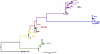 Figure 1
Phylogenetic tree representing the infecting Omicron subvariants in this study based on spike gene sequences (positions 21,565 to 24,025). Scale bar represents the number of nucleotide substitutions per site.
Virologic characteristics. We did not observe significant differences in median nasal SARS-CoV-2 RNA levels for the first sample collected (5.79–6.31 log10 RNA copies/mL, P = 0.63, Figure 2A), median peak RNA level (6.0–6.31 log10 RNA copies/mL, P = 0.82, Figure 2B), or days to reach peak RNA level (4–5 days from earliest of first positive test or symptom onset, P = 0.47, Figure 2C). Median days to negative PCR was similar across Omicron subvariants (12–14 days, P = 0.39, Figure 2D). We next assessed the median time for conversion to negative culture for all participants using a 50% tissue culture infectious dose (TCID50) assay. For the POSITIVES cohort, the TCID50 assay has previously been carried out on Vero-E6 cells (6–13). Using this established assay, median times for culture conversion were similar for BA.1x, BA.2x, BA.4/5x, and XBB.x subvariants (4–6 days, P = 0.52, Figure 3A). Unexpectedly, we observed a substantial discordance between nasal RNA level and viral culture for the JN.x subvariant, as JN.x samples showed no cytopathic effects on Vero-E6 cells even at high viral RNA levels. We hypothesized that JN.x may have evolved toward an alternate preferred mode of uptake into host cells. Using Vero-E6 cells overexpressing human ACE2 and TMPRSS2 (VeroE6-hACE2-hTMPRSS2, VAT), we tested the JN.x samples for cytopathic effect and were able to quantify TCID50 values. Using BA.1x and BA.4/5x samples, we confirmed that culture positivity on VAT cells reflected culture positivity on Vero-E6 cells at similar viral RNA levels (Supplemental Figure 2A), and that the median time for culture conversion for the BA.1x and BA.4/5x samples was not statistically different between the 2 cell lines (6–8 vs. 6–6.5 days, P = 0.08 and P = 0.23 respectively, Supplemental Figure 2B). For samples tested on VAT cells, the median times for culture conversion were 6.5–8 days for JN.x, BA.1x, and BA.4/5x (P = 0.28, Figure 3B). In comparing Cox proportional hazards models with and without vaccination status, we found modest increases in the hazard ratio (HR), suggesting faster time to viral culture clearance, for newer subvariants (Supplemental Table 2). This was particularly true for XBB.x, with HR increased to 1.85 (95% CI: 1.01–4.30) from 1.17 (95% CI: 0.74–1.87, P = 0.0045) after addition of vaccination status to the model. These results suggest that the similarity in viral clearance times seen in unadjusted models over time may partially be due to increasing immunity for more recent subvariants, which in turn may result in faster observed clearance of the virus.
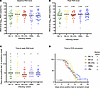 Figure 2
Baseline, peak, and clearance rates of SARS-CoV-2 RNA levels among Omicron subvariants. (A) Baseline viral RNA level (= first study nasal swab) for participants in BA.1x, BA.2x, BA.4/5x, XBB.x, and JN.x groups. P = 0.6371, Kruskal-Wallis test. (B) Peak viral RNA level for each participant in BA.1x, BA.2x, BA.4/5x, XBB.x, and JN.x groups. P = 0.8174, Kruskal-Wallis test. (C) Time to reach peak viral RNA level in days, counted from the day of first positive test or symptoms onset for each participant in BA.1x, BA.2x, BA.4/5x, XBB.x, and JN.x groups. P = 0.4688, Kruskal-Wallis test. (A–C) Dashed lines represent the median value for each group, which is reported above each group. (D) Kaplan-Meier survival curves showing time from initial positive SARS-CoV-2 test result or symptom onset until negative viral PCR for groups BA.1x, BA.2x, BA.4/5x, XBB.x, and JN.x. P = 0.3983, log-rank test.
 Figure 3
The duration of shedding live virus for Omicron subvariants. (A) Kaplan-Meier survival curves showing time from initial positive SARS-CoV-2 test result or symptom onset until negative viral culture on Vero-E6 cells for groups BA.1x, BA.2x, BA.4/5x, and XBB.x. P = 0.5178, log-rank test. (B) Kaplan-Meier survival curves showing time from initial positive SARS-CoV-2 test result or symptom onset until negative viral culture on VeroE6-hACE2-hTMPRSS2 (VAT) cells for groups BA.1x, BA.4/5x, and JN.x. P = 0.2783, Mantel-Cox log-rank test. (C) Logistic regression curves showing the probability (mean ± SEM) of positive viral culture on Vero-E6 cells for a range of viral RNA levels for groups BA.1x, BA.2x, BA.4/5x, and XBB.x. P < 0.001, Wald test; viral RNA level and variant category interaction terms from logistic regression model: BA.1x vs. BA.2x P = 0.004, BA.1x vs. BA.4/5x P = 0.871, BA.1x vs. XBB.x P = 0.018, BA.2x vs. BA.4/5x P = 0.004, XBB.x vs. BA.4/5x P = 0.018, and BA.2x vs. XBB.x P = 0.158 at 5 log10 copies RNA/mL. (D) Logistic regression curves showing the probability (mean ± SEM) of positive viral culture on VeroE6-hACE2-hTMPRSS2 cells for a range of viral RNA levels for groups BA.1x, BA.4/5x, and JN.x. P < 0.001, Wald test; viral RNA level and variant category interaction terms from logistic regression model: BA.1x vs. BA.4/5x P = 0.161, JN.x vs. BA.1x P = 0.051, and JN.x vs. BA.4/5x P = 0.545 at 5 log10 copies RNA/mL, JN.x vs. BA.1x P = 0.029 at 4 log10 copies RNA/mL.
We then calculated the probability of positive culture across different values of viral RNA for all studied subvariants by logistic regression. For each viral RNA level increase of 1 log10 unit, there was a 4-fold increase in odds ratio for a positive culture (P < 0.001). XBB.x and BA.2x were less likely to replicate on Vero-E6 cells at the same RNA levels (5 log10 RNA copies/mL) than BA.1x (P = 0.02 and P = 0.004, respectively) or BA.4/5x (P = 0.02 and P = 0.004, respectively) (Figure 3C). Similarly, JN.x was less likely than BA.1x (P = 0.03) to yield positive culture on VAT cells at the same RNA level (4 log10 RNA copies/mL) (Figure 3D). The threshold viral copy numbers for 50% probability of positive culture were lower for VAT cells than for Vero-E6 cells in both BA.1x and BA.4/5x (Supplemental Figure 2C and Supplemental Table 1).
Symptom characteristics. Together with the virus and background population immunity, public health guidance has evolved over the course of the pandemic. Current guidance for respiratory viruses is based primarily on symptoms (5). We thus explored how well symptoms correlate with the virologic course of infection. All but 1 participant reported symptoms at some point during observation (Table 1). The number of peak symptoms (3 symptoms, P = 0.64, Figure 4A) and time to peak symptoms (4–5 days, P = 0.25, Figure 4B) did not differ across Omicron subvariants. When binned by days since positive test or symptom onset (1–3, 4–6 or 7–10 days), the number of symptoms also did not vary by subvariant (Figure 4C and Supplemental Figure 3). We next sought to understand what proportion of individuals are shedding replication-competent virus and thus potentially still infectious at the time they stop isolating (Figure 4D). Using current US Centers for Disease Control and Prevention (CDC) guidelines as a metric for when individuals are likely to leave isolation (5), we found that 34% (95% CI: 27.5%–42.9%) of individuals continue to shed replication-competent virus at the time that they met criteria for ending isolation for BA.1x, BA.2x, BA.4/5x, and XBB.x (based on TCID50 assays carried out on Vero-E6 cells, Supplemental Figure 4A). For BA.1x, BA.4/5x, and JN.x (based on TCID50 assays carried out on VAT cells), the proportion of participants still shedding was 64.9% (95% CI: 56.00%–77.78%). Moreover, 8.1% (95% CI: 4.35%–14.29%) of individuals continued to shed replication-competent virus at the end of the recommended masking period in the BA.1x, BA.2x, BA.4/5x, and XBB.x groups (based on Vero-E6 assays, Supplemental Figure 4B) and 19.3% (95% CI: 11.11%–32.0%) for BA.1x, BA.4/5x, and JN.x groups (based on the VAT assays). We did not find evidence that these proportions differed among subvariants. Eight-four percent of participants had 1 or more symptoms when they stopped shedding replication-competent virus, and 55% had 2 or more symptoms (Supplemental Figure 4C). Interestingly, 13 out of 140 (9.29%) participants reported no symptoms on at least one day they submitted nasal swabs containing culturable virus. Fever is a prominent feature of symptom-based guidelines (5). However, across subvariants, less than 15% of individuals reported fever at any point during the course of infection (Supplemental Figure 4D). We compared how limiting the symptoms to only cough and congestion affected the relationship between symptoms and viral shedding. Although moderately better, using only 2 symptoms did not improve the predictability of viral shedding duration based on symptoms (Supplemental Table 3).
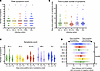 Figure 4
Symptom characteristics among Omicron subvariants. (A) Peak number of symptoms for each participant in BA.1x, BA.2x, BA.4/5x, XBB.x, and JN.x groups. P = 0.6454, Kruskal-Wallis test. (B) Time to reach peak number of symptoms in days, counted from the day of first positive test or symptoms onset for each participant in BA.1x, BA.2x, BA.4/5x, XBB.x, and JN.x groups. P = 0.2487, Kruskal-Wallis test. (A and B) Median values are reported above each group. (C) Number of symptoms at days 1–3, 4–6, and 7–10 for groups BA.1x, BA.2x, BA.4/5x, XBB.x, and JN.x. P = 0.2428 for days 1–3, P = 0.4658 for days 4–6, P = 0.1178 for days 7–10, Kruskal-Wallis test. (D) Time between end of isolation and conversion to negative viral culture for BA.1x, BA.2x, BA.4/5x, and XBB.x on Vero-E6 cells and for BA.1x, BA.4/5x, and JN.x on VAT cells. P = 0.2382 for Vero-E6, P = 0.6450 for VAT, Kruskal-Wallis test (A–D). Dashed lines represent the median value for each group.


