
Abstract
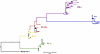
BACKGROUND SARS-CoV-2 has evolved subvariants since the emergence of the Omicron variant in 2021. Whether these changes impact viral shedding and transmissibility is not known.METHODS POSITIVES is a prospective longitudinal cohort of individuals with mild SARS-CoV-2 infection. Ambulatory, immunocompetent participants who did not receive antivirals self-administered 6 anterior nasal swabs over 15 days. Samples were analyzed by qPCR to quantify viral RNA, semiquantitative viral culture to detect shedding of replication-competent virus, and whole-genome sequencing to classify subvariants. Our predictor of interest was Omicron subvariants: BA.1x, BA.2x, BA.4/5x, XBB.x, and JN.x. Outcomes included RNA levels and duration of shedding replication-competent virus. We additionally explored whether symptoms are a valid marker for ending isolation.RESULTS The median peak nasal SARS-CoV-2 RNA (6.0–6.3 log10 RNA copies/mL), median days to peak RNA (4–5 days), median days to undetectable viral RNA (12–14 days), and median days to negative viral culture (4–8 days) were similar across Omicron subvariants. Number and duration of symptoms were also similar. For all subvariants, a sizeable percentage (range 27.5%–56.0%) shed replication-competent virus after fever resolution and improvement of symptoms.CONCLUSION Despite ongoing viral evolution, key aspects of viral dynamics of SARS-CoV-2 infection, including the duration of shedding replication-competent virus, have not substantially changed across Omicron subvariants. Replication-competent shedding of these subvariants is detected for a large proportion of people who meet criteria for ending isolation.FUNDING NIH (U19 AI110818, R01 AI176287, K24 HL166024), the Massachusetts Consortium on Pathogen Readiness, and the Massachusetts General Hospital Department of Medicine.
Authors
Julie Boucau, Owen T. Glover, Caitlin Marino, Gregory E. Edelstein, Manish C. Choudhary, Yijia Li, Brooke M. Leeman, Zahra Reynolds, Karry Su, Dessie Tien, Chase B. Mandell, Eliza Passell, Andrew Alexandrescu, Emory Abar, Mamadou Barry, Dibya Ghimire, Tammy D. Vyas, Jatin M. Vyas, Jacob E. Lemieux, Jonathan Z. Li, Mark J. Siedner, Amy K. Barczak
This file is in Adobe Acrobat (PDF) format. If you have not installed and configured the Adobe Acrobat Reader on your system.
Having trouble reading a PDF?
PDFs are designed to be printed out and read, but if you prefer to read them online, you may find it easier if you increase the view size to 125%.
Having trouble saving a PDF?
Many versions of the free Acrobat Reader do not allow Save. You must instead save the PDF from the JCI Online page you downloaded it from. PC users: Right-click on the Download link and choose the option that says something like "Save Link As...". Mac users should hold the mouse button down on the link to get these same options.
Having trouble printing a PDF?
- Try printing one page at a time or to a newer printer.
- Try saving the file to disk before printing rather than opening it "on the fly." This requires that you configure your browser to "Save" rather than "Launch Application" for the file type "application/pdf", and can usually be done in the "Helper Applications" options.
- Make sure you are using the latest version of Adobe's Acrobat Reader.


