
Research ArticleGeneticsReproductive biology
Open Access |  10.1172/jci.insight.191122
Genetic variants in HELB contribute to premature ovarian insufficiency and early age of natural menopause
Yuncheng Pan,1 Yuexin Yu,1 Jitong Mo,1 Shuting Ren,1 Zixue Zhou,1 Xi Yang,1 Yiqing Liu,1 Feng Zhang,2 Yanqin You,3 Xiaojin Zhang,4 and Yanhua Wu1,5
1School of Life Sciences, Human Phenome Institute, Fudan University, Shanghai, China.
2The Second Affiliated Hospital, Institute of Biomedical Innovation, Jiangxi Academy of Medical Sciences, Jiangxi Medical College, Nanchang University, Nanchang, China.
3Senior Department of Obstetrics and Gynecology, Chinese PLA General Hospital, Beijing, China.
4Obstetrics and Gynecology Hospital, Institute of Reproduction and Development, and
5National Demonstration Center for Experimental Biology Education, Fudan University, Shanghai, China.
Address correspondence to: Feng Zhang, Nanchang University, 999 Xuefu Ave., Nanchang (330031), China. Email: zhangfeng@ncu.edu.cn. Or to: Yanqin You, Chinese PLA General Hospital, 28 Fuxing Rd., Beijing (100853), China. Email: youyanqin76@163.com. Or to Xiaojin Zhang or Yanhua Wu, Fudan University, 220 Handan Rd., Shanghai (200433), China. Email: zxjgcp@sina.com (XZ); yanhuawu@fudan.edu.cn (YW).
Authorship note: YP, Y Yu, and JM contributed equally to this work.
Find articles by Pan, Y. in: PubMed | Google Scholar
1School of Life Sciences, Human Phenome Institute, Fudan University, Shanghai, China.
2The Second Affiliated Hospital, Institute of Biomedical Innovation, Jiangxi Academy of Medical Sciences, Jiangxi Medical College, Nanchang University, Nanchang, China.
3Senior Department of Obstetrics and Gynecology, Chinese PLA General Hospital, Beijing, China.
4Obstetrics and Gynecology Hospital, Institute of Reproduction and Development, and
5National Demonstration Center for Experimental Biology Education, Fudan University, Shanghai, China.
Address correspondence to: Feng Zhang, Nanchang University, 999 Xuefu Ave., Nanchang (330031), China. Email: zhangfeng@ncu.edu.cn. Or to: Yanqin You, Chinese PLA General Hospital, 28 Fuxing Rd., Beijing (100853), China. Email: youyanqin76@163.com. Or to Xiaojin Zhang or Yanhua Wu, Fudan University, 220 Handan Rd., Shanghai (200433), China. Email: zxjgcp@sina.com (XZ); yanhuawu@fudan.edu.cn (YW).
Authorship note: YP, Y Yu, and JM contributed equally to this work.
Find articles by Yu, Y. in: PubMed | Google Scholar
1School of Life Sciences, Human Phenome Institute, Fudan University, Shanghai, China.
2The Second Affiliated Hospital, Institute of Biomedical Innovation, Jiangxi Academy of Medical Sciences, Jiangxi Medical College, Nanchang University, Nanchang, China.
3Senior Department of Obstetrics and Gynecology, Chinese PLA General Hospital, Beijing, China.
4Obstetrics and Gynecology Hospital, Institute of Reproduction and Development, and
5National Demonstration Center for Experimental Biology Education, Fudan University, Shanghai, China.
Address correspondence to: Feng Zhang, Nanchang University, 999 Xuefu Ave., Nanchang (330031), China. Email: zhangfeng@ncu.edu.cn. Or to: Yanqin You, Chinese PLA General Hospital, 28 Fuxing Rd., Beijing (100853), China. Email: youyanqin76@163.com. Or to Xiaojin Zhang or Yanhua Wu, Fudan University, 220 Handan Rd., Shanghai (200433), China. Email: zxjgcp@sina.com (XZ); yanhuawu@fudan.edu.cn (YW).
Authorship note: YP, Y Yu, and JM contributed equally to this work.
Find articles by Mo, J. in: PubMed | Google Scholar
1School of Life Sciences, Human Phenome Institute, Fudan University, Shanghai, China.
2The Second Affiliated Hospital, Institute of Biomedical Innovation, Jiangxi Academy of Medical Sciences, Jiangxi Medical College, Nanchang University, Nanchang, China.
3Senior Department of Obstetrics and Gynecology, Chinese PLA General Hospital, Beijing, China.
4Obstetrics and Gynecology Hospital, Institute of Reproduction and Development, and
5National Demonstration Center for Experimental Biology Education, Fudan University, Shanghai, China.
Address correspondence to: Feng Zhang, Nanchang University, 999 Xuefu Ave., Nanchang (330031), China. Email: zhangfeng@ncu.edu.cn. Or to: Yanqin You, Chinese PLA General Hospital, 28 Fuxing Rd., Beijing (100853), China. Email: youyanqin76@163.com. Or to Xiaojin Zhang or Yanhua Wu, Fudan University, 220 Handan Rd., Shanghai (200433), China. Email: zxjgcp@sina.com (XZ); yanhuawu@fudan.edu.cn (YW).
Authorship note: YP, Y Yu, and JM contributed equally to this work.
Find articles by Ren, S. in: PubMed | Google Scholar
1School of Life Sciences, Human Phenome Institute, Fudan University, Shanghai, China.
2The Second Affiliated Hospital, Institute of Biomedical Innovation, Jiangxi Academy of Medical Sciences, Jiangxi Medical College, Nanchang University, Nanchang, China.
3Senior Department of Obstetrics and Gynecology, Chinese PLA General Hospital, Beijing, China.
4Obstetrics and Gynecology Hospital, Institute of Reproduction and Development, and
5National Demonstration Center for Experimental Biology Education, Fudan University, Shanghai, China.
Address correspondence to: Feng Zhang, Nanchang University, 999 Xuefu Ave., Nanchang (330031), China. Email: zhangfeng@ncu.edu.cn. Or to: Yanqin You, Chinese PLA General Hospital, 28 Fuxing Rd., Beijing (100853), China. Email: youyanqin76@163.com. Or to Xiaojin Zhang or Yanhua Wu, Fudan University, 220 Handan Rd., Shanghai (200433), China. Email: zxjgcp@sina.com (XZ); yanhuawu@fudan.edu.cn (YW).
Authorship note: YP, Y Yu, and JM contributed equally to this work.
Find articles by Zhou, Z. in: PubMed | Google Scholar
1School of Life Sciences, Human Phenome Institute, Fudan University, Shanghai, China.
2The Second Affiliated Hospital, Institute of Biomedical Innovation, Jiangxi Academy of Medical Sciences, Jiangxi Medical College, Nanchang University, Nanchang, China.
3Senior Department of Obstetrics and Gynecology, Chinese PLA General Hospital, Beijing, China.
4Obstetrics and Gynecology Hospital, Institute of Reproduction and Development, and
5National Demonstration Center for Experimental Biology Education, Fudan University, Shanghai, China.
Address correspondence to: Feng Zhang, Nanchang University, 999 Xuefu Ave., Nanchang (330031), China. Email: zhangfeng@ncu.edu.cn. Or to: Yanqin You, Chinese PLA General Hospital, 28 Fuxing Rd., Beijing (100853), China. Email: youyanqin76@163.com. Or to Xiaojin Zhang or Yanhua Wu, Fudan University, 220 Handan Rd., Shanghai (200433), China. Email: zxjgcp@sina.com (XZ); yanhuawu@fudan.edu.cn (YW).
Authorship note: YP, Y Yu, and JM contributed equally to this work.
Find articles by Yang, X. in: PubMed | Google Scholar
1School of Life Sciences, Human Phenome Institute, Fudan University, Shanghai, China.
2The Second Affiliated Hospital, Institute of Biomedical Innovation, Jiangxi Academy of Medical Sciences, Jiangxi Medical College, Nanchang University, Nanchang, China.
3Senior Department of Obstetrics and Gynecology, Chinese PLA General Hospital, Beijing, China.
4Obstetrics and Gynecology Hospital, Institute of Reproduction and Development, and
5National Demonstration Center for Experimental Biology Education, Fudan University, Shanghai, China.
Address correspondence to: Feng Zhang, Nanchang University, 999 Xuefu Ave., Nanchang (330031), China. Email: zhangfeng@ncu.edu.cn. Or to: Yanqin You, Chinese PLA General Hospital, 28 Fuxing Rd., Beijing (100853), China. Email: youyanqin76@163.com. Or to Xiaojin Zhang or Yanhua Wu, Fudan University, 220 Handan Rd., Shanghai (200433), China. Email: zxjgcp@sina.com (XZ); yanhuawu@fudan.edu.cn (YW).
Authorship note: YP, Y Yu, and JM contributed equally to this work.
Find articles by Liu, Y. in: PubMed | Google Scholar
1School of Life Sciences, Human Phenome Institute, Fudan University, Shanghai, China.
2The Second Affiliated Hospital, Institute of Biomedical Innovation, Jiangxi Academy of Medical Sciences, Jiangxi Medical College, Nanchang University, Nanchang, China.
3Senior Department of Obstetrics and Gynecology, Chinese PLA General Hospital, Beijing, China.
4Obstetrics and Gynecology Hospital, Institute of Reproduction and Development, and
5National Demonstration Center for Experimental Biology Education, Fudan University, Shanghai, China.
Address correspondence to: Feng Zhang, Nanchang University, 999 Xuefu Ave., Nanchang (330031), China. Email: zhangfeng@ncu.edu.cn. Or to: Yanqin You, Chinese PLA General Hospital, 28 Fuxing Rd., Beijing (100853), China. Email: youyanqin76@163.com. Or to Xiaojin Zhang or Yanhua Wu, Fudan University, 220 Handan Rd., Shanghai (200433), China. Email: zxjgcp@sina.com (XZ); yanhuawu@fudan.edu.cn (YW).
Authorship note: YP, Y Yu, and JM contributed equally to this work.
Find articles by Zhang, F. in: PubMed | Google Scholar
1School of Life Sciences, Human Phenome Institute, Fudan University, Shanghai, China.
2The Second Affiliated Hospital, Institute of Biomedical Innovation, Jiangxi Academy of Medical Sciences, Jiangxi Medical College, Nanchang University, Nanchang, China.
3Senior Department of Obstetrics and Gynecology, Chinese PLA General Hospital, Beijing, China.
4Obstetrics and Gynecology Hospital, Institute of Reproduction and Development, and
5National Demonstration Center for Experimental Biology Education, Fudan University, Shanghai, China.
Address correspondence to: Feng Zhang, Nanchang University, 999 Xuefu Ave., Nanchang (330031), China. Email: zhangfeng@ncu.edu.cn. Or to: Yanqin You, Chinese PLA General Hospital, 28 Fuxing Rd., Beijing (100853), China. Email: youyanqin76@163.com. Or to Xiaojin Zhang or Yanhua Wu, Fudan University, 220 Handan Rd., Shanghai (200433), China. Email: zxjgcp@sina.com (XZ); yanhuawu@fudan.edu.cn (YW).
Authorship note: YP, Y Yu, and JM contributed equally to this work.
Find articles by You, Y. in: PubMed | Google Scholar
1School of Life Sciences, Human Phenome Institute, Fudan University, Shanghai, China.
2The Second Affiliated Hospital, Institute of Biomedical Innovation, Jiangxi Academy of Medical Sciences, Jiangxi Medical College, Nanchang University, Nanchang, China.
3Senior Department of Obstetrics and Gynecology, Chinese PLA General Hospital, Beijing, China.
4Obstetrics and Gynecology Hospital, Institute of Reproduction and Development, and
5National Demonstration Center for Experimental Biology Education, Fudan University, Shanghai, China.
Address correspondence to: Feng Zhang, Nanchang University, 999 Xuefu Ave., Nanchang (330031), China. Email: zhangfeng@ncu.edu.cn. Or to: Yanqin You, Chinese PLA General Hospital, 28 Fuxing Rd., Beijing (100853), China. Email: youyanqin76@163.com. Or to Xiaojin Zhang or Yanhua Wu, Fudan University, 220 Handan Rd., Shanghai (200433), China. Email: zxjgcp@sina.com (XZ); yanhuawu@fudan.edu.cn (YW).
Authorship note: YP, Y Yu, and JM contributed equally to this work.
Find articles by Zhang, X. in: PubMed | Google Scholar
1School of Life Sciences, Human Phenome Institute, Fudan University, Shanghai, China.
2The Second Affiliated Hospital, Institute of Biomedical Innovation, Jiangxi Academy of Medical Sciences, Jiangxi Medical College, Nanchang University, Nanchang, China.
3Senior Department of Obstetrics and Gynecology, Chinese PLA General Hospital, Beijing, China.
4Obstetrics and Gynecology Hospital, Institute of Reproduction and Development, and
5National Demonstration Center for Experimental Biology Education, Fudan University, Shanghai, China.
Address correspondence to: Feng Zhang, Nanchang University, 999 Xuefu Ave., Nanchang (330031), China. Email: zhangfeng@ncu.edu.cn. Or to: Yanqin You, Chinese PLA General Hospital, 28 Fuxing Rd., Beijing (100853), China. Email: youyanqin76@163.com. Or to Xiaojin Zhang or Yanhua Wu, Fudan University, 220 Handan Rd., Shanghai (200433), China. Email: zxjgcp@sina.com (XZ); yanhuawu@fudan.edu.cn (YW).
Authorship note: YP, Y Yu, and JM contributed equally to this work.
Find articles by Wu, Y. in: PubMed | Google Scholar
Published November 10, 2025 - More info
JCI Insight. 2025;10(21):e191122. https://doi.org/10.1172/jci.insight.191122.
© 2025 Pan et al. This work is licensed under the Creative Commons Attribution 4.0 International License. To view a copy of this license, visit http://creativecommons.org/licenses/by/4.0/.
Received: January 9, 2025; Accepted: September 18, 2025

-
Results
Identifying a heterozygous missense variant of HELB in a Chinese family with POI and early menopause. The proband in the affected Chinese family (participant III-1, Figure 1A) experienced normal menarche at 14 years of age. After experiencing irregular menstruation for about 1 year, she was diagnosed with POI at the age of 35 years. Her FSH levels were 77.54 IU/L, and an ultrasound examination revealed small ovaries with undetectable follicles (Table 1). The patient had no history of ovarian surgery, chemotherapy, radiotherapy, or autoimmune disease. Premutation or full mutation of the FMR1 gene was excluded. A family history revealed that the proband’s grandmother and mother (participants I-2 and II-1) both experienced secondary amenorrhea at ages 30 and 38, respectively.
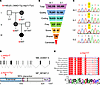 Figure 1
Identification of a deleterious variant of HELB in a Chinese family with POI and early menopause. (A) A heterozygous missense variant (M) c.349G>T (p.Asp117Tyr) of HELB was identified in a Chinese family with POI and early menopause. The black-filled symbol indicates the proband with POI, and gray-filled symbols represent family members affected with early menopause. (B) Flowchart of WES filtering strategies based on quality, frequency, deleteriousness, and biological significance. Filters include quality (variants with high/medium calling quality: sequencing depth > 30, genotype quality > 30, no low-quality calls); coding (exonic or splice site variants); Freq (minor allele frequencies < 0.001 in the 1000 Genomes Project [1000g], gnomAD, and ExAC databases); score (variants predicted to be damaging by SIFT, PolyPhen-2, MutationTaster, and CADD_phred > 25); and shared (variants shared by III-1 and II-1). (C) Sanger sequencing confirmation of the HELB variants in affected individuals. The mutated positions are highlighted in yellow. (D) Schematic representation of human genomic HELB (NM_033647.5) and human HELB protein (NP_387467.2). The mutated positions are indicated by red dots. (E) Conservation analysis of HELB amino acid residues across species. The red arrow indicates the Asp117 residue affected by the identified variant.
To identify genetic variants associated with POI or early menopause in this family, WES was performed on participants II-1 and III-1. Variants shared between the proband and her mother were considered in the genetic analysis (Figure 1B). Briefly, after excluding low-quality variants and noncoding sequences, we included variants with a MAF < 0.1% in the 1000g, gnomAD, and ExAC databases. Subsequently, nonsense variants, frameshift and non-frameshift indels, splicing variants affecting 1–3 residues at splicing sites, and missense variants predicted to be deleterious by in silico tools (SIFT, PolyPhen-2, MutationTaster, CADD) were retained. This process identified 16 variants in 16 different genes shared by the proband and the mother (Supplemental Table 1; supplemental material available online with this article; https://doi.org/10.1172/jci.insight.191122DS1), but no variant in known POI-causative genes was found. We further reviewed the biological function and expression patterns of all 16 genes and found 1 of the genes, HELB, has been reported to be significantly associated with ANM (29–31). Meanwhile, as none of the other 15 genes were found to be linked to ovarian function or ovarian aging in the existing literature (Supplemental Table 1), they were excluded from the analysis. Therefore, a rare missense variant in HELB (NM_033647.5, c.349G>T, p.Asp117Tyr) was finally identified, and Sanger sequencing confirmed the presence of this variant in the proband, her mother, and her affected grandmother (Figure 1C).
The HELB c.349G>T variant is located in exon 2, within the region coding for an incompletely understood N-terminal domain of HELB (Figure 1D). Conservation analysis across multiple species showed that the Asp117 residue is highly conserved in eukaryotes (Figure 1E). The variant is absent from 1000g, ExAC, and gnomAD databases; rare in PGG.Han database; and predicted to be damaging or deleterious by SIFT, PolyPhen-2, MutationTaster, and CADD (Table 2).
Shortened reproductive lifespan in the Helb+/D112Y female mice. To explore the relationship between heterozygous deleterious HELB variant and the early onset of ovarian-aging phenotypes observed in our cases, we generated a knockin mouse model using CRISPR/Cas9 technique (Figure 2A and Supplemental Figure 1A). The mutated mouse Helb+/D112Y carried a heterozygous missense variant (NM_080446.2, c.334G>T, p.Asp112Tyr), which corresponds to the c.349G>T variant identified in our patients. The introduced variant was confirmed by Sanger sequencing (Figure 2B and Supplemental Figure 1B).
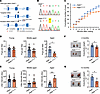 Figure 2
Helb+/D112Y knockin mice exhibit reduced female fertility. (A) Strategy for generating a knockin mouse model carrying a missense mutation in Helb (c.334G>T, p. Asp112Tyr). (B) Sanger sequencing confirmation of wild-type (Helb+/+) and mutant (Helb+/D112Y) mouse genotypes. The mutated position is highlighted in yellow. (C) Cumulative number of pups produced by Helb+/+ and Helb+/D112Y female mice bred continuously with wild-type males for 10 months. n = 5. (D) Average number of pups per litter for female mice. Mice were categorized into 3 age groups: young (2 to 6 months old), middle-aged (7 to 9 months old), and aged (10 to 12 months old). Data are presented as mean ± SD. n = 5. Two-tailed Student’s t tests were used for statistical comparisons between 2 groups. *P < 0.05. (E) Litter intervals of female mice. Data are presented as mean ± SD. n = 5. Two-tailed Student’s t tests were used for statistical comparisons between 2 groups. ***P < 0.001. (F) Representative images (left) and statistical analysis (right) of ovaries from 2-month-old female mice. Scale bar, 1 mm. Data are presented as mean ± SD. n = 6. Two-tailed Student’s t tests were used for statistical comparisons between 2 groups. *P < 0.05. (G) Representative images (left) and statistical analysis (left) of ovaries from 12-month-old female mice. Scale bar, 1 mm. Data are presented as mean ± SD, n = 4. Two-tailed Student’s t tests were used for statistical comparisons between 2 groups. *P < 0.05.
To assess the effect of the Helb mutant on female fertility, we first conducted a breeding assay. Adult Helb+/D112Y and wild-type female mice (6–8 weeks old) were paired with wild-type C57BL/6 males (8–10 weeks old). The number of pups and the birth dates were recorded continuously over a 10-month mating period. During the first 4 months, the cumulative number of offspring produced by young mutant mice was comparable to that of wild-type mice. However, from the fifth to seventh months, the cumulative number of offspring from middle-aged mutant mice began to decline. By the eighth to tenth months, aged wild-type female mice continued to produce offspring, whereas Helb+/D112Y mutant female mice had almost completely lost fertility, with their cumulative pup number remaining nearly unchanged (Figure 2C). Consistently, no markedly significant differences in litter size were observed between young and middle-aged Helb+/D112Y females and control groups. However, a statistically significant decline in litter size was evident in aged Helb+/D112Y females, with wild-type females producing a mean ± SD of 4.7 ± 1.8 pups per litter compared with only 2.25 ± 1.0 pups in Helb+/D112Y females (Figure 2D). Furthermore, the average litter interval was also statistically significantly prolonged in aged Helb+/D112Y females, increasing to 81.8 ± 25.8 days compared with 35.3 ± 13.3 days in wild-type females. No significant differences were observed in the young and middle-aged groups (Figure 2E).
Uteruses and ovaries were collected from female mice and subjected to morphological analysis. No anatomical difference was shown in the uteruses between Helb+/D112Y and wild-type mice (Supplemental Figure 2). The ovaries of young Helb+/D112Y female mice (2 months old) were slightly smaller than those of wild-type female mice (Figure 2F). Consistent with the breeding assay results, the relative ovarian weight of aged Helb+/D112Y female mice (12 months old) statistically significantly decreased, with approximately half that of wild-type mice (Figure 2G). Taken together, these findings indicate that the Helb+/D112Y heterozygous mutation leads to age-dependent reductions in female fertility and ovarian weight, ultimately resulting in a shortened reproductive lifespan in Helb+/D112Y female mice.
Impaired ovarian function in the Helb+/D112Y female mice. The impact of the Helb mutation on female fertility was further evaluated through hematoxylin and eosin (H&E) staining and quantitative analysis of follicle numbers at various stages in ovaries from 2-month-old and 12-month-old mice. The results showed that follicles at all developmental stages, from primordial to antral follicles, were present in 2-month-old Helb+/D112Y ovaries (Figure 3, A and B). However, the follicle numbers at all stages were statistically significantly reduced in 12-month-old Helb+/D112Y ovaries compared with wild-type ovaries (Figure 3, C and D). With aging, the total number of follicles in 12-month-old wild-type ovaries declined but still retained an average of over 20 primordial follicles and approximately 10 primary and secondary follicles per ovary. In contrast, Helb+/D112Y ovaries exhibited only one-fifth the number of primordial follicles and one-third the numbers of primary and secondary follicles observed in wild-type ovaries. In some mutant individuals, follicles at all developmental stages were nearly absent. Consistently, while large antral follicles were observed in wild-type ovaries, they were almost entirely absent in Helb+/D112Y ovaries.
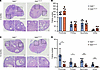 Figure 3
Impaired ovarian function in Helb+/D112Y mutant mice. (A) H&E staining of ovary sections from 2-month-old Helb+/+ and Helb+/D112Y mice. Scale bar, 100 μm. (B) Statistical analysis of the number of primordial, primary, secondary, and antral follicles in 2-month-old Helb+/+ and Helb+/D112Y mouse ovaries. Data are presented as mean ± SD. n = 5. (C) H&E staining of ovary sections from 12-month-old Helb+/+ and Helb+/D112Y mice. Scale bar, 100 μm. (D) Statistical analysis of the number of primordial, primary, secondary, and antral follicles in 12-month-old Helb+/+ and Helb+/D112Y mouse ovaries. Data are presented as mean ± SD. n = 5. Two-tailed Student’s t tests were used for statistical comparisons between 2 groups. *P < 0.05; ***P < 0.001.
To explore the effect of the Helb variant on the transcriptome, ovaries from 2-month-old wild-type and Helb+/D112Y mice were collected for RNA sequencing. A total of 188 upregulated genes and 419 downregulated genes were identified in Helb+/D112Y ovaries compared with wild-type ovaries (Figure 4A). The enriched biological processes of downregulated genes according to Gene Ontology (GO) enrichment analysis included ovulation cycle, hormone secretion, and reproductive system development (Figure 4B). To validate these findings, real-time quantitative PCR (RT-qPCR) was performed to examine the expression of specific genes involved in these pathways. The expression levels of gonadotropin receptors (Amh and Lhcgr) and key ovarian steroidogenic enzymes involved in estrogen synthesis (Cyp11a1 and Hsd3b2) were statistically significantly dysregulated in 2-month-old Helb+/D112Y ovaries compared with wild-type ovaries (Figure 4C). Since Helb has been reported to play roles in cell cycle progression and DDR, we also performed RT-qPCR to analyze gene expression related to these pathways. The results revealed statistically significant downregulation of several key genes related to mitotic cell cycle (e.g., Blm, Cdc14b, and Cdkn1b) and DNA DSB repair (e.g., Fancm) in 2-month-old Helb+/D112Y ovaries compared with wild-type controls (Supplemental Figure 3). Additionally, aged Helb+/D112Y ovaries showed downregulated expression of cell proliferation marker (Mki67) and upregulated expression of aging markers (Cdkn2a, Cdkn1a, Tp53, and IL1a) compared with wild-type ovaries (Figure 4D). Together, these results indicate that Helb+/D112Y mice exhibit impaired ovarian function and early onset of the ovarian aging process, resembling the phenotype of human POI.
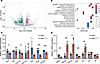 Figure 4
Transcriptomic alterations in Helb+/D112Y ovaries. (A) Volcano plot showing differentially expressed genes in ovaries from Helb+/D112Y mice compared with Helb+/+ mice at 2 months old. Genes with P < 0.05 were marked as red [log2 (fold-change) > 1)] or green [log2 (fold-change) < 1]. (B) GO analysis of downregulated genes in Helb+/D112Y mice compared with Helb+/+ mice. (C) The relative mRNA expression levels of Amh, Fshr, Cyp11a1, Cyp17a1, Star, and Hsd3b2 in ovaries from Helb+/+ and Helb+/D112Y mice at 2 months old measured by RT-qPCR and normalized to Gapdh expression. Data are represented as mean ± SD. n = 4. Two-tailed Student’s t tests were used for statistical comparisons between 2 groups. *P < 0.05; ***P < 0.001. (D) The relative mRNA expression levels of Mki67, Cdkn2a, Cdkn1a, Tp53, Il1a, Il1b, and Il6 in the ovaries from Helb+/+ and Helb+/D112Y mice at 12 months old measured by RT-qPCR and normalized to Gapdh expression. Data are represented as mean ± SD. n = 4. Two-tailed Student’s t tests were used for statistical comparisons between 2 groups. *P < 0.05; **P < 0.01; ***P < 0.001.
Figure 4Transcriptomic alterations in Helb+/D112Y ovaries. (A) Volcano plot showing differentially expressed genes in ovaries from Helb+/D112Y mice compared with Helb+/+ mice at 2 months old. Genes with P < 0.05 were marked as red [log2 (fold-change) > 1)] or green [log2 (fold-change) < 1]. (B) GO analysis of downregulated genes in Helb+/D112Y mice compared with Helb+/+ mice. (C) The relative mRNA expression levels of Amh, Fshr, Cyp11a1, Cyp17a1, Star, and Hsd3b2 in ovaries from Helb+/+ and Helb+/D112Y mice at 2 months old measured by RT-qPCR and normalized to Gapdh expression. Data are represented as mean ± SD. n = 4. Two-tailed Student’s t tests were used for statistical comparisons between 2 groups. *P < 0.05; ***P < 0.001. (D) The relative mRNA expression levels of Mki67, Cdkn2a, Cdkn1a, Tp53, Il1a, Il1b, and Il6 in the ovaries from Helb+/+ and Helb+/D112Y mice at 12 months old measured by RT-qPCR and normalized to Gapdh expression. Data are represented as mean ± SD. n = 4. Two-tailed Student’s t tests were used for statistical comparisons between 2 groups. *P < 0.05; **P < 0.01; ***P < 0.001.


