
Abstract
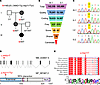
Premature ovarian insufficiency (POI) is a complex reproductive disorder with a strong genetic component. The known POI causative genes currently account for only a small fraction of cases. In this study, we conducted whole-exome sequencing and identified a rare heterozygous missense variant in DNA helicase B (HELB) (c.349G>T, p.Asp117Tyr) in a Chinese family with POI and early menopause. To investigate the pathogenicity of this variant, a knockin mouse model carrying a heterozygous missense Helb variant (Helb+/D112Y) homologous to the human HELB c.349G>T was constructed. The Helb-mutated female mice exhibited reduced litter sizes and prolonged interlitter intervals compared with wild-type mice after reaching 10 months of age, leading to a shortened reproductive lifespan. Consistently, aged Helb+/D112Y females showed decreased ovarian weight and accelerated follicle depletion. Transcriptomic analysis of the ovaries from Helb-mutated mice revealed dysregulated expression of genes associated with impaired ovarian function and ovarian aging. Collectively, these findings in both humans and mice suggest that HELB is involved in maintaining ovarian function and regulating reproductive aging, highlighting the importance of HELB in female reproductive health.
Authors
Yuncheng Pan, Yuexin Yu, Jitong Mo, Shuting Ren, Zixue Zhou, Xi Yang, Yiqing Liu, Feng Zhang, Yanqin You, Xiaojin Zhang, Yanhua Wu
This file is in Adobe Acrobat (PDF) format. If you have not installed and configured the Adobe Acrobat Reader on your system.
Having trouble reading a PDF?
PDFs are designed to be printed out and read, but if you prefer to read them online, you may find it easier if you increase the view size to 125%.
Having trouble saving a PDF?
Many versions of the free Acrobat Reader do not allow Save. You must instead save the PDF from the JCI Online page you downloaded it from. PC users: Right-click on the Download link and choose the option that says something like "Save Link As...". Mac users should hold the mouse button down on the link to get these same options.
Having trouble printing a PDF?
- Try printing one page at a time or to a newer printer.
- Try saving the file to disk before printing rather than opening it "on the fly." This requires that you configure your browser to "Save" rather than "Launch Application" for the file type "application/pdf", and can usually be done in the "Helper Applications" options.
- Make sure you are using the latest version of Adobe's Acrobat Reader.


