
Abstract
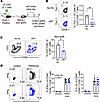
CD154 is a promising target for immunosuppression in transplantation, autoimmunity, and inflammatory diseases. We previously identified CD11b as a novel alternative receptor for CD154 during alloimmunity. However, the impact of specific CD154:CD11b blockade on immune responses to infection has not been well characterized. Here, we have shown that in contrast with its immunosuppressive effect on graft-specific CD8+ T cells, CD154:CD11b blockade unexpectedly improved both the quantity and quality of murine herpesvirus-68–specific CD8+ T cells as measured by an increase in tetramer-positive KLRG1loCD127hi memory precursor effector cells. The differential effect of CD154:CD11b blockade on graft- versus virus-specific CD8+ T cells was underpinned by differences in phosphorylated S6 downstream of mTOR complex 1; however, differential expression of key transcription factors Eomes and TCF-1 was dictated by the type of antigen stimulus. These data demonstrate that priming conditions play an important role in determining the outcome of immunotherapy and suggest that specific inhibition of CD154:CD11b interactions could be effective for suppressing alloimmune responses while maintaining protective immunity to minimize infectious complications following transplantation.
Authors
Katie L. Alexander, Kelsey B. Bennion, Danya Liu, Mandy L. Ford

Abstract
Systemic arterial stenosis, including moyamoya disease (MMD) and middle aortic syndrome (MAS), is a rare condition of unclear etiology. MMD is a cerebral angiopathy, and MAS affects the abdominal and thoracic aorta. Although some genetic associations with MAS have been identified, the causes remain elusive. In this study, de novo heterozygous missense variants of RING finger protein 213 (RNF213) (p.His4058Pro and p.Thr4155Pro) in 2 unrelated families with MAS and MMD were studied by whole-exome sequencing. To elucidate the significance of these variants, we produced knockin mice carrying the Rnf213 p.His4058Pro variant. Homozygous knockin mice exhibited perinatal lethality because of respiratory failure and lung dysplasia, suggesting that this variant is pathogenic. Lung dysplasia in homozygous knockin mice was associated with upregulated innate immunity and inflammatory responses and downregulated cell proliferation. These findings suggested that in mice, the RNF213 p.His4058Pro variant plays critical roles in regulation of innate immunity and inflammation that affect lung development, revealing the complexity of RNF213 function in various tissues and species. In conclusion, this study provides insights into the genetic basis of MAS and MMD, highlights the potential involvement of RNF213 variants in systemic vasculopathy, and identifies unexpected associations with lung development and immune processes.
Authors
Ayako Kashimada, Tomoko Mizuno, Eriko Tanaka, Susumu Hosokawa, Tomohiro Udagawa, Yuichi Hiraoka, Keisuke Uchida, Tomohiro Morio, Kenjiro Kosaki, Masatoshi Takagi

Abstract
Heme iron (HI), derived principally from hemoglobin (Hb) in animal foods, is a highly bioavailable source of dietary iron for humans. Despite several decades of focused research, however, molecular mechanisms governing HI absorption remain undefined. Previous studies in mice and rats have not produced a consensus, definitive model of efficient HI absorption/utilization. We hypothesized that a nutritional approach, using semipurified, HI-containing diets, could be utilized to establish a tractable rodent model of HI absorption that could ultimately be employed to test the roles of receptors, transporters, and enzymes using genetic engineering technology. Experiments were designed to assess HI utilization by feeding animals AIN-93G–based, HI-enriched experimental diets formulated with lyophilized porcine RBCs, containing approximately 85% HI and 15% nonheme iron (NHI). Total iron was within the physiological range (50–75 ppm) and precisely matched NHI control diets containing ferrous sulfate were utilized as comparators. Notably, in Sprague-Dawley (S-D) rats and C57BL/6 (B6) mice, dietary HI effectively (a) resolved iron-deficiency anemia; (b) supported normal pregnancy, lactation, and neonatal development; and (c) contributed to iron loading in Hamp-KO mice and rats (modeling hereditary hemochromatosis). A nutritional paradigm has thus been established that facilitates investigation into mechanisms of HI absorption by S-D rats and B6 mice.
Authors
Jennifer K. Lee, Yue He, Shireen R.L. Flores, Regina R. Woloshun, Xiaoyu Wang, Jacob S. Shine, Pearl O. Ebea-Ugwuanyi, Sitara Sriram, Melissa Fraga, Sean Zhu, Yang Yu, Iqbal Hamza, James F. Collins
Abstract
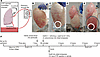
Bacterial pneumonia is the most common cause of acute respiratory distress syndrome (ARDS), characterized by disrupted pulmonary endothelial barrier function, hyperinflammation, and impaired alveolar epithelial fluid clearance. ARDS has a high mortality rate and no proven pharmacological treatments, stressing the need for new targeted therapies. The TIP peptide, mimicking the lectin-like domain of TNF, directly binds to the α subunit of the epithelial Na+ channel, expressed in both alveolar epithelial and capillary endothelial cells, and may increase lung endothelial barrier function and alveolar fluid clearance during bacterial infection. This study tested these potential therapeutic mechanisms of the TIP peptide in a clinically relevant preparation of the ex vivo–perfused human lung injured by Streptococcus pneumoniae. Therapeutic administration of the TIP peptide reduced pulmonary barrier permeability to protein and lung edema formation, increased alveolar edema fluid clearance, and produced an antiinflammatory effect in the airspaces with reductions in IL-6 and IL-8 levels. Additionally, the TIP peptide reduced the translocation of bacteria into the circulation. These findings establish 3 mechanisms of benefit with the TIP peptide to reduce injury in the human lung and support the clinical relevance as a potential therapeutic for pneumococcal bacterial pneumonia.
Authors
Mazharul Maishan, Hiroki Taenaka, Bruno Evrard, Shotaro Matsumoto, Angelika Ringor, Carolyn Leroux, Rudolf Lucas, Michael A. Matthay
Abstract
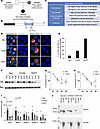
PDX1 mutations are associated with multiple forms of diabetes, including syndromic, neonatal, mature onset diabetes of the young (MODY), and type 2 diabetes. Two PDX1 missense mutations (Thr151Met and Asn196Thr) were identified in a pediatric female patient that cause permanent neonatal diabetes, pancreas hypoplasia, and a malformed gallbladder. We found that the mouse Pdx1 Asn197Thr variant (homologous to human PDX1 Asn196Thr), but not Pdx1 Thr152Met (homologous to human PDX1 Thr151Met), altered its nuclear localization and disrupted the PDX1-ONECUT1 interaction. Neither variant substantially affected PDX1 protein stability, but both reduced PDX1 binding to the Pdx1 gene promoter. Importantly, the Pdx1 Asn197Thr variant caused pancreas agenesis and reduced enteroendocrine cells in the duodenum in genetically engineered mice, due at least in part to reduced Pdx1 promoter binding and disrupted PDX1-ONECUT1 interaction.
Authors
Xiaodun Yang, Angela Zanfardino, Riccardo Schiaffini, Jeff Ishibashi, Bareket Daniel, Matthew W. Haemmerle, Novella Rapini, Alessia Piscopo, Emanuele Miraglia del Giudice, Maria Cristina Digilio, Raffaele Iorio, Mafalda Mucciolo, Stefano Cianfarani, Dario Iafusco, Fabrizio Barbetti, Doris A. Stoffers
Abstract
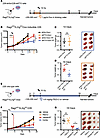
Despite aggressive chemoradiation treatment, the overall survival rate for patients with HPV– head and neck squamous cell carcinoma (HNSCC) remains poor, highlighting the urgent need for more effective drug-radiotherapy combinations to improve the therapeutic index of radiation therapy (RT). The fat mass and obesity-related gene (FTO) is emerging as a promising cancer therapeutic target; however, its role in the RT response has been underexplored. In our study, we found that both genetic and pharmacologic inhibition of FTO enhanced the efficacy of RT in human and mouse HNSCC tumor xenografts. Mechanistically, inhibition of FTO improved the RT response in HPV– HNSCC cells, which was associated with increased DNA damage, reduced efficiency of homology directed repair, and decreased formation of RAD51 homolog 1 (RAD51) foci. Importantly, pharmacologic inhibition of FTO did not exacerbate radiation-induced oral mucositis, a significant normal-tissue toxicity associated with HNSCC RT. In summary, our results indicate a role for FTO in regulating homologous recombination while identifying FTO as a potential therapeutic target to enhance the therapeutic index of RT in HPV– HNSCC treatment.
Authors
Lu Ji, Leighton Pu, Jinglong Wang, Hongbin Cao, Stavros Melemenidis, Subarna Sinha, Li Guan, Eyiwunmi E. Laseinde, Rie von Eyben, Sara A. Richter, Jin-Min Nam, Christina Kong, Kerriann M. Casey, Edward E. Graves, Richard L. Frock, Quynh Thu Le, Erinn B. Rankin

Abstract
Invasive aspergillosis is characterized by lung hemorrhage and release of extracellular heme, which promotes fungal growth. Heme can also mediate tissue injury directly, and both fungal growth and lung injury may induce hemorrhage. To assimilate these interdependent processes, we hypothesized that, during aspergillosis, heme mediates direct lung injury independent of fungal growth, leading to worse infection outcomes, and the scavenger protein hemopexin mitigates these effects. Mice with neutropenic aspergillosis developed a time-dependent increase in lung extracellular heme and a corresponding hemopexin induction. Hemopexin deficiency resulted in markedly increased lung injury, fungal growth, and lung hemorrhage. Using a computational model of the interactions of Aspergillus, heme, and the host, we predicted a critical role for heme-mediated generation of neutrophil extracellular traps (NETs) in this infection. We tested this prediction using a fungal strain unable to grow at body temperature and found that extracellular heme and fungal exposure synergized to induce lung injury by promoting NET release, and disruption of NET was sufficient to attenuate lung injury and fungal burden. These data implicate heme-mediated NETosis in both lung injury and fungal growth during aspergillosis, resulting in a detrimental positive feedback cycle that can be interrupted by scavenging heme or disrupting NETs.
Authors
Ganlin Qu, Henrique A.L. Ribeiro, Angelica L. Solomon, Luis Sordo Vieira, Yana Goddard, Nickolas G. Diodati, Arantxa V. Lazarte, Matthew Wheeler, Reinhard Laubenbacher, Borna Mehrad

Abstract
Asbestosis is a prototypical type of fibrosis that is progressive and does not resolve. ER stress is increased in multiple cell types that contribute to fibrosis; however, the mechanism(s) by which ER stress in lung macrophages contributes to fibrosis is poorly understood. Here, we show that ER stress resulted in protein kinase RNA-like ER kinase (PERK; Eif2ak3) activation in humans with asbestosis. Similar results were seen in asbestos-injured mice. Mice harboring a conditional deletion of Eif2ak3 were protected from fibrosis. Lung macrophages from asbestosis individuals had evidence of metabolic reprogramming to fatty acid oxidation (FAO). Eif2ak3fl/fl mice had increased oxygen consumption rate (OCR), whereas OCR in Eif2ak3–/– Lyz2-cre mice was reduced to control levels. PERK increased activating transcription factor 4 (Atf4) expression, and ATF4 bound to the Ppargc1a promoter to increase its expression. GSK2656157, a PERK-specific inhibitor, reduced FAO, Ppargc1a, and Aft4 in lung macrophages and reversed established fibrosis in mice. These observations suggest that PERK is a therapeutic target to reverse established fibrosis.
Authors
Jyotsana Pandey, Jennifer L. Larson-Casey, Mallikarjun H. Patil, Chao He, Nisarat Pinthong, A. Brent Carter

Abstract
Pharmacological rescue of F508del-CFTR by the triple combination CFTR modulator therapy elexacaftor/tezacaftor/ivacaftor (ETI) leads to unprecedented clinical benefits in patients with cystic fibrosis (CF). However, previous studies in CF primary human airway epithelial cultures demonstrated that chronic treatment with the potentiator ivacaftor can render the F508del protein unstable, thus limiting restoration of CFTR chloride channel function. Even so, quantitative studies of this unwanted effect of ivacaftor on F508del channel function with dependency on cell culture conditions remain limited, and the impact of chronic ivacaftor exposure on restoration of mucociliary clearance that is impaired in patients with CF has not been studied. In patient-derived primary nasal epithelial cultures, we found that different culture conditions (UNC-ALI medium vs. PneumaCult medium) have profound effects on ETI-mediated restoration of F508del-CFTR function. Chronic treatment with ivacaftor as part of ETI triple therapy limited the rescue of F508del-CFTR chloride channel function when CF nasal epithelial cultures were grown in UNC-ALI medium but not in PneumaCult medium. In PneumaCult medium, both chronic and acute addition of ivacaftor as part of ETI treatment led to constitutive CFTR-mediated chloride secretion in the absence of exogenous cAMP-dependent stimulation. This constitutive CFTR-mediated chloride secretion was essential to improve viscoelastic properties of the mucus layer and to restore mucociliary transport on CF nasal epithelial cultures. Furthermore, nasal potential difference measurements in patients with CF showed that ETI restored constitutive F508del-CFTR activity in vivo. These results demonstrate that ivacaftor as a component of ETI therapy is essential to restore mucociliary clearance and suggest that this effect is facilitated by its constitutive activation of F508del channels following their folding correction in patients with CF.
Authors
Anita Balázs, Tihomir Rubil, Christine K. Wong, Jasmin Berger, Marika Drescher, Kathrin Seidel, Mirjam Stahl, Simon Y. Graeber, Marcus A. Mall

Abstract
The SARS-CoV-2 pandemic highlighted the potential of mRNA vaccines in rapidly responding to emerging pathogens. However, immunity induced by conventional mRNA vaccines wanes quickly, requiring frequent boosters. Self-amplifying RNA (saRNA) vaccines, which extend antigen expression via self-replication, offer a promising strategy to induce more durable immune responses. In this study, we developed an saRNA vaccine encoding Zika virus (ZIKV) membrane and envelope proteins and evaluated its efficacy in mice. A single vaccination elicited strong humoral and cellular immune responses and reduced viral loads but only for 28 days. By day 84, antibody titers and T cell responses had significantly declined, resulting in reduced efficacy. To address this, we evaluated agonist antibodies targeting the T cell costimulatory molecules OX40 and 4-1BB. Coadministration of agonist antibodies enhanced CD8+ T cell responses to vaccination, resulting in sustained immunity and reduced viral loads at day 84. Depletion and passive transfer studies verified that long-term antiviral immunity was primarily CD8+ T cell dependent, with minimal contributions from antibody responses. These findings suggest that agonists targeting members of the tumor necrosis receptor superfamily, such as OX40 and 4-1BB, might enhance the durability of saRNA vaccine–induced protection, addressing a key limitation of current mRNA vaccine platforms.
Authors
Hsueh-Han Lu, Rúbens Prince dos Santos Alves, Qin Hui Li, Luke Eder, Julia Timis, Henry Madany, Kantinan Chuensirikulchai, Krithik V. Varghese, Aditi Singh, Linda Le Tran, Audrey Street, Annie Elong Ngono, Michael Croft, Sujan Shresta
No posts were found with this tag.


