
Submit a comment
Abstract
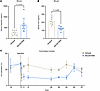
β-Thalassemia is a genetic disorder arising from mutations in the β-globin gene, leading to ineffective erythropoiesis and iron overload. Ineffective erythropoiesis, a hallmark of β-thalassemia, is an important driver of iron overload, which contributes to liver fibrosis, diabetes, and cardiac disease. Iron homeostasis is regulated by the hormone hepcidin; BMP6/hemojuvelin–mediated (BMP6/HJV-mediated) signaling induces hepatic hepcidin expression via SMAD1/5, with transmembrane serine protease 6 (TMPRSS6) being a negative regulator of HJV. Individuals with loss-of-function mutations in the TMPRSS6 gene show increased circulating hepcidin and iron-refractory iron-deficiency anemia, suggesting that blocking TMPRSS6 may be a viable strategy to elevate hepcidin levels in β-thalassemia. We generated a human mAb (REGN7999) that inhibits TMPRSS6. In an Hbbth3/+ mouse model of β-thalassemia, REGN7999 treatment led to significant reductions in liver iron, reduced ineffective erythropoiesis, and showed improvements in RBC health, running distance during forced exercise, and bone density. In a phase I, doubleblind, randomized, placebo-controlled study in healthy human volunteers (NCT05481333), REGN7999 increased serum hepcidin and reduced serum iron with an acceptable tolerability profile. Our results suggest that, by both reducing iron and improving RBC function, inhibition of TMPRSS6 by REGN7999 may offer a therapy for iron overload and impaired erythropoiesis in β-thalassemia.
Authors
Heinrich E. Lob, Nikhil Singh, Kusha Mohammadi, Larisa Ivanova, Beth Crowell, Hyon J. Kim, Leah Kravets, Nanditha M. Das, Yonaton Ray, Jee Hae Kim, Sylvie Rottey, Emily Labriola-Tompkins, Hazem E. Hassan, Lorna Farrelly, Harvey F. Chin, Marilena Preda, Leigh Spencer Noakes, Kei Saotome, Matthew Franklin, Marc W. Retter, Elif Karayusuf, John J. Flanagan, William Olson, Kalyan C. Nannuru, Vincent Idone, Michael E. Burczynski, Olivier A. Harari, Lorah Perlee, Griet Van Lancker, Andrew J. Murphy, Aris N. Economides, Sarah J. Hatsell
Guidelines
The Editorial Board will only consider comments that are deemed relevant and of interest to readers. The Journal will not post data that have not been subjected to peer review; or a comment that is essentially a reiteration of another comment.
- Comments appear on the Journal’s website and are linked from the original article’s web page.
- Authors are notified by email if their comments are posted.
- The Journal reserves the right to edit comments for length and clarity.
- No appeals will be considered.
- Comments are not indexed in PubMed.
Specific requirements
- Maximum length, 400 words
- Entered as plain text or HTML
- Author’s name and email address, to be posted with the comment
- Declaration of all potential conflicts of interest (even if these are not ultimately posted); see the Journal’s conflict-of-interest policy
- Comments may not include figures


