
Submit a comment
Abstract
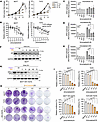
Estrogen receptor α (ER) is a critical driver of tumorigenesis and tumor progression in most breast cancers. Endocrine therapies (ET) targeting ER are central to treating hormone receptor–positive breast cancer, but resistance poses a clinical challenge. Some resistance mechanisms, particularly those involving estrogen-independent activity such as the ESR1 mutations, rely on ER signaling, supporting the need for next-generation ET. We investigated the preclinical efficacy of imlunestrant, an oral selective ER degrader, in ER-positive breast cancer preclinical models, including models harboring the Y537S ESR1 mutation, an activating mutation. Imlunestrant demonstrated antagonistic activity and effective degradation of both WT and mutant ER, resulting in cell growth suppression. In vivo, imlunestrant outperformed fulvestrant, leading to tumor regression in a patient-derived xenograft harboring the Y537S ESR1 mutation. Cyclic mutiplexed immunofluorescence and transcriptomic analysis revealed enhanced cell cycle arrest and downregulation of estrogen-responsive genes with imlunestrant treatment. Additionally, a genome-wide CRISPR knock–out screen identified several vulnerabilities that were either persistent or acquired after imlunestrant treatment, providing a rationale for future studies of combination treatments with imlunestrant. Collectively, these results highlight the on-target and selective activity of imlunestrant, which can circumvent resistance engendered by the Y537S ESR1 mutation.
Authors
Shira Sherman, Zachary M. Sandusky, Douglas Russo, David Zak, Agostina Nardone, Delia Friel, Francisco Hermida-Prado, Capucine Heraud, Genevra Kuziel, Ana Verma, Giorgio Gaglia, Sheheryar Kabraji, Quang-De Nguyen, Sandro Santagata, Sean W. Fanning, Rinath Jeselsohn
Guidelines
The Editorial Board will only consider comments that are deemed relevant and of interest to readers. The Journal will not post data that have not been subjected to peer review; or a comment that is essentially a reiteration of another comment.
- Comments appear on the Journal’s website and are linked from the original article’s web page.
- Authors are notified by email if their comments are posted.
- The Journal reserves the right to edit comments for length and clarity.
- No appeals will be considered.
- Comments are not indexed in PubMed.
Specific requirements
- Maximum length, 400 words
- Entered as plain text or HTML
- Author’s name and email address, to be posted with the comment
- Declaration of all potential conflicts of interest (even if these are not ultimately posted); see the Journal’s conflict-of-interest policy
- Comments may not include figures


