
Submit a comment
Abstract
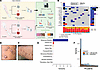
Prurigo nodularis (PN) is a chronic inflammatory skin disease characterized by pruritic skin nodules of unknown etiology. Little is known about genetic changes in PN pathogenesis, particularly somatic events, which are often implicated in inflammatory conditions. We thus performed whole-exome sequencing on 54 lesional and nonlesional skin biopsies from 17 patients with PN and 10 patients with atopic dermatitis (AD) for comparison. Somatic mutational analysis revealed that PN lesional skin harbors recurrent somatic mutations in fibrotic, neurotropic, and cancer-associated genes that are absent in adjacent PN nonlesional skin. Nonsynonymous mutations were most frequently present in NOTCH1 and the Notch signaling pathway, a key regulator of cellular proliferation and tissue fibrosis. In contrast, NOTCH1 mutations were absent in AD. Somatic copy-number analysis, combined with expression data, identified recurrently deleted and downregulated genes in PN lesional skin, which are associated with axonal guidance and extension. Follow-up immunofluorescence validation demonstrated increased NOTCH1 expression in PN lesional skin fibroblasts and increased Notch signaling in PN lesional dermis. Finally, a multicenter analysis revealed increased risk of NOTCH1-associated diseases in patients with PN. In characterizing the somatic landscape of PN, this study highlights the potential role of Notch pathway dysregulation in PN pathogenesis and fibrosis.
Authors
Ahmad Rajeh, Shahin Shahsavari, Hannah Cornman, Alexander Kollhoff, Anuj Gupta, Mindy D. Szeto, Anusha Kambala, Olusola O. Oladipo, Varsha Parthasarathy, Junwen Deng, Melika Marani, Shirin Shahsavari, Selina M. Yossef, Vedha Vaddaraju, Waleed Adawi, Yagiz M. Akiska, Davies M. Gage, Sarah Wheelan, Thomas Pritchard, Madan M. Kwatra, Yevgeniy R. Semenov, Alexander Gusev, Won Jin Ho, Srinivasan Yegnasubramanian, Shawn G. Kwatra
Guidelines
The Editorial Board will only consider comments that are deemed relevant and of interest to readers. The Journal will not post data that have not been subjected to peer review; or a comment that is essentially a reiteration of another comment.
- Comments appear on the Journal’s website and are linked from the original article’s web page.
- Authors are notified by email if their comments are posted.
- The Journal reserves the right to edit comments for length and clarity.
- No appeals will be considered.
- Comments are not indexed in PubMed.
Specific requirements
- Maximum length, 400 words
- Entered as plain text or HTML
- Author’s name and email address, to be posted with the comment
- Declaration of all potential conflicts of interest (even if these are not ultimately posted); see the Journal’s conflict-of-interest policy
- Comments may not include figures


