
Abstract
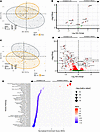
Serious non-AIDS events (SNAEs), including non-AIDS malignancies, cardiovascular disease, and hepatic complications, remain major causes of mortality in treated HIV infection. These outcomes are driven by persistent immune activation, systemic inflammation, and metabolic dysfunction despite effective viral suppression with antiretroviral therapy (ART). To investigate mechanisms underlying SNAE pathogenesis, we performed a cross-site multi-omic analysis integrating plasma proteins, plasma metabolites, and mucosal microbiomes in 82 ART-treated people with HIV (PWH) and 10 people without HIV from the United States and Mexico. Geography was the dominant source of variation, particularly across lipid classes. However, individuals at high risk for SNAEs, defined by low CD4+ T cell counts and low CD4/CD8 ratios, shared a consistent signature of systemic inflammation, mitochondrial dysfunction, and microbial dysbiosis, including elevated plasma IL-6 and ω-oxidation products (adipic and suberic acids) and depletion of short-chain fatty acid–producing commensals in the gut mucosa, including Akkermansia muciniphila, Bacteroides uniformis, and Ruminococcus. A. muciniphila abundance correlated with lower IL-6 levels, fewer HIV RNA-producing cells in lymph nodes, and higher CD4/CD8 ratios. These findings identify a shared inflammatory and metabolic phenotype in PWH and implicate A. muciniphila as a potential microbiome-based target to mitigate immune activation and SNAE risk in treated HIV.
Authors
Christopher M. Basting, Jodi Anderson, Kevin Escandón, Garritt Wieking, Candace Guerrero, Jarrett Reichel, Ross T. Cromarty, Erik Swanson, Ty Schroeder, Elaina Creagan, Maura Barrett, Fernanda Torres-Ruiz, Maribel Soto-Nava, Lady Carvajal-Ruiz, Karla Krystel Ordaz-Candelario, Olivia Briceño, Nicholas Funderburg, Melanie Graham, Peter Hunt, Santiago Avila-Rios, Gonzalo Salgado Montes de Oca, Timothy W. Schacker, Nichole R. Klatt
This file is in Adobe Acrobat (PDF) format. If you have not installed and configured the Adobe Acrobat Reader on your system.
Having trouble reading a PDF?
PDFs are designed to be printed out and read, but if you prefer to read them online, you may find it easier if you increase the view size to 125%.
Having trouble saving a PDF?
Many versions of the free Acrobat Reader do not allow Save. You must instead save the PDF from the JCI Online page you downloaded it from. PC users: Right-click on the Download link and choose the option that says something like "Save Link As...". Mac users should hold the mouse button down on the link to get these same options.
Having trouble printing a PDF?
- Try printing one page at a time or to a newer printer.
- Try saving the file to disk before printing rather than opening it "on the fly." This requires that you configure your browser to "Save" rather than "Launch Application" for the file type "application/pdf", and can usually be done in the "Helper Applications" options.
- Make sure you are using the latest version of Adobe's Acrobat Reader.


