
Clinical Research and Public HealthHematologyImmunologyOncology
Open Access |  10.1172/jci.insight.203988
Detection of cytokine release syndrome using wearables and cytokine profiling following CAR-T therapy for myeloma
Sridevi Rajeeve,1 Matt Wilkes,2 Nicole Zahradka,2 Lewis Tomalin,3 Mujahid Quidwai,4 Darren Pan,5 Nicholas J. Calafat,2 Martin Cusack,2 Adolfo Aleman,6,7 Kseniya Serebryakova,6,7 Katerina Kappes,6,7 Hayley Jackson,6,7 Sarita Agte,8 Santiago Thibaud,6,7 Larysa Sanchez,6,7 Shambavi Richard,6,7 Joshua Richter,6,7 Cesar Rodriguez,6,7 Hearn Jay Cho,6,7 Ajai Chari,5 Sundar Jagannath,6,7 Alessandro Laganà,4,7,9 Adriana C. Rossi,6,7 and Samir Parekh6,7
1Myeloma & Cellular Therapy Services, Memorial Sloan Kettering Cancer Center, New York, New York, USA.
2Current Health Inc., Boston, Massachusetts, USA.
3Department of Population Health Science and Policy and
4Department of Oncological Sciences, Icahn School of Medicine at Mount Sinai, New York, New York, USA.
5University of California San Francisco, San Francisco, California, USA.
6Department of Medicine, Hematology and Medical Oncology and
7Tisch Cancer Institute, Icahn School of Medicine at Mount Sinai, New York, New York, USA.
8Dorset County Hospital, NHS Foundation Trust, Dorchester, United Kingdom.
9Department of Genetics and Genomic Sciences, Icahn School of Medicine at Mount Sinai, New York, New York, USA.
Address correspondence to: Samir Parekh, Adriana Rossi, or Alessandro Laganà, 1470 Madison Avenue, New York, New York 10029, USA. Email: samir.parekh@mssm.edu (SP); adriana.rossi@mssm.edu (AR): alessandro.lagana@mssm.edu (AL).
Find articles by Rajeeve, S. in: PubMed | Google Scholar
1Myeloma & Cellular Therapy Services, Memorial Sloan Kettering Cancer Center, New York, New York, USA.
2Current Health Inc., Boston, Massachusetts, USA.
3Department of Population Health Science and Policy and
4Department of Oncological Sciences, Icahn School of Medicine at Mount Sinai, New York, New York, USA.
5University of California San Francisco, San Francisco, California, USA.
6Department of Medicine, Hematology and Medical Oncology and
7Tisch Cancer Institute, Icahn School of Medicine at Mount Sinai, New York, New York, USA.
8Dorset County Hospital, NHS Foundation Trust, Dorchester, United Kingdom.
9Department of Genetics and Genomic Sciences, Icahn School of Medicine at Mount Sinai, New York, New York, USA.
Address correspondence to: Samir Parekh, Adriana Rossi, or Alessandro Laganà, 1470 Madison Avenue, New York, New York 10029, USA. Email: samir.parekh@mssm.edu (SP); adriana.rossi@mssm.edu (AR): alessandro.lagana@mssm.edu (AL).
Find articles by Wilkes, M. in: PubMed | Google Scholar
1Myeloma & Cellular Therapy Services, Memorial Sloan Kettering Cancer Center, New York, New York, USA.
2Current Health Inc., Boston, Massachusetts, USA.
3Department of Population Health Science and Policy and
4Department of Oncological Sciences, Icahn School of Medicine at Mount Sinai, New York, New York, USA.
5University of California San Francisco, San Francisco, California, USA.
6Department of Medicine, Hematology and Medical Oncology and
7Tisch Cancer Institute, Icahn School of Medicine at Mount Sinai, New York, New York, USA.
8Dorset County Hospital, NHS Foundation Trust, Dorchester, United Kingdom.
9Department of Genetics and Genomic Sciences, Icahn School of Medicine at Mount Sinai, New York, New York, USA.
Address correspondence to: Samir Parekh, Adriana Rossi, or Alessandro Laganà, 1470 Madison Avenue, New York, New York 10029, USA. Email: samir.parekh@mssm.edu (SP); adriana.rossi@mssm.edu (AR): alessandro.lagana@mssm.edu (AL).
Find articles by Zahradka, N. in: PubMed | Google Scholar
1Myeloma & Cellular Therapy Services, Memorial Sloan Kettering Cancer Center, New York, New York, USA.
2Current Health Inc., Boston, Massachusetts, USA.
3Department of Population Health Science and Policy and
4Department of Oncological Sciences, Icahn School of Medicine at Mount Sinai, New York, New York, USA.
5University of California San Francisco, San Francisco, California, USA.
6Department of Medicine, Hematology and Medical Oncology and
7Tisch Cancer Institute, Icahn School of Medicine at Mount Sinai, New York, New York, USA.
8Dorset County Hospital, NHS Foundation Trust, Dorchester, United Kingdom.
9Department of Genetics and Genomic Sciences, Icahn School of Medicine at Mount Sinai, New York, New York, USA.
Address correspondence to: Samir Parekh, Adriana Rossi, or Alessandro Laganà, 1470 Madison Avenue, New York, New York 10029, USA. Email: samir.parekh@mssm.edu (SP); adriana.rossi@mssm.edu (AR): alessandro.lagana@mssm.edu (AL).
Find articles by
Tomalin, L.
in:
PubMed
|
Google Scholar
|

1Myeloma & Cellular Therapy Services, Memorial Sloan Kettering Cancer Center, New York, New York, USA.
2Current Health Inc., Boston, Massachusetts, USA.
3Department of Population Health Science and Policy and
4Department of Oncological Sciences, Icahn School of Medicine at Mount Sinai, New York, New York, USA.
5University of California San Francisco, San Francisco, California, USA.
6Department of Medicine, Hematology and Medical Oncology and
7Tisch Cancer Institute, Icahn School of Medicine at Mount Sinai, New York, New York, USA.
8Dorset County Hospital, NHS Foundation Trust, Dorchester, United Kingdom.
9Department of Genetics and Genomic Sciences, Icahn School of Medicine at Mount Sinai, New York, New York, USA.
Address correspondence to: Samir Parekh, Adriana Rossi, or Alessandro Laganà, 1470 Madison Avenue, New York, New York 10029, USA. Email: samir.parekh@mssm.edu (SP); adriana.rossi@mssm.edu (AR): alessandro.lagana@mssm.edu (AL).
Find articles by Quidwai, M. in: PubMed | Google Scholar
1Myeloma & Cellular Therapy Services, Memorial Sloan Kettering Cancer Center, New York, New York, USA.
2Current Health Inc., Boston, Massachusetts, USA.
3Department of Population Health Science and Policy and
4Department of Oncological Sciences, Icahn School of Medicine at Mount Sinai, New York, New York, USA.
5University of California San Francisco, San Francisco, California, USA.
6Department of Medicine, Hematology and Medical Oncology and
7Tisch Cancer Institute, Icahn School of Medicine at Mount Sinai, New York, New York, USA.
8Dorset County Hospital, NHS Foundation Trust, Dorchester, United Kingdom.
9Department of Genetics and Genomic Sciences, Icahn School of Medicine at Mount Sinai, New York, New York, USA.
Address correspondence to: Samir Parekh, Adriana Rossi, or Alessandro Laganà, 1470 Madison Avenue, New York, New York 10029, USA. Email: samir.parekh@mssm.edu (SP); adriana.rossi@mssm.edu (AR): alessandro.lagana@mssm.edu (AL).
Find articles by Pan, D. in: PubMed | Google Scholar
1Myeloma & Cellular Therapy Services, Memorial Sloan Kettering Cancer Center, New York, New York, USA.
2Current Health Inc., Boston, Massachusetts, USA.
3Department of Population Health Science and Policy and
4Department of Oncological Sciences, Icahn School of Medicine at Mount Sinai, New York, New York, USA.
5University of California San Francisco, San Francisco, California, USA.
6Department of Medicine, Hematology and Medical Oncology and
7Tisch Cancer Institute, Icahn School of Medicine at Mount Sinai, New York, New York, USA.
8Dorset County Hospital, NHS Foundation Trust, Dorchester, United Kingdom.
9Department of Genetics and Genomic Sciences, Icahn School of Medicine at Mount Sinai, New York, New York, USA.
Address correspondence to: Samir Parekh, Adriana Rossi, or Alessandro Laganà, 1470 Madison Avenue, New York, New York 10029, USA. Email: samir.parekh@mssm.edu (SP); adriana.rossi@mssm.edu (AR): alessandro.lagana@mssm.edu (AL).
Find articles by Calafat, N. in: PubMed | Google Scholar
1Myeloma & Cellular Therapy Services, Memorial Sloan Kettering Cancer Center, New York, New York, USA.
2Current Health Inc., Boston, Massachusetts, USA.
3Department of Population Health Science and Policy and
4Department of Oncological Sciences, Icahn School of Medicine at Mount Sinai, New York, New York, USA.
5University of California San Francisco, San Francisco, California, USA.
6Department of Medicine, Hematology and Medical Oncology and
7Tisch Cancer Institute, Icahn School of Medicine at Mount Sinai, New York, New York, USA.
8Dorset County Hospital, NHS Foundation Trust, Dorchester, United Kingdom.
9Department of Genetics and Genomic Sciences, Icahn School of Medicine at Mount Sinai, New York, New York, USA.
Address correspondence to: Samir Parekh, Adriana Rossi, or Alessandro Laganà, 1470 Madison Avenue, New York, New York 10029, USA. Email: samir.parekh@mssm.edu (SP); adriana.rossi@mssm.edu (AR): alessandro.lagana@mssm.edu (AL).
Find articles by Cusack, M. in: PubMed | Google Scholar
1Myeloma & Cellular Therapy Services, Memorial Sloan Kettering Cancer Center, New York, New York, USA.
2Current Health Inc., Boston, Massachusetts, USA.
3Department of Population Health Science and Policy and
4Department of Oncological Sciences, Icahn School of Medicine at Mount Sinai, New York, New York, USA.
5University of California San Francisco, San Francisco, California, USA.
6Department of Medicine, Hematology and Medical Oncology and
7Tisch Cancer Institute, Icahn School of Medicine at Mount Sinai, New York, New York, USA.
8Dorset County Hospital, NHS Foundation Trust, Dorchester, United Kingdom.
9Department of Genetics and Genomic Sciences, Icahn School of Medicine at Mount Sinai, New York, New York, USA.
Address correspondence to: Samir Parekh, Adriana Rossi, or Alessandro Laganà, 1470 Madison Avenue, New York, New York 10029, USA. Email: samir.parekh@mssm.edu (SP); adriana.rossi@mssm.edu (AR): alessandro.lagana@mssm.edu (AL).
Find articles by Aleman, A. in: PubMed | Google Scholar
1Myeloma & Cellular Therapy Services, Memorial Sloan Kettering Cancer Center, New York, New York, USA.
2Current Health Inc., Boston, Massachusetts, USA.
3Department of Population Health Science and Policy and
4Department of Oncological Sciences, Icahn School of Medicine at Mount Sinai, New York, New York, USA.
5University of California San Francisco, San Francisco, California, USA.
6Department of Medicine, Hematology and Medical Oncology and
7Tisch Cancer Institute, Icahn School of Medicine at Mount Sinai, New York, New York, USA.
8Dorset County Hospital, NHS Foundation Trust, Dorchester, United Kingdom.
9Department of Genetics and Genomic Sciences, Icahn School of Medicine at Mount Sinai, New York, New York, USA.
Address correspondence to: Samir Parekh, Adriana Rossi, or Alessandro Laganà, 1470 Madison Avenue, New York, New York 10029, USA. Email: samir.parekh@mssm.edu (SP); adriana.rossi@mssm.edu (AR): alessandro.lagana@mssm.edu (AL).
Find articles by Serebryakova, K. in: PubMed | Google Scholar
1Myeloma & Cellular Therapy Services, Memorial Sloan Kettering Cancer Center, New York, New York, USA.
2Current Health Inc., Boston, Massachusetts, USA.
3Department of Population Health Science and Policy and
4Department of Oncological Sciences, Icahn School of Medicine at Mount Sinai, New York, New York, USA.
5University of California San Francisco, San Francisco, California, USA.
6Department of Medicine, Hematology and Medical Oncology and
7Tisch Cancer Institute, Icahn School of Medicine at Mount Sinai, New York, New York, USA.
8Dorset County Hospital, NHS Foundation Trust, Dorchester, United Kingdom.
9Department of Genetics and Genomic Sciences, Icahn School of Medicine at Mount Sinai, New York, New York, USA.
Address correspondence to: Samir Parekh, Adriana Rossi, or Alessandro Laganà, 1470 Madison Avenue, New York, New York 10029, USA. Email: samir.parekh@mssm.edu (SP); adriana.rossi@mssm.edu (AR): alessandro.lagana@mssm.edu (AL).
Find articles by Kappes, K. in: PubMed | Google Scholar
1Myeloma & Cellular Therapy Services, Memorial Sloan Kettering Cancer Center, New York, New York, USA.
2Current Health Inc., Boston, Massachusetts, USA.
3Department of Population Health Science and Policy and
4Department of Oncological Sciences, Icahn School of Medicine at Mount Sinai, New York, New York, USA.
5University of California San Francisco, San Francisco, California, USA.
6Department of Medicine, Hematology and Medical Oncology and
7Tisch Cancer Institute, Icahn School of Medicine at Mount Sinai, New York, New York, USA.
8Dorset County Hospital, NHS Foundation Trust, Dorchester, United Kingdom.
9Department of Genetics and Genomic Sciences, Icahn School of Medicine at Mount Sinai, New York, New York, USA.
Address correspondence to: Samir Parekh, Adriana Rossi, or Alessandro Laganà, 1470 Madison Avenue, New York, New York 10029, USA. Email: samir.parekh@mssm.edu (SP); adriana.rossi@mssm.edu (AR): alessandro.lagana@mssm.edu (AL).
Find articles by Jackson, H. in: PubMed | Google Scholar
1Myeloma & Cellular Therapy Services, Memorial Sloan Kettering Cancer Center, New York, New York, USA.
2Current Health Inc., Boston, Massachusetts, USA.
3Department of Population Health Science and Policy and
4Department of Oncological Sciences, Icahn School of Medicine at Mount Sinai, New York, New York, USA.
5University of California San Francisco, San Francisco, California, USA.
6Department of Medicine, Hematology and Medical Oncology and
7Tisch Cancer Institute, Icahn School of Medicine at Mount Sinai, New York, New York, USA.
8Dorset County Hospital, NHS Foundation Trust, Dorchester, United Kingdom.
9Department of Genetics and Genomic Sciences, Icahn School of Medicine at Mount Sinai, New York, New York, USA.
Address correspondence to: Samir Parekh, Adriana Rossi, or Alessandro Laganà, 1470 Madison Avenue, New York, New York 10029, USA. Email: samir.parekh@mssm.edu (SP); adriana.rossi@mssm.edu (AR): alessandro.lagana@mssm.edu (AL).
Find articles by Agte, S. in: PubMed | Google Scholar
1Myeloma & Cellular Therapy Services, Memorial Sloan Kettering Cancer Center, New York, New York, USA.
2Current Health Inc., Boston, Massachusetts, USA.
3Department of Population Health Science and Policy and
4Department of Oncological Sciences, Icahn School of Medicine at Mount Sinai, New York, New York, USA.
5University of California San Francisco, San Francisco, California, USA.
6Department of Medicine, Hematology and Medical Oncology and
7Tisch Cancer Institute, Icahn School of Medicine at Mount Sinai, New York, New York, USA.
8Dorset County Hospital, NHS Foundation Trust, Dorchester, United Kingdom.
9Department of Genetics and Genomic Sciences, Icahn School of Medicine at Mount Sinai, New York, New York, USA.
Address correspondence to: Samir Parekh, Adriana Rossi, or Alessandro Laganà, 1470 Madison Avenue, New York, New York 10029, USA. Email: samir.parekh@mssm.edu (SP); adriana.rossi@mssm.edu (AR): alessandro.lagana@mssm.edu (AL).
Find articles by Thibaud, S. in: PubMed | Google Scholar
1Myeloma & Cellular Therapy Services, Memorial Sloan Kettering Cancer Center, New York, New York, USA.
2Current Health Inc., Boston, Massachusetts, USA.
3Department of Population Health Science and Policy and
4Department of Oncological Sciences, Icahn School of Medicine at Mount Sinai, New York, New York, USA.
5University of California San Francisco, San Francisco, California, USA.
6Department of Medicine, Hematology and Medical Oncology and
7Tisch Cancer Institute, Icahn School of Medicine at Mount Sinai, New York, New York, USA.
8Dorset County Hospital, NHS Foundation Trust, Dorchester, United Kingdom.
9Department of Genetics and Genomic Sciences, Icahn School of Medicine at Mount Sinai, New York, New York, USA.
Address correspondence to: Samir Parekh, Adriana Rossi, or Alessandro Laganà, 1470 Madison Avenue, New York, New York 10029, USA. Email: samir.parekh@mssm.edu (SP); adriana.rossi@mssm.edu (AR): alessandro.lagana@mssm.edu (AL).
Find articles by Sanchez, L. in: PubMed | Google Scholar
1Myeloma & Cellular Therapy Services, Memorial Sloan Kettering Cancer Center, New York, New York, USA.
2Current Health Inc., Boston, Massachusetts, USA.
3Department of Population Health Science and Policy and
4Department of Oncological Sciences, Icahn School of Medicine at Mount Sinai, New York, New York, USA.
5University of California San Francisco, San Francisco, California, USA.
6Department of Medicine, Hematology and Medical Oncology and
7Tisch Cancer Institute, Icahn School of Medicine at Mount Sinai, New York, New York, USA.
8Dorset County Hospital, NHS Foundation Trust, Dorchester, United Kingdom.
9Department of Genetics and Genomic Sciences, Icahn School of Medicine at Mount Sinai, New York, New York, USA.
Address correspondence to: Samir Parekh, Adriana Rossi, or Alessandro Laganà, 1470 Madison Avenue, New York, New York 10029, USA. Email: samir.parekh@mssm.edu (SP); adriana.rossi@mssm.edu (AR): alessandro.lagana@mssm.edu (AL).
Find articles by Richard, S. in: PubMed | Google Scholar
1Myeloma & Cellular Therapy Services, Memorial Sloan Kettering Cancer Center, New York, New York, USA.
2Current Health Inc., Boston, Massachusetts, USA.
3Department of Population Health Science and Policy and
4Department of Oncological Sciences, Icahn School of Medicine at Mount Sinai, New York, New York, USA.
5University of California San Francisco, San Francisco, California, USA.
6Department of Medicine, Hematology and Medical Oncology and
7Tisch Cancer Institute, Icahn School of Medicine at Mount Sinai, New York, New York, USA.
8Dorset County Hospital, NHS Foundation Trust, Dorchester, United Kingdom.
9Department of Genetics and Genomic Sciences, Icahn School of Medicine at Mount Sinai, New York, New York, USA.
Address correspondence to: Samir Parekh, Adriana Rossi, or Alessandro Laganà, 1470 Madison Avenue, New York, New York 10029, USA. Email: samir.parekh@mssm.edu (SP); adriana.rossi@mssm.edu (AR): alessandro.lagana@mssm.edu (AL).
Find articles by Richter, J. in: PubMed | Google Scholar
1Myeloma & Cellular Therapy Services, Memorial Sloan Kettering Cancer Center, New York, New York, USA.
2Current Health Inc., Boston, Massachusetts, USA.
3Department of Population Health Science and Policy and
4Department of Oncological Sciences, Icahn School of Medicine at Mount Sinai, New York, New York, USA.
5University of California San Francisco, San Francisco, California, USA.
6Department of Medicine, Hematology and Medical Oncology and
7Tisch Cancer Institute, Icahn School of Medicine at Mount Sinai, New York, New York, USA.
8Dorset County Hospital, NHS Foundation Trust, Dorchester, United Kingdom.
9Department of Genetics and Genomic Sciences, Icahn School of Medicine at Mount Sinai, New York, New York, USA.
Address correspondence to: Samir Parekh, Adriana Rossi, or Alessandro Laganà, 1470 Madison Avenue, New York, New York 10029, USA. Email: samir.parekh@mssm.edu (SP); adriana.rossi@mssm.edu (AR): alessandro.lagana@mssm.edu (AL).
Find articles by Rodriguez, C. in: PubMed | Google Scholar
1Myeloma & Cellular Therapy Services, Memorial Sloan Kettering Cancer Center, New York, New York, USA.
2Current Health Inc., Boston, Massachusetts, USA.
3Department of Population Health Science and Policy and
4Department of Oncological Sciences, Icahn School of Medicine at Mount Sinai, New York, New York, USA.
5University of California San Francisco, San Francisco, California, USA.
6Department of Medicine, Hematology and Medical Oncology and
7Tisch Cancer Institute, Icahn School of Medicine at Mount Sinai, New York, New York, USA.
8Dorset County Hospital, NHS Foundation Trust, Dorchester, United Kingdom.
9Department of Genetics and Genomic Sciences, Icahn School of Medicine at Mount Sinai, New York, New York, USA.
Address correspondence to: Samir Parekh, Adriana Rossi, or Alessandro Laganà, 1470 Madison Avenue, New York, New York 10029, USA. Email: samir.parekh@mssm.edu (SP); adriana.rossi@mssm.edu (AR): alessandro.lagana@mssm.edu (AL).
Find articles by
Cho, H.
in:
PubMed
|
Google Scholar
|
1Myeloma & Cellular Therapy Services, Memorial Sloan Kettering Cancer Center, New York, New York, USA.
2Current Health Inc., Boston, Massachusetts, USA.
3Department of Population Health Science and Policy and
4Department of Oncological Sciences, Icahn School of Medicine at Mount Sinai, New York, New York, USA.
5University of California San Francisco, San Francisco, California, USA.
6Department of Medicine, Hematology and Medical Oncology and
7Tisch Cancer Institute, Icahn School of Medicine at Mount Sinai, New York, New York, USA.
8Dorset County Hospital, NHS Foundation Trust, Dorchester, United Kingdom.
9Department of Genetics and Genomic Sciences, Icahn School of Medicine at Mount Sinai, New York, New York, USA.
Address correspondence to: Samir Parekh, Adriana Rossi, or Alessandro Laganà, 1470 Madison Avenue, New York, New York 10029, USA. Email: samir.parekh@mssm.edu (SP); adriana.rossi@mssm.edu (AR): alessandro.lagana@mssm.edu (AL).
Find articles by Chari, A. in: PubMed | Google Scholar
1Myeloma & Cellular Therapy Services, Memorial Sloan Kettering Cancer Center, New York, New York, USA.
2Current Health Inc., Boston, Massachusetts, USA.
3Department of Population Health Science and Policy and
4Department of Oncological Sciences, Icahn School of Medicine at Mount Sinai, New York, New York, USA.
5University of California San Francisco, San Francisco, California, USA.
6Department of Medicine, Hematology and Medical Oncology and
7Tisch Cancer Institute, Icahn School of Medicine at Mount Sinai, New York, New York, USA.
8Dorset County Hospital, NHS Foundation Trust, Dorchester, United Kingdom.
9Department of Genetics and Genomic Sciences, Icahn School of Medicine at Mount Sinai, New York, New York, USA.
Address correspondence to: Samir Parekh, Adriana Rossi, or Alessandro Laganà, 1470 Madison Avenue, New York, New York 10029, USA. Email: samir.parekh@mssm.edu (SP); adriana.rossi@mssm.edu (AR): alessandro.lagana@mssm.edu (AL).
Find articles by Jagannath, S. in: PubMed | Google Scholar
1Myeloma & Cellular Therapy Services, Memorial Sloan Kettering Cancer Center, New York, New York, USA.
2Current Health Inc., Boston, Massachusetts, USA.
3Department of Population Health Science and Policy and
4Department of Oncological Sciences, Icahn School of Medicine at Mount Sinai, New York, New York, USA.
5University of California San Francisco, San Francisco, California, USA.
6Department of Medicine, Hematology and Medical Oncology and
7Tisch Cancer Institute, Icahn School of Medicine at Mount Sinai, New York, New York, USA.
8Dorset County Hospital, NHS Foundation Trust, Dorchester, United Kingdom.
9Department of Genetics and Genomic Sciences, Icahn School of Medicine at Mount Sinai, New York, New York, USA.
Address correspondence to: Samir Parekh, Adriana Rossi, or Alessandro Laganà, 1470 Madison Avenue, New York, New York 10029, USA. Email: samir.parekh@mssm.edu (SP); adriana.rossi@mssm.edu (AR): alessandro.lagana@mssm.edu (AL).
Find articles by Laganà, A. in: PubMed | Google Scholar
1Myeloma & Cellular Therapy Services, Memorial Sloan Kettering Cancer Center, New York, New York, USA.
2Current Health Inc., Boston, Massachusetts, USA.
3Department of Population Health Science and Policy and
4Department of Oncological Sciences, Icahn School of Medicine at Mount Sinai, New York, New York, USA.
5University of California San Francisco, San Francisco, California, USA.
6Department of Medicine, Hematology and Medical Oncology and
7Tisch Cancer Institute, Icahn School of Medicine at Mount Sinai, New York, New York, USA.
8Dorset County Hospital, NHS Foundation Trust, Dorchester, United Kingdom.
9Department of Genetics and Genomic Sciences, Icahn School of Medicine at Mount Sinai, New York, New York, USA.
Address correspondence to: Samir Parekh, Adriana Rossi, or Alessandro Laganà, 1470 Madison Avenue, New York, New York 10029, USA. Email: samir.parekh@mssm.edu (SP); adriana.rossi@mssm.edu (AR): alessandro.lagana@mssm.edu (AL).
Find articles by Rossi, A. in: PubMed | Google Scholar
1Myeloma & Cellular Therapy Services, Memorial Sloan Kettering Cancer Center, New York, New York, USA.
2Current Health Inc., Boston, Massachusetts, USA.
3Department of Population Health Science and Policy and
4Department of Oncological Sciences, Icahn School of Medicine at Mount Sinai, New York, New York, USA.
5University of California San Francisco, San Francisco, California, USA.
6Department of Medicine, Hematology and Medical Oncology and
7Tisch Cancer Institute, Icahn School of Medicine at Mount Sinai, New York, New York, USA.
8Dorset County Hospital, NHS Foundation Trust, Dorchester, United Kingdom.
9Department of Genetics and Genomic Sciences, Icahn School of Medicine at Mount Sinai, New York, New York, USA.
Address correspondence to: Samir Parekh, Adriana Rossi, or Alessandro Laganà, 1470 Madison Avenue, New York, New York 10029, USA. Email: samir.parekh@mssm.edu (SP); adriana.rossi@mssm.edu (AR): alessandro.lagana@mssm.edu (AL).
Find articles by Parekh, S. in: PubMed | Google Scholar
Published May 5, 2026 - More info
JCI Insight. 2026;11(12):e203988. https://doi.org/10.1172/jci.insight.203988.
© 2026 Rajeeve et al. This work is licensed under the Creative Commons Attribution 4.0 International License. To view a copy of this license, visit http://creativecommons.org/licenses/by/4.0/.
Received: December 23, 2025; Accepted: April 30, 2026

-
Results
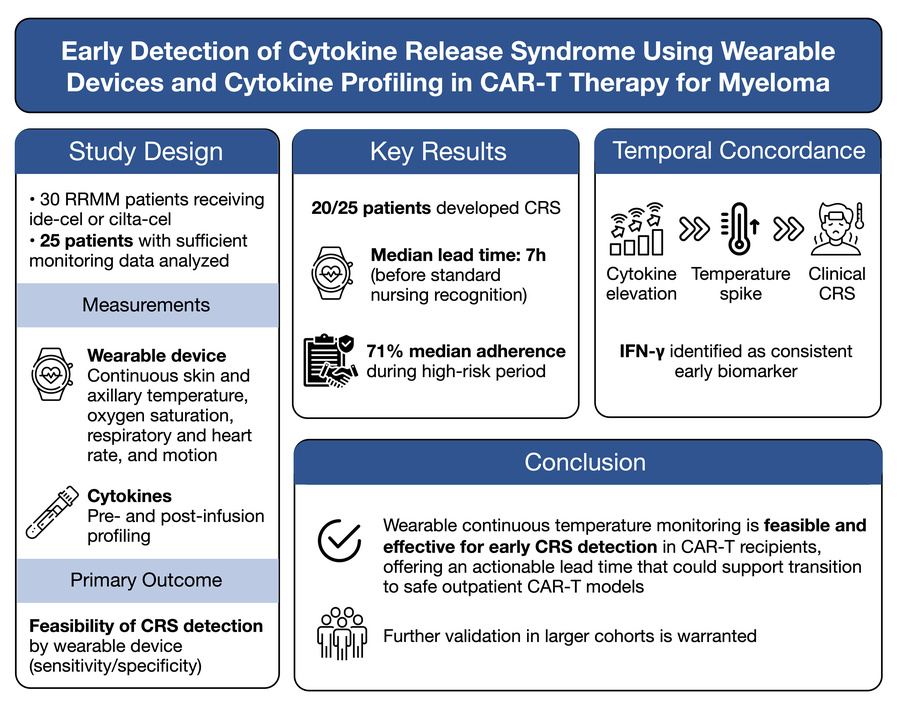
Thirty patients were enrolled in the trial. The median (IQR) length of stay was 13 (12 to 14) days. One patient was excluded from the CRS detection analysis due to concurrent SARS-CoV-2 infection. Of the remaining 29 patients, 25 developed CRS, predominantly Grade 1 (n = 22), with fewer patients experiencing Grade 2 (n = 1), Grade 3 (n = 1), and Grade 4 (n = 1) events (see Figure 1, Table 1, Supplemental Table 1, and CONSORT diagram in Supplemental Figure 1; supplemental material available online with this article; https://doi.org/10.1172/jci.insight.203988DS1).
Wearable temperature monitoring enables early CRS detection with high specificity and feasibility in patients who were hospitalized. Wearable adherence, defined as the proportion of valid sensor observations (nonnull readings) to the total number of possible observations based on the sensor’s sampling rate (every 2 seconds for skin temperature, pulse rate, SpO2, and motion; every 4 seconds for respiratory rate), was 67% (IQR: 52%–78%) overall and 71% (IQR: 55%–84%) during product-specific high-risk periods (days 0–5 postinfusion for ide-cel; days 5–11 for cilta-cel). This was achieved in a hospital setting with blinding to device outputs and utility. Temperature analysis included 25 of 29 patients, excluding 4 due to insufficient axillary temperature data prior to CRS episodes. Most gaps in wearable data occurred when the patients left the floor or the device was removed briefly for personal care.
To optimize the detection of CRS, we tested various observation windows (time for aggregating vital signs) and step sizes (overlap between windows), finding a 60-minute window with a 10-minute step size feasible. Longer windows can smoothen out transient fluctuations, while larger steps reduce data processing (Supplemental Figure 2). These settings can guide home-use applications where daily activities introduce variability (17).
The best model combined axillary temperature with individual baselines and a fixed 36.4°C threshold (observation window: 60 minutes, step size: 10 minutes), detecting 18 of 20 CRS episodes with a sensitivity of 0.72 (mean 0.75; 95% CI 0.60–0.91), specificity of 0.80 (mean 0.76; 95% CI 0.68–0.84), and a median lead time of 7:00 hours (IQR: 3:16) before standard nursing recognition. A simpler fixed threshold of 38.0 °C, corresponding with the ASTCT definition of grade 1 CRS detected only 12 episodes, with a median lead time of 1:45 hours (Table 2 and Supplemental Table 2).
Distinct cytokine profiles and temporal patterns differentiate CRS onset across CAR-T products. Currently, CRS in patients with RRMM is managed per ASTCT guidelines, developed primarily for CD19-directed CAR-T cells. While clinical manifestations are broadly similar, CRS onset and severity vary across CAR-T products, suggesting distinct cytokine responses.
As an exploratory analysis complementing the primary wearable feasibility assessment, we collected peripheral blood samples at predetermined intervals and analyzed them using the Olink Proteomics Platform (see Methods). Longitudinal inflammatory profiles revealed 73 inflammatory markers with significant changes following CAR-T treatment, clustering into distinct temporal patterns (Figure 2, A and B). While most cytokines changed in both treatments, some were treatment-specific changes. Twenty-six cytokines significantly changed specifically following cilta-cel, including IL-18, CD28, and CD70, while ide-cel–specific increases included 10 cytokines such as CCL20, ARG1, and IL-1α, although these were transient. MCP-1 and IL-5 showed more sustained increases with ide-cel than cilta-cel (Supplemental Figure 3).
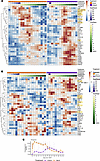 Figure 2
Olink analysis reveals distinct timing of peak inflammation following ide-cel and cilta-cel. (A and B) The heatmaps show scaled model-estimated mean expression of inflammatory biomarkers following treatment with cilta-cel or ide-cel. Biomarkers showing significant changes in both treatment groups are shown in A, whereas biomarkers showing treatment-specific changes are shown in B. Longitudinal expression of each inflammatory marker was analyzed using a linear mixed-effects regression model fit with the DREAM framework, with time as a fixed effect, age as a covariate, and random intercepts for patient ID and plate ID. Comparisons of interest were performed using contrasts, and P values were adjusted for multiple testing using the Benjamini-Hochberg method. Asterisks indicate significant change from baseline at the indicated time point (fold-change > 1.3). (C) Model-estimated fold-change from baseline for IFN-γ following ide-cel or cilta-cel treatment. Fold-changes and significance were derived from the same linear mixed-effects regression/DREAM analysis described above, with Benjamini-Hochberg correction for multiple testing. Asterisks indicate significant change from baseline at each time point (* FDR < 0.05, ** FDR < 0.01, *** FDR < 0.001).
IFN-γ, an early inflammatory marker, rose sharply within 24 hours after ide-cel infusion, with a fold-change of 2.1 (FDR < 0.001), and peaked earlier than cilta-cel, where levels increased more gradually and peaked at 1.6 fold-change by day 8 (Figure 2C). This timing mirrored CRS onset, which was delayed with cilta-cel. Similar treatment-specific temporal patterns were observed for MCP-2, TNF, CCL3, CCL23, CCL4, and CCL19, although IFN-γ showed the largest fold-change from baseline to peak (Figure 2C).
Considering the prominent early increase in IFN-γ and the central role of fever in CRS, we next examined whether IFN-γ dynamics were associated with physiologic temperature measurements captured by the wearable devices. To estimate the within-patient association between axillary temperature and IFN-γ while accounting for repeated observations from the same individual, we employed repeated-measures Pearson correlation implemented in the rmcorr R package. Using this approach, we observed a moderate positive association between mean daily temperature and daily IFN-γ NPX score (r = 0.50, P < 0.001), suggesting that IFN-γ–driven inflammatory activity may contribute to the physiologic temperature elevations detected by wearable monitoring during CRS development (Supplemental Figure 4).
IFN-γ fold-change as a predictive biomarker for CRS. Given the substantial changes in IFN-γ following CAR-T therapy, we evaluated its potential as a simple, single-biomarker predictive marker for CRS onset that could be paired with wearable monitoring in future outpatient protocols. Using daily IFN-γ fold-change from baseline, we developed a decision-tree classifier for cilta-cel patients, achieving a precision of 100%, sensitivity of 75%, specificity of 100%, accuracy of 80%, and F1 score of 85.7%, correctly identifying 9 of 12 CRS patients with no false positives (Figure 3). Patients were identified with a median lead-time of 24 hours before CRS onset (min = 24, max = 144). A logistic regression model performed similarly (precision = 83.3%, sensitivity = 83.3%, specificity = 33.3%, accuracy = 73.3%, F1 = 83.3%) (Table 3).
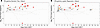 Figure 3
IFN-γ fold-change as a predictive biomarker for CRS. (A) Decision tree model (B) and logistic regression model using IFN-γ log2 fold-change from baseline in patients treated with cilta-cel. Points represent individual observations, and dashed curves illustrate the fitted decision boundaries of the model across time from CAR-T infusion. The red points indicate the day that CRS occurred for each patient, orange labels indicate lead time for each patient, ‘FP’ indicates False Positive (i.e. patient never experienced CRS during the study).
For ide-cel, the decision-tree classifier achieved 83.3% precision, 62.5% sensitivity, 0% specificity, 55.6% accuracy, and F1 of 71.4%, while logistic regression had similar performance (precision = 80%, sensitivity = 50%, specificity = 0%, accuracy = 44.4%, F1 = 61.5%) (Supplemental Figure 5). Low specificity reflected the limited sample size, as only one non-CRS patient was included in the ide-cel cohort. While the performance of these classifiers is likely not generalizable due to the small sample size, the high precision suggested potential predictive value for IFN-γ, warranting validation in larger cohorts.
Exploratory integration of temperature and cytokine data. In further exploratory analysis, we asked whether combining temperature with cytokine levels could suggest improved CRS prediction. For each product (Ide-cel and Cilta-cel), two models were developed: (a) cytokines only and (b) cytokines plus wearable data, for a total of four models. Among 5 classifiers tested (see Methods), Gradient Boosting was optimal for ide-cel (F1: 81%, accuracy: 77%, precision: 86%, sensitivity: 77%, specificity: 67%), and Random Forest for cilta-cel (F1: 82%, accuracy: 79%, precision: 86%, sensitivity: 78%, specificity: 70%). For context, a naive majority-class baseline that always predicts no-CRS (the majority class comprising 82% of ide-cel and 81% of cilta-cel observation) would achieve comparable accuracy but 0% sensitivity and 0% F1 for CRS detection, demonstrating that our models learn a clinically meaningful decision boundary (see Supplemental Table 3). Unlike fixed temperature thresholds used clinically to trigger CRS evaluation (Table 2), these models do not rely on a single physiologic cutoff; instead, they learn multivariable patterns associated with CRS from longitudinal biomarker data.
Key predictive biomarkers varied by product, with IL-5, IFN-γ, NOS3, CD4, and TNFRSF9 most important for ide-cel, and IL-10, CCL4, MCP-2, MCP-3, and IFN-γ for cilta-cel (Supplemental Figure 6). IFN-γ’s presence in both models highlighted its potential role in CRS detection.
Our analysis above demonstrated that both axillary and skin temperature monitoring using wearable devices accurately detected CRS ahead of standard nursing care. Therefore, we hypothesized that adding wearable temperature data would enhance model performance. Skin temperature measured from the upper arm wearable was chosen over axillary due to continuous collection, better adherence, and ease of future deployment. While skin temperature was affected by ambient conditions and skin perfusion, it closely tracked axillary temperature (typically 1–2°C lower) during febrile events. We applied interpolation to align the less frequent cytokine measurements with continuous temperature data for model input (see Methods). Combined models integrating temperature and cytokine data showed mixed results across evaluation metrics: while overall accuracy increased (ide-cel: 85%, Random Forest; cilta-cel: 81%, Gradient Boosting), precision and sensitivity declined relative to cytokine-only models (ide-cel: precision 67%, sensitivity 50%, F1 57%; cilta-cel: precision 43%, sensitivity 38%, F1 40%), though specificity improved for cilta-cel (88%) within a 6-hour prediction window (Supplemental Figure 7). These trade-offs suggest that adding skin temperature may help reduce false positives but does not uniformly enhance prediction, likely reflecting the challenge of aligning interpolated cytokine data with continuous temperature measurements. Time-lagged features, defined as the rate of change between consecutive measurements at 6-, 12-, and 24- hour intervals (ΔC = C(t) − C(t−lag)), were included to capture dynamic biomarker trajectories. While these features contributed to the models, their independent effect on performance could not be reliably isolated, given the small sample size. Overall, these results suggest that integrating physiologic temperature trajectories with cytokine signals may improve discrimination of CRS compared with simple fever thresholds, although larger datasets will be required to fully realize the predictive potential of this multimodal approach. Although underpowered, these exploratory findings are encouraging and provide a rationale for future studies evaluating multimodal biomarker models for earlier CRS detection. Complete performance metrics for CRS classification models are provided in Supplemental Table 3.


