Go to The Journal of Clinical Investigation
  • About
  • Editors
  • Consulting Editors
  • For authors
  • Publication ethics
  • Publication alerts by email
  • Transfers
  • Advertising
  • Job board
  • Contact
  • Physician-Scientist Development
  • Current issue
  • Past issues
  • By specialty
    • COVID-19
    • Cardiology
    • Immunology
    • Metabolism
    • Nephrology
    • Oncology
    • Pulmonology
    • All ...
  • Videos
  • Collections
    • In-Press Preview
    • Resource and Technical Advances
    • Clinical Research and Public Health
    • Research Letters
    • Editorials
    • Perspectives
    • Physician-Scientist Development
    • Reviews
    • Top read articles

  • Current issue
  • Past issues
  • Specialties
  • In-Press Preview
  • Resource and Technical Advances
  • Clinical Research and Public Health
  • Research Letters
  • Editorials
  • Perspectives
  • Physician-Scientist Development
  • Reviews
  • Top read articles
  • About
  • Editors
  • Consulting Editors
  • For authors
  • Publication ethics
  • Publication alerts by email
  • Transfers
  • Advertising
  • Job board
  • Contact
Epithelial TMPRSS2 impairs glucose homeostasis in obese mice by regulating ghrelin–GLP-1 receptor signaling pathway
Dilraj Kaur, Sagarika Chakrabarty, Claudius Witzler, Hongjie Wang, Mengwen Wang, Romina Wolz, Petra Wilgenbus, Jens J.N. Posma, Sivaramakrishna Rachakonda, Federico Marini, Valeriya V. Zinina, Sabine Reyda, Rajinikanth Gogiraju, Claudine Graf, Fahumiya Samad, Katrin Schäfer, Christoph Reinhardt, Natalia Soshnikova, Wolfram Ruf, Thati Madhusudhan
View: Text | PDF
Research Article Inflammation Metabolism Vascular biology

Epithelial TMPRSS2 impairs glucose homeostasis in obese mice by regulating ghrelin–GLP-1 receptor signaling pathway

  • Text
  • PDF
Abstract

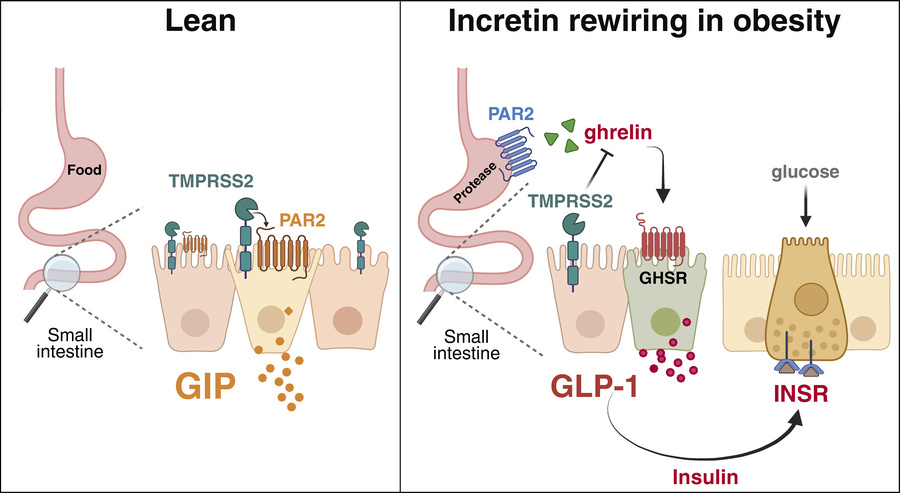
Glucagon-like peptide-1 (GLP-1) and glucose-induced insulinotropic polypeptide (GIP) receptor agonists have revolutionized obesity therapy, but causes of obesity-associated dysregulation of endogenous incretin production remain incompletely understood. Here we show that intestinal transmembrane serine protease 2 (TMPRSS2) plays a pivotal role in deregulating anti-diabetic GLP-1 production in obesity. TMPRSS2 is widely coexpressed in intestinal epithelial cells along with its signaling target protease-activated receptor 2 (PAR2). In addition to its role in regulating coagulation protease–mediated adipose tissue inflammation, PAR2 signaling in the gut controls postprandial GIP secretion. TMPRSS2, but not the epithelial cell–expressed proteases FXa or matriptase, activates PAR2 and thereby promotes postprandial GIP release. Accordingly, a PAR2-mutant mouse resistant to TMPRSS2 cleavage is protected from GIP upregulation and diet-induced obesity. In the context of obesity, TMPRSS2 also attenuates bioavailability of the ghrelin pathway and thereby suppresses GLP-1–mediated control of glucose homeostasis. Pharmacological inhibition or genetic deletion of TMPRSS2 restores ghrelin signaling–dependent GLP-1 secretion and GLP-1’s anti-diabetic effects on nutritional glucose homeostasis. Thus, epithelial cell–expressed TMPRSS2, which critically contributes to the lung pathology in SARS-CoV-2 infection, emerges as an intestinal incretin regulator and a potential link between infection and chronic cardiometabolic diseases.

Authors

Dilraj Kaur, Sagarika Chakrabarty, Claudius Witzler, Hongjie Wang, Mengwen Wang, Romina Wolz, Petra Wilgenbus, Jens J.N. Posma, Sivaramakrishna Rachakonda, Federico Marini, Valeriya V. Zinina, Sabine Reyda, Rajinikanth Gogiraju, Claudine Graf, Fahumiya Samad, Katrin Schäfer, Christoph Reinhardt, Natalia Soshnikova, Wolfram Ruf, Thati Madhusudhan

×

Graphical abstract

Options: View larger image (or click on image)

Copyright © 2026 American Society for Clinical Investigation
ISSN 2379-3708

Sign up for email alerts