
Go to The Journal of Clinical Investigation
  • About
  • Editors
  • Consulting Editors
  • For authors
  • Publication ethics
  • Publication alerts by email
  • Transfers
  • Advertising
  • Job board
  • Contact
  • Physician-Scientist Development
  • Current issue
  • Past issues
  • By specialty
    • COVID-19
    • Cardiology
    • Immunology
    • Metabolism
    • Nephrology
    • Oncology
    • Pulmonology
    • All ...
  • Videos
  • Collections
    • In-Press Preview
    • Resource and Technical Advances
    • Clinical Research and Public Health
    • Research Letters
    • Editorials
    • Perspectives
    • Physician-Scientist Development
    • Reviews
    • Top read articles

  • Current issue
  • Past issues
  • Specialties
  • In-Press Preview
  • Resource and Technical Advances
  • Clinical Research and Public Health
  • Research Letters
  • Editorials
  • Perspectives
  • Physician-Scientist Development
  • Reviews
  • Top read articles
  • About
  • Editors
  • Consulting Editors
  • For authors
  • Publication ethics
  • Publication alerts by email
  • Transfers
  • Advertising
  • Job board
  • Contact
Longitudinal clinical proteomics reveals pneumonia type–specific protein biomarkers and autoantibodies
Anna Semenova, Taylor A. Poor, Johannes B. Müller-Reif, Sai Rama Sridatta Prakki, Phillip Geyer, Martin Mück-Häusl, Rogan A. Grant, Luke Rasmussen, Lesca M. Holdt, Daniel Teupser, Matthias Mann, Ali Ö. Yildirim, Richard G. Wunderink, Alexander V. Misharin, Ben D. Singer, G.R. Scott Budinger, Theodore S. Kapellos, Herbert B. Schiller
View: Text | PDF
Research Article Infectious disease Inflammation

Longitudinal clinical proteomics reveals pneumonia type–specific protein biomarkers and autoantibodies

  • Text
  • PDF
Abstract

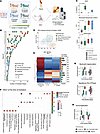
Community-acquired pneumonia is a major cause of morbidity and mortality globally. Specific molecular endotypes are currently not well defined, and different viral or bacterial pathogens may trigger specific host responses and pathogenic mechanisms. We performed longitudinal proteomic profiling of bronchoalveolar lavage fluid and plasma from bacterial, influenza, and SARS-CoV-2–driven pneumonia. Our analysis revealed highly pneumonia type–specific proteomic signatures, including COVID-19–specific antibodies locally produced in the lung. These antibodies showed biased immunoglobulin V–domain usage, linked to a CD69/CD83 plasma cell state associated with disease severity and degree of autoimmunity. Using mass spectrometry–driven autoantibody profiling in 2 independent COVID-19 cohorts, we identified 177 putative autoantibodies targeting extracellular matrix, nuclear, and immune-related proteins. Of note, temporal changes in autoantibody profiles correlated with clinical markers of inflammation, organ dysfunction, and duration of hospitalization. These findings highlight the autoimmune aspects of COVID-19 and provide potential biomarkers and therapeutic targets to help improve patient outcomes.

Authors

Anna Semenova, Taylor A. Poor, Johannes B. Müller-Reif, Sai Rama Sridatta Prakki, Phillip Geyer, Martin Mück-Häusl, Rogan A. Grant, Luke Rasmussen, Lesca M. Holdt, Daniel Teupser, Matthias Mann, Ali Ö. Yildirim, Richard G. Wunderink, Alexander V. Misharin, Ben D. Singer, G.R. Scott Budinger, Theodore S. Kapellos, Herbert B. Schiller

×

Supporting data values - Download (86.27 KB)

No preview available for this file type: xlsx
Use the download link to access the file.
Advertisement

Copyright © 2026 American Society for Clinical Investigation
ISSN 2379-3708

Sign up for email alerts