
Clinical Research and Public HealthImmunologyOncology
Open Access |  10.1172/jci.insight.198203
Pretreatment naive T cells are associated with severe irAE following PD-1/CTLA-4 checkpoint blockade for melanoma
Kathryne E. Marks,1 Alice Horisberger,1 Mehreen Elahee,1 Ifeoluwakiisi A. Adejoorin,1 Nilasha Ghosh,2 Michael Postow,3 Laura Donlin,4 Anne R. Bass,2 and Deepak A. Rao1
1Division of Rheumatology, Inflammation, Immunity, Brigham and Women’s Hospital and Harvard Medical School, Boston, Massachusetts, USA.
2Division of Rheumatology, Hospital for Special Surgery and Weill Cornell Medicine, New York, New York, USA.
3Memorial Sloan Kettering Center and Weill Cornell Medical College, New York, New York, USA.
4HSS Research Institute, Hospital for Special Surgery, New York, New York, USA.
Address correspondence to: Deepak A. Rao, Brigham and Women’s Hospital Harvard Medical School, 60 Fenwood Road, Room 6002R, Boston, Massachusetts, 02115, USA. Email: darao@bwh.harvard.edu.
Find articles by Marks, K. in: PubMed | Google Scholar
1Division of Rheumatology, Inflammation, Immunity, Brigham and Women’s Hospital and Harvard Medical School, Boston, Massachusetts, USA.
2Division of Rheumatology, Hospital for Special Surgery and Weill Cornell Medicine, New York, New York, USA.
3Memorial Sloan Kettering Center and Weill Cornell Medical College, New York, New York, USA.
4HSS Research Institute, Hospital for Special Surgery, New York, New York, USA.
Address correspondence to: Deepak A. Rao, Brigham and Women’s Hospital Harvard Medical School, 60 Fenwood Road, Room 6002R, Boston, Massachusetts, 02115, USA. Email: darao@bwh.harvard.edu.
Find articles by Horisberger, A. in: PubMed | Google Scholar
1Division of Rheumatology, Inflammation, Immunity, Brigham and Women’s Hospital and Harvard Medical School, Boston, Massachusetts, USA.
2Division of Rheumatology, Hospital for Special Surgery and Weill Cornell Medicine, New York, New York, USA.
3Memorial Sloan Kettering Center and Weill Cornell Medical College, New York, New York, USA.
4HSS Research Institute, Hospital for Special Surgery, New York, New York, USA.
Address correspondence to: Deepak A. Rao, Brigham and Women’s Hospital Harvard Medical School, 60 Fenwood Road, Room 6002R, Boston, Massachusetts, 02115, USA. Email: darao@bwh.harvard.edu.
Find articles by Elahee, M. in: PubMed | Google Scholar
1Division of Rheumatology, Inflammation, Immunity, Brigham and Women’s Hospital and Harvard Medical School, Boston, Massachusetts, USA.
2Division of Rheumatology, Hospital for Special Surgery and Weill Cornell Medicine, New York, New York, USA.
3Memorial Sloan Kettering Center and Weill Cornell Medical College, New York, New York, USA.
4HSS Research Institute, Hospital for Special Surgery, New York, New York, USA.
Address correspondence to: Deepak A. Rao, Brigham and Women’s Hospital Harvard Medical School, 60 Fenwood Road, Room 6002R, Boston, Massachusetts, 02115, USA. Email: darao@bwh.harvard.edu.
Find articles by Adejoorin, I. in: PubMed | Google Scholar
1Division of Rheumatology, Inflammation, Immunity, Brigham and Women’s Hospital and Harvard Medical School, Boston, Massachusetts, USA.
2Division of Rheumatology, Hospital for Special Surgery and Weill Cornell Medicine, New York, New York, USA.
3Memorial Sloan Kettering Center and Weill Cornell Medical College, New York, New York, USA.
4HSS Research Institute, Hospital for Special Surgery, New York, New York, USA.
Address correspondence to: Deepak A. Rao, Brigham and Women’s Hospital Harvard Medical School, 60 Fenwood Road, Room 6002R, Boston, Massachusetts, 02115, USA. Email: darao@bwh.harvard.edu.
Find articles by Ghosh, N. in: PubMed | Google Scholar
1Division of Rheumatology, Inflammation, Immunity, Brigham and Women’s Hospital and Harvard Medical School, Boston, Massachusetts, USA.
2Division of Rheumatology, Hospital for Special Surgery and Weill Cornell Medicine, New York, New York, USA.
3Memorial Sloan Kettering Center and Weill Cornell Medical College, New York, New York, USA.
4HSS Research Institute, Hospital for Special Surgery, New York, New York, USA.
Address correspondence to: Deepak A. Rao, Brigham and Women’s Hospital Harvard Medical School, 60 Fenwood Road, Room 6002R, Boston, Massachusetts, 02115, USA. Email: darao@bwh.harvard.edu.
Find articles by Postow, M. in: PubMed | Google Scholar
1Division of Rheumatology, Inflammation, Immunity, Brigham and Women’s Hospital and Harvard Medical School, Boston, Massachusetts, USA.
2Division of Rheumatology, Hospital for Special Surgery and Weill Cornell Medicine, New York, New York, USA.
3Memorial Sloan Kettering Center and Weill Cornell Medical College, New York, New York, USA.
4HSS Research Institute, Hospital for Special Surgery, New York, New York, USA.
Address correspondence to: Deepak A. Rao, Brigham and Women’s Hospital Harvard Medical School, 60 Fenwood Road, Room 6002R, Boston, Massachusetts, 02115, USA. Email: darao@bwh.harvard.edu.
Find articles by Donlin, L. in: PubMed | Google Scholar
1Division of Rheumatology, Inflammation, Immunity, Brigham and Women’s Hospital and Harvard Medical School, Boston, Massachusetts, USA.
2Division of Rheumatology, Hospital for Special Surgery and Weill Cornell Medicine, New York, New York, USA.
3Memorial Sloan Kettering Center and Weill Cornell Medical College, New York, New York, USA.
4HSS Research Institute, Hospital for Special Surgery, New York, New York, USA.
Address correspondence to: Deepak A. Rao, Brigham and Women’s Hospital Harvard Medical School, 60 Fenwood Road, Room 6002R, Boston, Massachusetts, 02115, USA. Email: darao@bwh.harvard.edu.
Find articles by Bass, A. in: PubMed | Google Scholar
1Division of Rheumatology, Inflammation, Immunity, Brigham and Women’s Hospital and Harvard Medical School, Boston, Massachusetts, USA.
2Division of Rheumatology, Hospital for Special Surgery and Weill Cornell Medicine, New York, New York, USA.
3Memorial Sloan Kettering Center and Weill Cornell Medical College, New York, New York, USA.
4HSS Research Institute, Hospital for Special Surgery, New York, New York, USA.
Address correspondence to: Deepak A. Rao, Brigham and Women’s Hospital Harvard Medical School, 60 Fenwood Road, Room 6002R, Boston, Massachusetts, 02115, USA. Email: darao@bwh.harvard.edu.
Find articles by
Rao, D.
in:
PubMed
|
Google Scholar
|

Published November 26, 2025 - More info
JCI Insight. 2026;11(2):e198203. https://doi.org/10.1172/jci.insight.198203.
© 2026 Marks et al. This work is licensed under the Creative Commons Attribution 4.0 International License. To view a copy of this license, visit http://creativecommons.org/licenses/by/4.0/.
Received: July 22, 2025; Accepted: November 21, 2025

-
Results
Patient characteristics. We obtained PBMCs from patients with advanced melanoma enrolled in the ADAPT-IT (5). Patients in this multicenter, single-arm, phase II clinical trial were treated with 2 doses of both nivolumab (1 mg/kg), an anti–PD-1 therapy, and ipilimumab (3 mg/kg), an anti–CTLA-4 therapy, either followed by nivolumab monotherapy every 2 or 4 weeks or 2 more doses of combination therapy followed by nivolumab monotherapy every 2 or 4 weeks. Patients in this trial had no prior exposure to ICI-therapy and no active autoimmune disease at the time of participation. The demographics of analyzed patients are summarized in Table 1 and Supplemental Table 1 (supplemental material available online with this article; https://doi.org/10.1172/jci.insight.198203DS1). Among the overall cohort, the mean age was 60 years, and the cohort was 59% male.
After treatment initiation, participants were diagnosed with irAEs of varying severity, type, and onset time. The most common irAEs were gastrointestinal and endocrine related. The median number of irAEs per participant was 3. In total, 61% of paired patients had already been diagnosed with at least 1 irAE at the 6-week collection time point, and the majority of participants (95%) were diagnosed with an irAE at some point during the trial. For analysis of baseline sample associations with irAE severity, we considered all irAEs diagnosed at any time following the initial dosing. irAEs were graded 0–5 using the Common Terminology Criteria for Adverse Events (CTCAE) and were divided into low (grade 1–2) and high (grade 3–5) severity (24).
We obtained PBMCs before treatment from 49 unique patients and paired blood 6 weeks after treatment initiation (after 2 doses of combination ICI therapy) from 31 of these patients. Cryopreserved PBMCs were processed for mass cytometry using a panel of antibodies to identify major lineages as well as specific T cell phenotypes (Figure 1A). Gated live cells, gated using FlowJo, were corrected for batch effects using the CyCombine R package (25) and then clustered in an unsupervised manner using Seurat (26). We then analyzed the data for effects of therapy and associations with irAE severity.
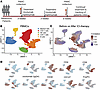 Figure 1
Changes in circulating cell frequency following combination ICI therapy. (A) Schematic of experimental setup of analysis of PBMCs from patients with melanoma undergoing ICI treatment. (B) UMAP representation following unsupervised clustering of PBMCs of melanoma patients before and after treatment (n = 49 patients; 31 paired). (C) CNA of before treatment samples versus after treatment samples. Red cells indicate neighborhoods significantly associated with posttreatment samples, while blue cells indicate neighborhoods significantly associated with pretreatment samples. CNA (28) global P = 0.023; FDR < 0.1. (D) Feature plots of the indicated markers on the PBMC UMAP. Red indicates high expression.
Changes in proportions of immune cells following combination ICI therapy. We looked broadly at changes in frequencies of circulating immune cell populations induced by ICI therapy. The total proportions of CD4+ T cells, CD8+ T cells, NK cells, or myeloid cells did not consistently change following initiation of combination ICI therapy (Figure 1B and Supplemental Figure 1, A and B). The frequency of total circulating B cells, however, was reduced following ICI therapy (Supplemental Figure 1A). To gain further insight into specific B cell changes following checkpoint blockade and to determine any association with irAE severity in this cohort, we performed flow cytometry focused on B cell populations on the same samples. We confirmed a reduction of CD19+ cells in PBMCs in this dataset (Supplemental Figure 2A). However, among CD19+ B cells, we observed increases in the proportion of both CD21lo B cells and CD38hiCD27hi plasmablasts (Supplemental Figure 2, B and C). The frequency of CD27+ memory B cells did not change after therapy; however, IgG+ memory B cells decreased significantly in most patients (Supplemental Figure 2, D and E). Despite the changes in B cell frequencies, the baseline frequencies of each B cell population and the changes induced by ICI therapy in each B cell population were similar between those who were diagnosed with a severe irAE or a mild irAE (Supplemental Figure 3, A–D).
In addition to B cells, we also analyzed frequencies of plasmacytoid DCs (pDCs) before and after combination ICI therapy by flow cytometry due to their association with autoimmune diseases and their production of type I IFN, a factor that promotes expansion of CD38hiCD8+ T cells in ICI-associated arthritis (27). pDCs, identified as CD3–CD19–CD14–CD11C–BDCA2+CD123+ cells, were decreased following ICI therapy, with similar decreases in patients with and without severe irAE development (Supplemental Figure 2, F and L). The frequency of pDCs at baseline was not associated with the irAE severity, and despite decreasing in most patients, the level of decrease in pDC frequency did not vary with irAE severity level (Supplemental Figure 2M).
To assess effects of ICI therapy on circulating immune cell phenotypes broadly yet with high resolution, we utilized covarying neighborhood analysis (CNA) within the mass cytometry data (28). We observed significant differences in T cells, including clear increases in the posttreatment group in subsets of CD4+ and CD8+ T cells (Figure 1C). Expanded T cells had phenotypes of memory T cell subsets characterized by high levels of CD38 and low levels of CD127, and they express the proliferation marker Ki67 (Figure 1D).
Changes in circulating T cells following combination ICI therapy. To evaluate changes in T cells more granularly, we performed focused analyses on CD4+ T cells and CD8+ T cells (Figure 2, A and D, and Supplemental Figure 3, A and B). CNA and cluster analyses demonstrated widespread changes in both CD4+ and CD8+ T cell composition following ICI therapy (Figure 2, B and E). The most clearly expanded CD4+ T cells were in CD4 Cluster 10, which showed high levels of CD38 and low levels of CD127 as well as expression of granzyme B, granzyme K, perforin, and HLA-DR (Figure 2, C and H, and Supplemental Figure 3A). These CD4+ T cells were the highest expressors of the proliferation marker Ki67 (Figure 2C). Similarly, CD8 Cluster 6, which closely resembles CD4 Cluster 10, was dramatically induced following ICI therapy (Figure 2, F and I), consistent with prior analyses (27). Interestingly, CD4 Cluster 8, which was characterized by granzyme B expression, but not CD38, did not change following ICI therapy (Figure 2, B and C, and Supplemental Figure 3C). Thus, cytotoxic CD4+ T cells in general did not increase, but rather a separate population of proliferating CD4s with granzyme B expression increased. We confirmed these changes to T cell populations using biaxial gating (Supplemental Figure 3, E and F).
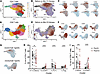 Figure 2
Changes in T cells following combination ICI therapy. (A) UMAP representation following unsupervised clustering of CD4 T cells. (B) CNA of pretreatment samples versus after treatment samples. CNA (28) global P = 0.001; FDR <0.1. (C) Feature plots of the indicated markers on the CD4 T cell UMAP. (D) UMAP representation following unsupervised clustering of CD8 T cells. (E) CNA of before treatment samples versus after treatment samples. P = 0.001. (F) Feature plots of the indicated markers on the CD8 T cell UMAP. (G) Feature plots of in the CD4 (left) and CD8 (right) T cells indicating detection of nivolumab. (H and I) Paired analysis of percent of indicated cluster in CD4 or CD8 T cells. **P < 0.01, ***P < 0.001, ****P < 0.0001 by Wilcoxon paired test.
Our mass cytometry panel included an antibody against IgG4, the isotype of nivolumab (29), enabling detection and evaluation of cells bound by nivolumab. Most of the IgG4+ cells, the cells currently being treated by nivolumab, were identified in the expanded Ki67hiCD38hi cluster. This observation was found in both the CD4 and CD8+ T cells (Figure 2G). Both CD8+ and CD4+ T cells were bound by nivolumab, although CD8+ T cells had a higher mean binding of nivolumab (Supplemental Figure 5, A and B). The frequency of nivolumab-bound CD4+ or CD8+ T cells was not higher in those patients with current or future severe irAEs (grade 3–4) compared with patients with less severe irAEs (grade 1–2) (Supplemental Figure 5C). Similarly, the expression of PD-1 on T cells at baseline was not different between patients with irAEs of grades 0–2 irAEs (Low Severity) and grades 3–4 irAEs (High Severity) and was not correlated with time of irAE onset or the total number of irAEs (Supplemental Figure 5D). Other CD4+ T cell cluster changes included a decrease in the proportion of Cluster 4, characterized by CCR6 and CD161, representing a decrease in Th17 cells (Figure 2H and Supplemental Figure 3, C–F). Additionally, both naive CD4+ and CD8+ T cells exhibited a slight but significant decrease in proportion following ICI therapy (Figure 2, H and I, and Supplemental Figure 3, C–F).
We also observed a significant increase in the frequency of Cluster 7 following combination ICI therapy. Cluster 7 was characterized by FOXP3, CD25, and Helios, consistent with CD4+ Tregs (Figure 2H). In this cohort, ICI therapy induced an overall increase in frequency of CD25hiCD127–CD4+ T cells (Supplemental Figure 4, A and C). Within Tregs, we observed clear changes in Treg phenotypes following ICI therapy (Supplemental Figure 4B). Several markers related to Treg function and activation increased, including FOXP3, Helios, CD39, CD38, ICOS, HLA-DR, and Ki67, while TCF1 decreased (Supplemental Figure 4, D and E).
Frequency of naive T cells is associated with irAE severity. We next attempted to identify PBMC populations in the baseline, pretreatment samples that were associated with severity of future irAE following ICI therapy. We first employed CNA to look for correlations of fine-grained neighborhoods with severity of subsequent irAEs (28). CNA comparing PBMCs from patients who subsequently developed high grade irAEs (High Severity) to those who did not (Low Severity) identified several cell neighborhoods significantly correlated with irAE severity (Figure 3A). The cell neighborhoods with positive correlation values correlated with development of severe irAEs; these neighborhoods were primarily composed of naive CD4+ and naive CD8+ T cells (Figure 3A). Among CD4+ T cells, the association of naive CD4+ T cells with development of severe irAEs remained even when adjusting for age and sex (Figure 3, B and C). To confirm this association using a cell cluster–based analysis, we implemented mixed-effects modeling of association of single cells (MASC), which identifies cell clusters associated with a clinical variable using a mixed-effect logistic regression model at a single-cell level. Consistent with CNA results, MASC analyses controlling for age and sex also identified CD4 Clusters 0 and 1 as significantly associated with severe irAEs, while CD4 Clusters 5, 6, 9, and 13 were negatively associated with severe irAEs (Figure 3D). CD4 Clusters 0 and 1 contained naive CD4 T cells, while Clusters 5, 6, 9, and 13 contained memory CD4 populations including those expressing CD40L, Tbet, CD57, and granzyme B. Among CD8+ T cell clusters, MASC analysis highlighted the naive CD8+ T cell cluster, Cluster 0, as associated with development of severe irAEs; however, this observation did not pass correction for multiple testing (Supplemental Figure 6E).
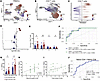 Figure 3
Naive T cell levels before ICI therapy are associated with irAE severity. (A and B) CNA for high severity irAE PBMCs or CD4 T cells before ICI treatment. Red correlation values indicate significant positive association with development of severe irAE. All colored cells are filtered for FDR < 0.1. (C) Correlation values of cells shown in B sorted by cluster membership of the correlated cells. Red indicates positive correlation with severe irAEs. (D) MASC analysis of CD4 T cells. Red indicates positive association with high severity irAE, and blue indicates association with low severity irAE. P < 0.05 and are filtered for FDR < 0.1. Bars indicate confidence interval. (E) Proportion of CD4 clusters at baseline with P < 0.05 for comparison of low versus high severity. (F) ROC curves of proportion of CD4 clusters 0, 1, and CD8 Cluster 0 (in blue) and CD4 clusters 0, 1, 6, and 9 and CD8 Cluster 0 (in green) for development of severe irAE. (G) Gating of mass cytometry data to quantify frequency of naive T cells (CD3+CD4+CD45RA+CCR7– or CD3+CD8+CD45RA+CCR7–) out of total PBMCs of patients grouped by irAE severity. *P < 0.05 by Mann-Whitney U test. (H and I) Spearman correlation of gated naive CD4 T cell proportion before ICI treatment with maximum grade or total number of irAEs (n = 37 patients). (J) ROC curve of proportion of naive CD4 T cells and naive CD8 T cells for development of severe irAE.
The proportions of CD4+ cluster T cell clusters 0 and 1, out of all CD4 T cells, were significantly higher at baseline in those who developed high severity irAEs, and the proportions of clusters 6 and 9 were significantly lower (Figure 3E). Additionally, the proportion of CD8 Cluster 0 out of all CD8 T cells was significantly higher in those who developed high severity irAEs than those with low severity irAEs (Supplemental Figure 6F). In ROC analysis, the AUC for the baseline proportion of CD4 T cell clusters 0, 1, 6, 9, and CD8 Cluster 0 could predict severe irAE (AUC 0.856; 95% CI, 0.734–0.934) (Figure 3F). The same analysis including naive T cells only, CD4 T cell clusters 0 and 1, and CD8 Cluster 0, resulted in the same AUC (Figure 3F).
We next attempted to confirm these observations using biaxial gating of the mass cytometry data. Biaxial gating of the memory CD4 T cell subsets could not replicate the clusters associated with lower severity irAEs (clusters 6 and 9); therefore, we did not pursue these further. However, naive CD4+ or CD8+ T cells, corresponding to clusters 0 and 1, could be easily gated as CD19–CD14–CD3+CD4+/CD8+CD45RA+CCR7+. Patients who developed severe irAEs had a higher proportion of gated naive CD4 and CD8+ T cells out of all PBMCs at baseline than patients who did not develop severe irAEs (Figure 3G). Furthermore, the frequency of all naive CD4+ T cells (r = 0.4377, P = 0.012) and naive CD8+ T cells (r = 0.3854, P = 0.029) before therapy was significantly correlated with maximum grade of future irAE (Figure 3H and Supplemental Figure 6C). Frequency of naive CD4+ T cells, but not naive CD8+ T cells, at baseline was also correlated with the total number of irAEs per patient (r = 0.4284, P = 0.01) (Figure 3I and Supplemental Figure 6D). ROC analysis of gated naive CD4 and CD8+ T cells predicted onset of severe irAE (AUC 0.776; 95% CI, 0.622–0.931) (Figure 3J). Naive CD4 T cell proportion at baseline was not associated with overall survival of melanoma within this cohort (Supplemental Figure 6, F and G) (30).


