
Submit a comment
Abstract
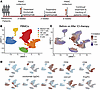
Immune checkpoint inhibitors (ICIs) such as anti–PD-1 and anti–CTLA-4 antibodies are used to induce an immune response against many types of tumors. However, ICIs often also induce autoimmune responses, referred to as immune-related adverse events (irAEs), which occur unpredictably and at varying levels of severity. We utilized high-dimensional immunophenotyping of longitudinal blood samples from patients with metastatic melanoma treated with combination anti–PD-1/CTLA-4 therapy in a clinical trial to characterize alterations in immune profiles induced by combination ICI therapy and to identify immune features associated with severe irAE development. T cell profiling highlighted that ICI therapy induces prominent expansions of activated, CD38hi CD4+ and CD8+ T cells, which are frequently bound by the therapeutic anti–PD-1 antibody, as well as substantial changes in Treg phenotypes. However, neither the baseline frequency nor the extent of expansion of these cell populations was associated with severe irAE development. Rather, naive CD4+ T cell abundance pretreatment was significantly associated with development of severe irAEs and with the number of irAEs developed. These results indicate the abundance of naive CD4+ T cells as a predictive feature for the development of severe irAEs following combination ICI therapy.
Authors
Kathryne E. Marks, Alice Horisberger, Mehreen Elahee, Ifeoluwakiisi A. Adejoorin, Nilasha Ghosh, Michael Postow, Laura Donlin, Anne R. Bass, Deepak A. Rao
Guidelines
The Editorial Board will only consider comments that are deemed relevant and of interest to readers. The Journal will not post data that have not been subjected to peer review; or a comment that is essentially a reiteration of another comment.
- Comments appear on the Journal’s website and are linked from the original article’s web page.
- Authors are notified by email if their comments are posted.
- The Journal reserves the right to edit comments for length and clarity.
- No appeals will be considered.
- Comments are not indexed in PubMed.
Specific requirements
- Maximum length, 400 words
- Entered as plain text or HTML
- Author’s name and email address, to be posted with the comment
- Declaration of all potential conflicts of interest (even if these are not ultimately posted); see the Journal’s conflict-of-interest policy
- Comments may not include figures


