
Go to The Journal of Clinical Investigation
  • About
  • Editors
  • Consulting Editors
  • For authors
  • Publication ethics
  • Publication alerts by email
  • Transfers
  • Advertising
  • Job board
  • Contact
  • Physician-Scientist Development
  • Current issue
  • Past issues
  • By specialty
    • COVID-19
    • Cardiology
    • Immunology
    • Metabolism
    • Nephrology
    • Oncology
    • Pulmonology
    • All ...
  • Videos
  • Collections
    • In-Press Preview
    • Resource and Technical Advances
    • Clinical Research and Public Health
    • Research Letters
    • Editorials
    • Perspectives
    • Physician-Scientist Development
    • Reviews
    • Top read articles

  • Current issue
  • Past issues
  • Specialties
  • In-Press Preview
  • Resource and Technical Advances
  • Clinical Research and Public Health
  • Research Letters
  • Editorials
  • Perspectives
  • Physician-Scientist Development
  • Reviews
  • Top read articles
  • About
  • Editors
  • Consulting Editors
  • For authors
  • Publication ethics
  • Publication alerts by email
  • Transfers
  • Advertising
  • Job board
  • Contact

Citations to this article
Extracellular matrix alterations in chronic ischemic cardiomyopathy revealed by quantitative proteomics
Kevin M. Buck, Holden T. Rogers, Zachery R. Gregorich, Morgan W. Mann, Timothy J. Aballo, Zhan Gao, Emily A. Chapman, Andrew J. Perciaccante, Scott J. Price, Ienglam Lei, Paul C. Tang, Ying Ge
View: Text | PDF
Research Article Cardiology Genetics

Extracellular matrix alterations in chronic ischemic cardiomyopathy revealed by quantitative proteomics

  • Text
  • PDF
Abstract

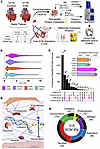
Ischemic cardiomyopathy (ICM) is a leading cause of heart failure characterized by extensive remodeling of the cardiac extracellular matrix (ECM). While initially adaptive, ECM deposition following ischemic injury eventually turns maladaptive, promoting adverse cardiac remodeling. The strong link between the extent of fibrosis and adverse clinical outcomes has led to growing interest in ECM-targeted therapies to prevent or reverse maladaptive cardiac remodeling in ICM; yet, the precise composition of the ECM in ICM remains poorly defined. In this study, we employed sequential protein extraction enabled by the photocleavable surfactant Azo to enrich ECM proteins from left ventricular tissues of patients with end-stage ICM and nonfailing donor hearts. High-resolution mass spectrometry–based quantitative proteomics identified and quantified over 6,000 unique protein groups, including 315 ECM proteins. We discovered significant upregulation of key ECM components, particularly glycoproteins, proteoglycans, collagens, and ECM regulators. Notably, LOXL1, FBLN1, and VCAN were among the most differentially expressed. Functional enrichment analyses revealed enhanced TGFB signaling, integrin-mediated adhesion, and complement activation in ICM tissues, suggesting a feedback loop driving continued ECM deposition in the end-stage failing heart. Together, our findings provide a comprehensive proteomic landscape of ECM alterations in the end-stage ICM myocardium and identify promising molecular targets for therapeutic intervention.

Authors

Kevin M. Buck, Holden T. Rogers, Zachery R. Gregorich, Morgan W. Mann, Timothy J. Aballo, Zhan Gao, Emily A. Chapman, Andrew J. Perciaccante, Scott J. Price, Ienglam Lei, Paul C. Tang, Ying Ge

×

Loading citation information...
Advertisement

Copyright © 2025 American Society for Clinical Investigation
ISSN 2379-3708

Sign up for email alerts