
Research ArticleHematologyNephrology
Open Access |  10.1172/jci.insight.193884
Thrombomodulin protects against acute vascular and multiorgan injury in sickle cell disease
Guohui Ren,1 Dustin R. Fraidenburg,2 Suman Setty,3 Jiwang Chen,2,4 Janae Gonzales,2 Maria Armila Ruiz,1 Zalaya Ivy,1 Najmeh Eskandari,1 Richard D. Minshall,5 James P. Lash,6 Victor R. Gordeuk,1 and Santosh L. Saraf1
1Division of Hematology and Oncology, Department of Medicine,
2Division of Pulmonary, Critical Care, Sleep and Allergy, Department of Medicine,
3Department of Pathology,
4Cardiovascular Research Core,
5Departments of Anesthesiology and Pharmacology, College of Medicine, and
6Division of Nephrology, Department of Medicine, University of Illinois Chicago, Chicago, Illinois, USA.
Address correspondence to: Santosh L. Saraf, Division of Hematology-Oncology, University of Illinois at Chicago, 820 South Wood Street, Suite 172, Chicago, Illinois, 60612, USA. Phone: 312.996.2187; Email: ssaraf@uic.edu.
Find articles by Ren, G. in: PubMed | Google Scholar
1Division of Hematology and Oncology, Department of Medicine,
2Division of Pulmonary, Critical Care, Sleep and Allergy, Department of Medicine,
3Department of Pathology,
4Cardiovascular Research Core,
5Departments of Anesthesiology and Pharmacology, College of Medicine, and
6Division of Nephrology, Department of Medicine, University of Illinois Chicago, Chicago, Illinois, USA.
Address correspondence to: Santosh L. Saraf, Division of Hematology-Oncology, University of Illinois at Chicago, 820 South Wood Street, Suite 172, Chicago, Illinois, 60612, USA. Phone: 312.996.2187; Email: ssaraf@uic.edu.
Find articles by Fraidenburg, D. in: PubMed | Google Scholar
1Division of Hematology and Oncology, Department of Medicine,
2Division of Pulmonary, Critical Care, Sleep and Allergy, Department of Medicine,
3Department of Pathology,
4Cardiovascular Research Core,
5Departments of Anesthesiology and Pharmacology, College of Medicine, and
6Division of Nephrology, Department of Medicine, University of Illinois Chicago, Chicago, Illinois, USA.
Address correspondence to: Santosh L. Saraf, Division of Hematology-Oncology, University of Illinois at Chicago, 820 South Wood Street, Suite 172, Chicago, Illinois, 60612, USA. Phone: 312.996.2187; Email: ssaraf@uic.edu.
Find articles by Setty, S. in: PubMed | Google Scholar
1Division of Hematology and Oncology, Department of Medicine,
2Division of Pulmonary, Critical Care, Sleep and Allergy, Department of Medicine,
3Department of Pathology,
4Cardiovascular Research Core,
5Departments of Anesthesiology and Pharmacology, College of Medicine, and
6Division of Nephrology, Department of Medicine, University of Illinois Chicago, Chicago, Illinois, USA.
Address correspondence to: Santosh L. Saraf, Division of Hematology-Oncology, University of Illinois at Chicago, 820 South Wood Street, Suite 172, Chicago, Illinois, 60612, USA. Phone: 312.996.2187; Email: ssaraf@uic.edu.
Find articles by Chen, J. in: PubMed | Google Scholar
1Division of Hematology and Oncology, Department of Medicine,
2Division of Pulmonary, Critical Care, Sleep and Allergy, Department of Medicine,
3Department of Pathology,
4Cardiovascular Research Core,
5Departments of Anesthesiology and Pharmacology, College of Medicine, and
6Division of Nephrology, Department of Medicine, University of Illinois Chicago, Chicago, Illinois, USA.
Address correspondence to: Santosh L. Saraf, Division of Hematology-Oncology, University of Illinois at Chicago, 820 South Wood Street, Suite 172, Chicago, Illinois, 60612, USA. Phone: 312.996.2187; Email: ssaraf@uic.edu.
Find articles by Gonzales, J. in: PubMed | Google Scholar
1Division of Hematology and Oncology, Department of Medicine,
2Division of Pulmonary, Critical Care, Sleep and Allergy, Department of Medicine,
3Department of Pathology,
4Cardiovascular Research Core,
5Departments of Anesthesiology and Pharmacology, College of Medicine, and
6Division of Nephrology, Department of Medicine, University of Illinois Chicago, Chicago, Illinois, USA.
Address correspondence to: Santosh L. Saraf, Division of Hematology-Oncology, University of Illinois at Chicago, 820 South Wood Street, Suite 172, Chicago, Illinois, 60612, USA. Phone: 312.996.2187; Email: ssaraf@uic.edu.
Find articles by Ruiz, M. in: PubMed | Google Scholar
1Division of Hematology and Oncology, Department of Medicine,
2Division of Pulmonary, Critical Care, Sleep and Allergy, Department of Medicine,
3Department of Pathology,
4Cardiovascular Research Core,
5Departments of Anesthesiology and Pharmacology, College of Medicine, and
6Division of Nephrology, Department of Medicine, University of Illinois Chicago, Chicago, Illinois, USA.
Address correspondence to: Santosh L. Saraf, Division of Hematology-Oncology, University of Illinois at Chicago, 820 South Wood Street, Suite 172, Chicago, Illinois, 60612, USA. Phone: 312.996.2187; Email: ssaraf@uic.edu.
Find articles by Ivy, Z. in: PubMed | Google Scholar
1Division of Hematology and Oncology, Department of Medicine,
2Division of Pulmonary, Critical Care, Sleep and Allergy, Department of Medicine,
3Department of Pathology,
4Cardiovascular Research Core,
5Departments of Anesthesiology and Pharmacology, College of Medicine, and
6Division of Nephrology, Department of Medicine, University of Illinois Chicago, Chicago, Illinois, USA.
Address correspondence to: Santosh L. Saraf, Division of Hematology-Oncology, University of Illinois at Chicago, 820 South Wood Street, Suite 172, Chicago, Illinois, 60612, USA. Phone: 312.996.2187; Email: ssaraf@uic.edu.
Find articles by Eskandari, N. in: PubMed | Google Scholar
1Division of Hematology and Oncology, Department of Medicine,
2Division of Pulmonary, Critical Care, Sleep and Allergy, Department of Medicine,
3Department of Pathology,
4Cardiovascular Research Core,
5Departments of Anesthesiology and Pharmacology, College of Medicine, and
6Division of Nephrology, Department of Medicine, University of Illinois Chicago, Chicago, Illinois, USA.
Address correspondence to: Santosh L. Saraf, Division of Hematology-Oncology, University of Illinois at Chicago, 820 South Wood Street, Suite 172, Chicago, Illinois, 60612, USA. Phone: 312.996.2187; Email: ssaraf@uic.edu.
Find articles by
Minshall, R.
in:
PubMed
|
Google Scholar
|

1Division of Hematology and Oncology, Department of Medicine,
2Division of Pulmonary, Critical Care, Sleep and Allergy, Department of Medicine,
3Department of Pathology,
4Cardiovascular Research Core,
5Departments of Anesthesiology and Pharmacology, College of Medicine, and
6Division of Nephrology, Department of Medicine, University of Illinois Chicago, Chicago, Illinois, USA.
Address correspondence to: Santosh L. Saraf, Division of Hematology-Oncology, University of Illinois at Chicago, 820 South Wood Street, Suite 172, Chicago, Illinois, 60612, USA. Phone: 312.996.2187; Email: ssaraf@uic.edu.
Find articles by Lash, J. in: PubMed | Google Scholar
1Division of Hematology and Oncology, Department of Medicine,
2Division of Pulmonary, Critical Care, Sleep and Allergy, Department of Medicine,
3Department of Pathology,
4Cardiovascular Research Core,
5Departments of Anesthesiology and Pharmacology, College of Medicine, and
6Division of Nephrology, Department of Medicine, University of Illinois Chicago, Chicago, Illinois, USA.
Address correspondence to: Santosh L. Saraf, Division of Hematology-Oncology, University of Illinois at Chicago, 820 South Wood Street, Suite 172, Chicago, Illinois, 60612, USA. Phone: 312.996.2187; Email: ssaraf@uic.edu.
Find articles by
Gordeuk, V.
in:
PubMed
|
Google Scholar
|
1Division of Hematology and Oncology, Department of Medicine,
2Division of Pulmonary, Critical Care, Sleep and Allergy, Department of Medicine,
3Department of Pathology,
4Cardiovascular Research Core,
5Departments of Anesthesiology and Pharmacology, College of Medicine, and
6Division of Nephrology, Department of Medicine, University of Illinois Chicago, Chicago, Illinois, USA.
Address correspondence to: Santosh L. Saraf, Division of Hematology-Oncology, University of Illinois at Chicago, 820 South Wood Street, Suite 172, Chicago, Illinois, 60612, USA. Phone: 312.996.2187; Email: ssaraf@uic.edu.
Find articles by Saraf, S. in: PubMed | Google Scholar
Published December 9, 2025 - More info
JCI Insight. 2026;11(2):e193884. https://doi.org/10.1172/jci.insight.193884.
© 2026 Ren et al. This work is licensed under the Creative Commons Attribution 4.0 International License. To view a copy of this license, visit http://creativecommons.org/licenses/by/4.0/.
Received: March 27, 2025; Accepted: December 3, 2025

-
Results
Worsening anemia, thrombocytopenia, and vascular injury biomarkers in patients with SCD and multiorgan failure. This study sample consisted of 12 patients with SCD who developed multiorgan failure and had blood samples available within 24 hours of hospitalization for a VOE between September 2020 and April 2022 (Supplemental Table 1; supplemental material available online with this article; https://doi.org/10.1172/jci.insight.193884DS1). All 12 patients developed acute kidney injury; 7 had acute chest syndrome with respiratory failure, 5 had hepatopathy, and 5 had encephalopathy during the multiorgan failure event. Laboratory features of thrombotic microangiopathy (decline in hemoglobin concentration and platelet count from baseline values) were more significant in patients with SCD who developed multiorgan failure (hemoglobin: –1.4 g/dL [IQR, –1.2 to –1.6 g/dL]; platelet count: –64 × 109 cells/L [IQR, –13 × 109 to –95 × 109 cells/L]) compared with 12 patients matched by age, sex, and SCD genotype admitted for an uncomplicated VOE during the same time period (hemoglobin: –0.2 g/dL [IQR, –0.6 to 0.4 g/dL]; platelet count: 18 × 109 cells/L [IQR, –39 × 109 to 69 × 109 cells/L]) (Figure 1, A and B). Patients with multiorgan failure had similar rates of i.v. volume resuscitation prior to lab collection (multiorgan failure: 538 mL [IQR, 188–1,025 mL]; uncomplicated VOE: 550 mL [IQR, 188–1,650 mL]; P = 0.6) and interval of days between the hospitalized versus preceding outpatient lab values (multiorgan failure: 16 [IQR 9–50] days; uncomplicated VOE: 34 [IQR 21–42] days; P = 0.5). Vascular injury biomarkers were significantly higher in patients with SCD who developed multiorgan failure compared with patients without multiorgan failure: VCAM-1 was 1,438 ng/mL (IQR, 1,058–2,444 ng/mL) versus 1,009 ng/mL (IQR, 610–1,160 ng/mL), respectively; vWF was 113 μg/mL (IQR, 111–114 μg/mL) versus 62 μg/mL (IQR, 44–104 μg/mL), respectively; and VEGF was 696 pg/mL (IQR, 251–1,900 pg/mL) versus 222 pg/mL (IQR, 148–414 pg/mL), respectively (Figure 1, C–E).
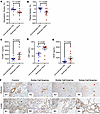 Figure 1
Thrombotic microangiopathy–type features in patients with SCD. Patients with SCD who develop multiorgan failure had a larger (A) red blood cell hemoglobin and (B) platelet count decline relative to the most recent preceding outpatient laboratory values and higher (C) VCAM-1, (D) vWF, and (E) VEGF compared with those hospitalized for a VOE without multiorgan failure by 1-way ANOVA. (F) Kidney section from a resection control (A1) and autopsy specimens of patients with SCD (A2–A4) (original magnification, ×200); stained with TM. The kidneys of patients with SCD show decreased expression (weak to moderate patchy positivity) in the endothelial cells of the glomeruli (black *), arterioles (green *), and peritubular capillaries (red *) compared with the control (A1). Lung section from a resection control (B1) and autopsy specimens of patients with SCD (B2–B4) (original magnification, 200×); stained with TM. The lungs of patients with SCD show decreased expression (weak to moderate patchy positivity) in the endothelial cells in the alveolar spaces (green asterisk) compared with the control (black asterisk) (B1).
Reduced TM in kidneys and lungs during multiorgan failure. We identified 3 additional patients with SCD who had an autopsy between January 2019 and December 2023 during a hospitalization for a VOE complicated by multiorgan failure. All 3 patients had hemoglobin SS genotype, and their hospital courses were complicated by acute kidney injury and acute respiratory failure in the setting of acute chest syndrome. The kidney and lung tissue demonstrated loss of TM on the vascular endothelium, based on a weak to patchy pattern of TM expression, compared with healthy control tissue (Figure 1F). Thrombi in the pulmonary arteries were observed in 2 patients with SCD in regions of reduced endothelial TM.
TM rescues the vasculature from cell-free hemoglobin-mediated injury in transgenic SCD mice. Next, we conducted experiments in the transgenic SCD Townes mouse model to investigate the effects of cell-free hemoglobin challenge on TM function and of recombinant TM rescue on biomarkers of vascular, kidney, and lung function. The median plasma concentrations of (a) cell-free hemoglobin (control: 146 mg/L [IQR, 124–172 mg/L]; hemoglobin challenge: 585 mg/L [IQR, 556–652 mg/L]) and (b) heme (control: 57 μM [IQR, 46–63 μM]; hemoglobin challenge: 119 μM [IQR, 110–129 μM]) in the transgenic SCD mice 5 minutes after infusion of i.v. hemoglobin represented 4- and 2-fold increases in cell-free hemoglobin and heme, respectively, similar to the degree of elevations observed in the plasma of patients with SCD at steady-state versus during a VOE or acute chest syndrome event (3, 19–21) (Supplemental Figure 1, A and B). Transgenic SCD mice challenged with cell-free hemoglobin demonstrated reduced TM expression on the glomerular endothelium (Figure 2, A and B) and increased soluble TM released in circulation (Figure 2C). The SCD mice also had increased concentrations of neutrophil elastase, a serine protease released by activated neutrophils that cleaves TM from the endothelium (22), in circulation after exposure to cell-free hemoglobin (Figure 2D). Administration of sivelestat, a neutrophil elastase inhibitor, before and after exposure to the cell-free hemoglobin challenge led to increased TM retained on the glomerular vasculature (Figure 2E and Supplemental Figure 2) and reduced soluble TM released in circulation (Figure 2F).
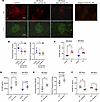 Figure 2
Cell-free hemoglobin reduces TM expression and increases circulating concentrations of soluble TM and neutrophil elastase in SCD mice. (A and B) TM expression was reduced in the glomerular endothelium relative to CD31 expression (n = 8; 4 male, 4 female mice per condition) (original magnification, 600×) by the test for linear trend while (C) increased concentrations of soluble TM were released in circulation from control to 26 and 48 hours after cell-free hemoglobin exposure (n = 6; 3 male, 3 female mice per condition; Mann-Whitney U test). (D) Circulating concentrations of neutrophil elastase (ELANE) were increased at 26 hours and trended higher at 48 hours after the cell-free hemoglobin challenge (n = 4; 2 male, 2 female mice per condition; 1-way ANOVA). (E) Administration of sivelestat, an ELANE inhibitor, led to retained TM on the vasculature by fluorescent intensity at 48 hours after cell-free hemoglobin challenge (1-way ANOVA) and (F) reduced soluble TM released into circulation (n = 6; 3 male, 3 female mice per condition; Mann-Whitney U test). Mice were challenged with a cell-free hemoglobin dose of 0.24 g/kg, and samples and tissue were harvested 26 and 48 hours later. Scale bars: 50 μm. *P < 0.05, **P < 0.01.
Reduced TM function, as determined by increased fibrinogen and complement C3 intensity in the glomerular vasculature, was observed in the cell-free hemoglobin–challenged mice versus control SCD mice (Figure 3A). Administration of TM 2 or 24 hours after the cell-free hemoglobin challenge mitigated the intensity of fibrinogen and C3 in the glomerular vasculature. Consistent with the antithrombotic effect of TM, we observed increased activated protein C and reduced thrombin-antithrombin complex concentrations in the plasma with TM administration at 2 or 24 hours after the cell-free hemoglobin challenge (Figure 3, B and C). Vascular injury biomarkers VCAM-1, vWF, VEGF, soluble E-selectin, and endothelin-1 were increased in the circulation of cell-free hemoglobin–challenged SCD mice; these biomarkers were reduced after TM administration at 2 or 24 hours after challenge to levels similar to control SCD mice (Figure 3, D–H). We did not observe increased TM expression on the endothelial surface after the TM infusion (Supplemental Figure 3), suggesting that the protective effects against thrombotic, complement, and vascular injury were mediated by the increase in circulating intact recombinant TM.
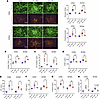 Figure 3
Cell-free hemoglobin reduces TM function, which can be restored with recombinant TM rescue 2 or 24 hours after the cell-free hemoglobin challenge in SCD mice. (A) Fluorescence intensity of fibrinogen and C3 complement were increased in cell-free hemoglobin–challenged SCD mice; levels were reduced after rescue with TM, similar to control conditions (n = 8; 4 male, 4 female mice per condition; Mann-Whitney U test) (original magnification, ×400). (B) Activated protein C concentrations were unchanged with cell-free hemoglobin challenge and increased with TM rescue and (C) thrombin-antithrombin complexes increased with cell-free hemoglobin challenge and were improved with TM rescue (n = 6; 3 male, 3 female per condition; Mann-Whitney U test). Increases in vascular injury biomarkers (D) VCAM-1, (E) vWF, (F) VEGF, (G) E-selectin, and (H) endothelin-1 were observed in cell-free hemoglobin–challenged mice; those that received TM rescue had levels similar to control conditions (D–F: n = 8, 4 male, 4 female mice per condition; G and H: n = 6, 3 male, 3 female per condition; Mann-Whitney U test). Mice were challenged with cell-free hemoglobin (0.24 g/kg i.v.) and rescued with TM (5 mg/kg s.c. + 1 mg/kg i.v.) under the respective conditions, and samples and tissue were harvested 24 hours after TM rescue (26 hours for the 2-hour TM rescue and 48 hours for the 24-hour TM rescue after cell-free hemoglobin challenges). Scale bars: 50 μm. Median and IQR values provided in Supplemental Table 2; *P < 0.05, **P < 0.01, ***P < 0.001.
To evaluate the in vivo effects of cell-free hemoglobin and TM rescue on vascular function, we measured cortical blood flow by microbubble contrast–enhanced ultrasound. The peak enhancement, a measure of cortical blood volume that reflects vascular function, was reduced after the cell-free hemoglobin challenge (Figure 4). Administering TM at 2 or 24 hours after challenge led to restoration of cortical blood volume to levels that were similar to control SCD mice.
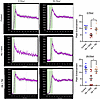 Figure 4
Administration of TM 2 or 24 hours after a cell-free hemoglobin challenge recovers renal cortical perfusion. The images on the left are representative graphs for contrast-enhanced renal cortical perfusion (n = 6; 3 male, 3 female mice per condition at 2 hours; n = 9; 4 male, 5 female at 24 hours per condition). Peak enhancement, calculated by the ratio of the plateau to baseline value, was reduced 26 or 48 hours after a cell-free hemoglobin challenge compared with SCD mice receiving TM rescue or control conditions (Mann-Whitney U test). Mice were challenged with cell-free hemoglobin (0.24 g/kg i.v.) and rescued with TM (5 mg/kg s.c. + 1 mg/kg i.v.) under the respective conditions, and renal cortical perfusion was measured 24 hours after TM rescue (26 hours for the 2-hour TM rescue and 48 hours for the 24-hour TM rescue after cell-free hemoglobin challenge). Median and IQR values provided in Supplemental Table 2; *P < 0.05.
TM protects against cell-free hemoglobin-mediated kidney and lung injury in transgenic SCD mice. Cell-free hemoglobin–challenged SCD mice demonstrated increased complement activation, reflected by sC5b-9 (Figure 5A), as well as increased urine concentrations of tubular injury biomarkers, kidney injury molecule-1 (KIM-1) and neutrophil gelatinase-associated lipocalin (NGAL) (Figure 5, B and C). Treatment of the SCD mice with TM at 2 hours or 24 hours after challenge reduced the levels of sC5b-9, KIM-1, and NGAL to concentrations observed in the non-challenged control SCD mice. The changes in biomarkers of kidney function paralleled the injury biomarkers with acute elevations in urine albumin concentration, serum blood urea nitrogen (BUN), and cystatin C after the cell-free hemoglobin challenge (Figure 5, D–F). These kidney function biomarkers improved after TM rescue and were similar to levels observed in the control conditions.
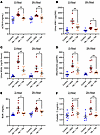 Figure 5
Biomarkers of complement activation, tubular injury, and acute kidney injury were abated with TM rescue at 2 or 24 hours after a cell-free hemoglobin challenge. Biomarkers of (A) complement activation (sC5b-9) in circulation and tubular injury (B) KIM-1 and (C) NGAL in the urine were increased after the cell-free hemoglobin challenge and abated with recombinant TM therapy (n = 8; 4 male, 4 female mice per condition; Mann-Whitney U test). (D–F) Kidney function was assessed by urine albumin concentration, serum BUN, and serum cystatin-C, which were increased after the cell-free hemoglobin challenge, consistent with acute kidney injury, whereas TM administered 2 or 24 hours after the challenge was renoprotective (n = 8; 4 male, 4 female mice per condition; Mann-Whitney U test). Mice were challenged with cell-free hemoglobin (0.24 g/kg i.v.) and rescued with TM (5 mg/kg s.c. + 1 mg/kg i.v.) under the respective conditions, and samples and tissue were harvested 24 hours after the TM rescue (26 hours for the 2-hour TM rescue and 48 hours for the 24-hour TM rescue after cell-free hemoglobin challenges). Median and IQR values provided in Supplemental Table 2; *P < 0.05, **P < 0.01.
Acute lung injury, determined by a composite score of neutrophil infiltration into the alveolar or interstitial space, hyaline membrane formation, proteinaceous debris, and alveolar wall thickening, was evident in the SCD mice challenged with cell-free hemoglobin compared with control SCD mice (Figure 6, A and B). Alveolar barrier dysfunction, as determined by lung wet-to-dry ratio, and biomarkers of neutrophil activity (myeloperoxidase), inflammation (IL-6, TNF-α), and vascular injury (VCAM-1, ICAM-1) were increased, whereas a biomarker of vascular integrity (VE-cadherin) was reduced in the lung lysates of SCD mice after cell-free hemoglobin challenge (Figure 6, C–F, and Figure 7). TM rescue mitigated the degree of lung injury at 2 hours with a trend for improvement at 24 hours after the cell-free hemoglobin challenge (Figure 6, A and B). In parallel, the lung wet-to-dry ratio and biomarkers of injury and vascular integrity improved in the lung lysates of SCD mice that received TM rescue (Figure 6, C–F, and Figure 7).
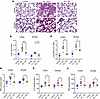 Figure 6
Lung injury improved with TM rescue. (A and B) Acute lung injury by histopathology elicited after cell-free hemoglobin challenge was improved with TM rescue at 2 or 24 hours after the challenge (n = 8, 4 male, 4 female at 2 hours per condition; n = 6, 3 male, 3 female at 24 hours per condition; Mann-Whitney U test) (original magnification, ×400). (C) Lung wet-to-dry ratios increased with cell-free hemoglobin challenges and improved with TM rescue (n = 6, 3 male, 3 female per condition at 2 and 24 hours; Mann-Whitney U test). Biomarkers of (D) neutrophil activity (myeloperoxidase [MPO]) and (E and F) inflammation (IL-6, TNF-α) increased after cell-free hemoglobin exposure and were improved with TM rescue in lung lysates from the SCD mice (n = 8, 4 male, 4 female per condition at 2 and 24 hours; 1-way ANOVA). Mice were challenged with cell-free hemoglobin (0.24 g/kg i.v.) and rescued with TM (5 mg/kg s.c. + 1 mg/kg i.v.) under the respective conditions, and samples and tissue were harvested 24 hours after the TM rescue (26 hours for the 2-hour TM rescue and 48 hours for the 24-hour TM rescue after cell-free hemoglobin challenges). Median and IQR values provided in Supplemental Table 2; *P < 0.05, **P < 0.01, ***P < 0.001.
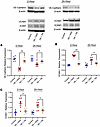 Figure 7
Vascular integrity and injury biomarkers are improved in the lungs of SCD mice treated with TM 2 or 24 hours after a cell-free hemoglobin challenge. The images at the top of the figure are representative Western blots of VE-Cadherin, VCAM-1, and ICAM-1 in the lung lysates under the respective conditions. (A) VE-cadherin concentrations were reduced while (B and C) VCAM-1 and ICAM-1 were increased after cell-free hemoglobin challenges in the lung lysates of SCD mice. VE-cadherin levels improved while VCAM-1 and ICAM-1 were decreased after TM rescue (n = 6; 3 male, 3 female mice per condition at 2 and 24 hours; Mann-Whitney U test). Mice were challenged with cell-free hemoglobin (0.24 g/kg i.v.) and rescued with TM (5 mg/kg s.c. + 1 mg/kg i.v.) under the respective conditions, and samples and tissue were harvested 24 hours after the TM rescue (26 hours for the 2-hour TM rescue and 48 hours for the 24-hour TM rescue after cell-free hemoglobin challenges). *P < 0.05, **P < 0.01.


