
Abstract
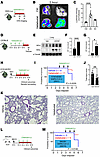
Hypoxia-inducible factors (HIFs) promote lung protection and pathogen eradication during acute lung injury. We, therefore, tested the theory that pharmacologic stabilization of HIFs dampens lung injury during SARS-CoV-2 pneumonia. Initial studies in murine SARS-CoV-2 models showed improved outcomes after treatment with the FDA-approved HIF stabilizer vadadustat. Subsequent studies in genetic models implicated alveolus-expressed Hif1a in mediating lung protection. Therefore, we performed a randomized, double-blinded, multicenter phase II trial in patients admitted for SARS-CoV-2 infection and concomitant hypoxia (SpO2 ≤ 94%). Patients (n = 448) were randomized to oral vadadustat (900 mg/day) or placebo for up to 14 days. Safety events were similar between the 2 groups. Vadadustat treatment induced surrogate HIF target genes. The primary outcome of severe lung injury requiring high oxygen support on day 14 occurred in 43 patients in the vadadustat group and 53 patients in the placebo group (estimated probability, 13.3% vs. 16.9%). Among patients with baseline fraction of inspired oxygen of 80% or higher (n = 106), the estimated probability of the primary outcome was 12.1% (vadadustat) versus 79.1% (placebo), indicating an even greater benefit in patients with more severe baseline hypoxia. HIF1A is a likely therapeutic target during SARS-CoV-2–associated lung injury. Robust clinical trials of HIF stabilizers during pathogen-associated lung injury are warranted.
Authors
Bentley Bobrow, Samuel D. Luber, Paul Potnuru, Katherine Figarella, Jieun Kim, Yanyu Wang, In Hyuk Bang, David Robinson, Paulina B. Sergot, Steven K. Burke, Tingting Mills, Constanza de Dios, Robert Suchting, George W. Williams, Adit A. Ginde, Yafen Liang, Hongfang Liu, Charles Green, Marie-Francoise Doursout, Alparslan Turan, Daniel I. Sessler, Xiaoyi Yuan, Holger K. Eltzschig
This file is in Adobe Acrobat (PDF) format. If you have not installed and configured the Adobe Acrobat Reader on your system.
Having trouble reading a PDF?
PDFs are designed to be printed out and read, but if you prefer to read them online, you may find it easier if you increase the view size to 125%.
Having trouble saving a PDF?
Many versions of the free Acrobat Reader do not allow Save. You must instead save the PDF from the JCI Online page you downloaded it from. PC users: Right-click on the Download link and choose the option that says something like "Save Link As...". Mac users should hold the mouse button down on the link to get these same options.
Having trouble printing a PDF?
- Try printing one page at a time or to a newer printer.
- Try saving the file to disk before printing rather than opening it "on the fly." This requires that you configure your browser to "Save" rather than "Launch Application" for the file type "application/pdf", and can usually be done in the "Helper Applications" options.
- Make sure you are using the latest version of Adobe's Acrobat Reader.


