
Clinical Research and Public HealthImmunologyVaccines
Open Access |  10.1172/jci.insight.184128
Boosting effect of high-dose influenza vaccination on innate immunity among elderly
Olivia Bonduelle,1 Tristan Delory,2 Isabelle Franco-Moscardini,1 Marion Ghidi,2 Selma Bennacer,1 Michele Wokam,1 Mathieu Lenormand,2 Melissa Petrier,2 Olivier Rogeaux,3 Simon de Bernard,4 Karine Alves,4 Julien Nourikyan,4 Bruno Lina,5,6 INFLUOMICS Study group,7 Behazine Combadiere,1 and Cécile Janssen2
1Sorbonne Université, Institut National de Santé et de Recherche Médicale, Inserm U1135, Centre d’Immunologie et des Maladies Infectieuses, Cimi-Paris, Paris, France.
2Centre Hospitalier Annecy Genevois, Epagny Metz-Tessy, France.
3Centre Hospitalier Centre Hospitalier Métropole Savoie, Chambéry, France.
4Altrabio, Lyon, France.
5Centre International de Recherche en Infectiologie, Université Claude Bernard Lyon-1, INSERM U1111, CNRS, UMR5308, ENS Lyon, Université Jean Monnet de Saint-Etienne, Lyon, France.
6Laboratoire de Virologie, Institut des Agents Infectieux, Centre National de Référence des Virus des Infections Respiratoires, Hospices Civils de Lyon, Lyon, France.
7The INFLUOMICS Study group is detailed in Supplemental Acknowledgments.
Address correspondence to: Cécile Janssen, Centre Hospitalier Annecy Genevois, 74330, Epagny Metz-Tessy, France. Email: cjanssen@ch-annecygenevois.fr. Or to: Behazine Combadiere, Center for Immunology and Diseases (Cimi-Paris), Inserm, Sorbonne University, 91 Boulevard de l’Hôpital, 75013 Paris, France. Email: behazine.combadiere@inserm.fr.
Authorship note: OB and TD contribtued equally to this work. BC and CJ contributed equally to this work.
Find articles by Bonduelle, O. in: PubMed | Google Scholar
1Sorbonne Université, Institut National de Santé et de Recherche Médicale, Inserm U1135, Centre d’Immunologie et des Maladies Infectieuses, Cimi-Paris, Paris, France.
2Centre Hospitalier Annecy Genevois, Epagny Metz-Tessy, France.
3Centre Hospitalier Centre Hospitalier Métropole Savoie, Chambéry, France.
4Altrabio, Lyon, France.
5Centre International de Recherche en Infectiologie, Université Claude Bernard Lyon-1, INSERM U1111, CNRS, UMR5308, ENS Lyon, Université Jean Monnet de Saint-Etienne, Lyon, France.
6Laboratoire de Virologie, Institut des Agents Infectieux, Centre National de Référence des Virus des Infections Respiratoires, Hospices Civils de Lyon, Lyon, France.
7The INFLUOMICS Study group is detailed in Supplemental Acknowledgments.
Address correspondence to: Cécile Janssen, Centre Hospitalier Annecy Genevois, 74330, Epagny Metz-Tessy, France. Email: cjanssen@ch-annecygenevois.fr. Or to: Behazine Combadiere, Center for Immunology and Diseases (Cimi-Paris), Inserm, Sorbonne University, 91 Boulevard de l’Hôpital, 75013 Paris, France. Email: behazine.combadiere@inserm.fr.
Authorship note: OB and TD contribtued equally to this work. BC and CJ contributed equally to this work.
Find articles by Delory, T. in: PubMed | Google Scholar
1Sorbonne Université, Institut National de Santé et de Recherche Médicale, Inserm U1135, Centre d’Immunologie et des Maladies Infectieuses, Cimi-Paris, Paris, France.
2Centre Hospitalier Annecy Genevois, Epagny Metz-Tessy, France.
3Centre Hospitalier Centre Hospitalier Métropole Savoie, Chambéry, France.
4Altrabio, Lyon, France.
5Centre International de Recherche en Infectiologie, Université Claude Bernard Lyon-1, INSERM U1111, CNRS, UMR5308, ENS Lyon, Université Jean Monnet de Saint-Etienne, Lyon, France.
6Laboratoire de Virologie, Institut des Agents Infectieux, Centre National de Référence des Virus des Infections Respiratoires, Hospices Civils de Lyon, Lyon, France.
7The INFLUOMICS Study group is detailed in Supplemental Acknowledgments.
Address correspondence to: Cécile Janssen, Centre Hospitalier Annecy Genevois, 74330, Epagny Metz-Tessy, France. Email: cjanssen@ch-annecygenevois.fr. Or to: Behazine Combadiere, Center for Immunology and Diseases (Cimi-Paris), Inserm, Sorbonne University, 91 Boulevard de l’Hôpital, 75013 Paris, France. Email: behazine.combadiere@inserm.fr.
Authorship note: OB and TD contribtued equally to this work. BC and CJ contributed equally to this work.
Find articles by Franco-Moscardini, I. in: PubMed | Google Scholar
1Sorbonne Université, Institut National de Santé et de Recherche Médicale, Inserm U1135, Centre d’Immunologie et des Maladies Infectieuses, Cimi-Paris, Paris, France.
2Centre Hospitalier Annecy Genevois, Epagny Metz-Tessy, France.
3Centre Hospitalier Centre Hospitalier Métropole Savoie, Chambéry, France.
4Altrabio, Lyon, France.
5Centre International de Recherche en Infectiologie, Université Claude Bernard Lyon-1, INSERM U1111, CNRS, UMR5308, ENS Lyon, Université Jean Monnet de Saint-Etienne, Lyon, France.
6Laboratoire de Virologie, Institut des Agents Infectieux, Centre National de Référence des Virus des Infections Respiratoires, Hospices Civils de Lyon, Lyon, France.
7The INFLUOMICS Study group is detailed in Supplemental Acknowledgments.
Address correspondence to: Cécile Janssen, Centre Hospitalier Annecy Genevois, 74330, Epagny Metz-Tessy, France. Email: cjanssen@ch-annecygenevois.fr. Or to: Behazine Combadiere, Center for Immunology and Diseases (Cimi-Paris), Inserm, Sorbonne University, 91 Boulevard de l’Hôpital, 75013 Paris, France. Email: behazine.combadiere@inserm.fr.
Authorship note: OB and TD contribtued equally to this work. BC and CJ contributed equally to this work.
Find articles by Ghidi, M. in: PubMed | Google Scholar
1Sorbonne Université, Institut National de Santé et de Recherche Médicale, Inserm U1135, Centre d’Immunologie et des Maladies Infectieuses, Cimi-Paris, Paris, France.
2Centre Hospitalier Annecy Genevois, Epagny Metz-Tessy, France.
3Centre Hospitalier Centre Hospitalier Métropole Savoie, Chambéry, France.
4Altrabio, Lyon, France.
5Centre International de Recherche en Infectiologie, Université Claude Bernard Lyon-1, INSERM U1111, CNRS, UMR5308, ENS Lyon, Université Jean Monnet de Saint-Etienne, Lyon, France.
6Laboratoire de Virologie, Institut des Agents Infectieux, Centre National de Référence des Virus des Infections Respiratoires, Hospices Civils de Lyon, Lyon, France.
7The INFLUOMICS Study group is detailed in Supplemental Acknowledgments.
Address correspondence to: Cécile Janssen, Centre Hospitalier Annecy Genevois, 74330, Epagny Metz-Tessy, France. Email: cjanssen@ch-annecygenevois.fr. Or to: Behazine Combadiere, Center for Immunology and Diseases (Cimi-Paris), Inserm, Sorbonne University, 91 Boulevard de l’Hôpital, 75013 Paris, France. Email: behazine.combadiere@inserm.fr.
Authorship note: OB and TD contribtued equally to this work. BC and CJ contributed equally to this work.
Find articles by Bennacer, S. in: PubMed | Google Scholar
1Sorbonne Université, Institut National de Santé et de Recherche Médicale, Inserm U1135, Centre d’Immunologie et des Maladies Infectieuses, Cimi-Paris, Paris, France.
2Centre Hospitalier Annecy Genevois, Epagny Metz-Tessy, France.
3Centre Hospitalier Centre Hospitalier Métropole Savoie, Chambéry, France.
4Altrabio, Lyon, France.
5Centre International de Recherche en Infectiologie, Université Claude Bernard Lyon-1, INSERM U1111, CNRS, UMR5308, ENS Lyon, Université Jean Monnet de Saint-Etienne, Lyon, France.
6Laboratoire de Virologie, Institut des Agents Infectieux, Centre National de Référence des Virus des Infections Respiratoires, Hospices Civils de Lyon, Lyon, France.
7The INFLUOMICS Study group is detailed in Supplemental Acknowledgments.
Address correspondence to: Cécile Janssen, Centre Hospitalier Annecy Genevois, 74330, Epagny Metz-Tessy, France. Email: cjanssen@ch-annecygenevois.fr. Or to: Behazine Combadiere, Center for Immunology and Diseases (Cimi-Paris), Inserm, Sorbonne University, 91 Boulevard de l’Hôpital, 75013 Paris, France. Email: behazine.combadiere@inserm.fr.
Authorship note: OB and TD contribtued equally to this work. BC and CJ contributed equally to this work.
Find articles by Wokam, M. in: PubMed | Google Scholar
1Sorbonne Université, Institut National de Santé et de Recherche Médicale, Inserm U1135, Centre d’Immunologie et des Maladies Infectieuses, Cimi-Paris, Paris, France.
2Centre Hospitalier Annecy Genevois, Epagny Metz-Tessy, France.
3Centre Hospitalier Centre Hospitalier Métropole Savoie, Chambéry, France.
4Altrabio, Lyon, France.
5Centre International de Recherche en Infectiologie, Université Claude Bernard Lyon-1, INSERM U1111, CNRS, UMR5308, ENS Lyon, Université Jean Monnet de Saint-Etienne, Lyon, France.
6Laboratoire de Virologie, Institut des Agents Infectieux, Centre National de Référence des Virus des Infections Respiratoires, Hospices Civils de Lyon, Lyon, France.
7The INFLUOMICS Study group is detailed in Supplemental Acknowledgments.
Address correspondence to: Cécile Janssen, Centre Hospitalier Annecy Genevois, 74330, Epagny Metz-Tessy, France. Email: cjanssen@ch-annecygenevois.fr. Or to: Behazine Combadiere, Center for Immunology and Diseases (Cimi-Paris), Inserm, Sorbonne University, 91 Boulevard de l’Hôpital, 75013 Paris, France. Email: behazine.combadiere@inserm.fr.
Authorship note: OB and TD contribtued equally to this work. BC and CJ contributed equally to this work.
Find articles by Lenormand, M. in: PubMed | Google Scholar
1Sorbonne Université, Institut National de Santé et de Recherche Médicale, Inserm U1135, Centre d’Immunologie et des Maladies Infectieuses, Cimi-Paris, Paris, France.
2Centre Hospitalier Annecy Genevois, Epagny Metz-Tessy, France.
3Centre Hospitalier Centre Hospitalier Métropole Savoie, Chambéry, France.
4Altrabio, Lyon, France.
5Centre International de Recherche en Infectiologie, Université Claude Bernard Lyon-1, INSERM U1111, CNRS, UMR5308, ENS Lyon, Université Jean Monnet de Saint-Etienne, Lyon, France.
6Laboratoire de Virologie, Institut des Agents Infectieux, Centre National de Référence des Virus des Infections Respiratoires, Hospices Civils de Lyon, Lyon, France.
7The INFLUOMICS Study group is detailed in Supplemental Acknowledgments.
Address correspondence to: Cécile Janssen, Centre Hospitalier Annecy Genevois, 74330, Epagny Metz-Tessy, France. Email: cjanssen@ch-annecygenevois.fr. Or to: Behazine Combadiere, Center for Immunology and Diseases (Cimi-Paris), Inserm, Sorbonne University, 91 Boulevard de l’Hôpital, 75013 Paris, France. Email: behazine.combadiere@inserm.fr.
Authorship note: OB and TD contribtued equally to this work. BC and CJ contributed equally to this work.
Find articles by Petrier, M. in: PubMed | Google Scholar
1Sorbonne Université, Institut National de Santé et de Recherche Médicale, Inserm U1135, Centre d’Immunologie et des Maladies Infectieuses, Cimi-Paris, Paris, France.
2Centre Hospitalier Annecy Genevois, Epagny Metz-Tessy, France.
3Centre Hospitalier Centre Hospitalier Métropole Savoie, Chambéry, France.
4Altrabio, Lyon, France.
5Centre International de Recherche en Infectiologie, Université Claude Bernard Lyon-1, INSERM U1111, CNRS, UMR5308, ENS Lyon, Université Jean Monnet de Saint-Etienne, Lyon, France.
6Laboratoire de Virologie, Institut des Agents Infectieux, Centre National de Référence des Virus des Infections Respiratoires, Hospices Civils de Lyon, Lyon, France.
7The INFLUOMICS Study group is detailed in Supplemental Acknowledgments.
Address correspondence to: Cécile Janssen, Centre Hospitalier Annecy Genevois, 74330, Epagny Metz-Tessy, France. Email: cjanssen@ch-annecygenevois.fr. Or to: Behazine Combadiere, Center for Immunology and Diseases (Cimi-Paris), Inserm, Sorbonne University, 91 Boulevard de l’Hôpital, 75013 Paris, France. Email: behazine.combadiere@inserm.fr.
Authorship note: OB and TD contribtued equally to this work. BC and CJ contributed equally to this work.
Find articles by Rogeaux, O. in: PubMed | Google Scholar
1Sorbonne Université, Institut National de Santé et de Recherche Médicale, Inserm U1135, Centre d’Immunologie et des Maladies Infectieuses, Cimi-Paris, Paris, France.
2Centre Hospitalier Annecy Genevois, Epagny Metz-Tessy, France.
3Centre Hospitalier Centre Hospitalier Métropole Savoie, Chambéry, France.
4Altrabio, Lyon, France.
5Centre International de Recherche en Infectiologie, Université Claude Bernard Lyon-1, INSERM U1111, CNRS, UMR5308, ENS Lyon, Université Jean Monnet de Saint-Etienne, Lyon, France.
6Laboratoire de Virologie, Institut des Agents Infectieux, Centre National de Référence des Virus des Infections Respiratoires, Hospices Civils de Lyon, Lyon, France.
7The INFLUOMICS Study group is detailed in Supplemental Acknowledgments.
Address correspondence to: Cécile Janssen, Centre Hospitalier Annecy Genevois, 74330, Epagny Metz-Tessy, France. Email: cjanssen@ch-annecygenevois.fr. Or to: Behazine Combadiere, Center for Immunology and Diseases (Cimi-Paris), Inserm, Sorbonne University, 91 Boulevard de l’Hôpital, 75013 Paris, France. Email: behazine.combadiere@inserm.fr.
Authorship note: OB and TD contribtued equally to this work. BC and CJ contributed equally to this work.
Find articles by de Bernard, S. in: PubMed | Google Scholar
1Sorbonne Université, Institut National de Santé et de Recherche Médicale, Inserm U1135, Centre d’Immunologie et des Maladies Infectieuses, Cimi-Paris, Paris, France.
2Centre Hospitalier Annecy Genevois, Epagny Metz-Tessy, France.
3Centre Hospitalier Centre Hospitalier Métropole Savoie, Chambéry, France.
4Altrabio, Lyon, France.
5Centre International de Recherche en Infectiologie, Université Claude Bernard Lyon-1, INSERM U1111, CNRS, UMR5308, ENS Lyon, Université Jean Monnet de Saint-Etienne, Lyon, France.
6Laboratoire de Virologie, Institut des Agents Infectieux, Centre National de Référence des Virus des Infections Respiratoires, Hospices Civils de Lyon, Lyon, France.
7The INFLUOMICS Study group is detailed in Supplemental Acknowledgments.
Address correspondence to: Cécile Janssen, Centre Hospitalier Annecy Genevois, 74330, Epagny Metz-Tessy, France. Email: cjanssen@ch-annecygenevois.fr. Or to: Behazine Combadiere, Center for Immunology and Diseases (Cimi-Paris), Inserm, Sorbonne University, 91 Boulevard de l’Hôpital, 75013 Paris, France. Email: behazine.combadiere@inserm.fr.
Authorship note: OB and TD contribtued equally to this work. BC and CJ contributed equally to this work.
Find articles by Alves, K. in: PubMed | Google Scholar
1Sorbonne Université, Institut National de Santé et de Recherche Médicale, Inserm U1135, Centre d’Immunologie et des Maladies Infectieuses, Cimi-Paris, Paris, France.
2Centre Hospitalier Annecy Genevois, Epagny Metz-Tessy, France.
3Centre Hospitalier Centre Hospitalier Métropole Savoie, Chambéry, France.
4Altrabio, Lyon, France.
5Centre International de Recherche en Infectiologie, Université Claude Bernard Lyon-1, INSERM U1111, CNRS, UMR5308, ENS Lyon, Université Jean Monnet de Saint-Etienne, Lyon, France.
6Laboratoire de Virologie, Institut des Agents Infectieux, Centre National de Référence des Virus des Infections Respiratoires, Hospices Civils de Lyon, Lyon, France.
7The INFLUOMICS Study group is detailed in Supplemental Acknowledgments.
Address correspondence to: Cécile Janssen, Centre Hospitalier Annecy Genevois, 74330, Epagny Metz-Tessy, France. Email: cjanssen@ch-annecygenevois.fr. Or to: Behazine Combadiere, Center for Immunology and Diseases (Cimi-Paris), Inserm, Sorbonne University, 91 Boulevard de l’Hôpital, 75013 Paris, France. Email: behazine.combadiere@inserm.fr.
Authorship note: OB and TD contribtued equally to this work. BC and CJ contributed equally to this work.
Find articles by
Nourikyan, J.
in:
PubMed
|
Google Scholar
|

1Sorbonne Université, Institut National de Santé et de Recherche Médicale, Inserm U1135, Centre d’Immunologie et des Maladies Infectieuses, Cimi-Paris, Paris, France.
2Centre Hospitalier Annecy Genevois, Epagny Metz-Tessy, France.
3Centre Hospitalier Centre Hospitalier Métropole Savoie, Chambéry, France.
4Altrabio, Lyon, France.
5Centre International de Recherche en Infectiologie, Université Claude Bernard Lyon-1, INSERM U1111, CNRS, UMR5308, ENS Lyon, Université Jean Monnet de Saint-Etienne, Lyon, France.
6Laboratoire de Virologie, Institut des Agents Infectieux, Centre National de Référence des Virus des Infections Respiratoires, Hospices Civils de Lyon, Lyon, France.
7The INFLUOMICS Study group is detailed in Supplemental Acknowledgments.
Address correspondence to: Cécile Janssen, Centre Hospitalier Annecy Genevois, 74330, Epagny Metz-Tessy, France. Email: cjanssen@ch-annecygenevois.fr. Or to: Behazine Combadiere, Center for Immunology and Diseases (Cimi-Paris), Inserm, Sorbonne University, 91 Boulevard de l’Hôpital, 75013 Paris, France. Email: behazine.combadiere@inserm.fr.
Authorship note: OB and TD contribtued equally to this work. BC and CJ contributed equally to this work.
Find articles by Lina, B. in: PubMed | Google Scholar
1Sorbonne Université, Institut National de Santé et de Recherche Médicale, Inserm U1135, Centre d’Immunologie et des Maladies Infectieuses, Cimi-Paris, Paris, France.
2Centre Hospitalier Annecy Genevois, Epagny Metz-Tessy, France.
3Centre Hospitalier Centre Hospitalier Métropole Savoie, Chambéry, France.
4Altrabio, Lyon, France.
5Centre International de Recherche en Infectiologie, Université Claude Bernard Lyon-1, INSERM U1111, CNRS, UMR5308, ENS Lyon, Université Jean Monnet de Saint-Etienne, Lyon, France.
6Laboratoire de Virologie, Institut des Agents Infectieux, Centre National de Référence des Virus des Infections Respiratoires, Hospices Civils de Lyon, Lyon, France.
7The INFLUOMICS Study group is detailed in Supplemental Acknowledgments.
Address correspondence to: Cécile Janssen, Centre Hospitalier Annecy Genevois, 74330, Epagny Metz-Tessy, France. Email: cjanssen@ch-annecygenevois.fr. Or to: Behazine Combadiere, Center for Immunology and Diseases (Cimi-Paris), Inserm, Sorbonne University, 91 Boulevard de l’Hôpital, 75013 Paris, France. Email: behazine.combadiere@inserm.fr.
Authorship note: OB and TD contribtued equally to this work. BC and CJ contributed equally to this work.
1Sorbonne Université, Institut National de Santé et de Recherche Médicale, Inserm U1135, Centre d’Immunologie et des Maladies Infectieuses, Cimi-Paris, Paris, France.
2Centre Hospitalier Annecy Genevois, Epagny Metz-Tessy, France.
3Centre Hospitalier Centre Hospitalier Métropole Savoie, Chambéry, France.
4Altrabio, Lyon, France.
5Centre International de Recherche en Infectiologie, Université Claude Bernard Lyon-1, INSERM U1111, CNRS, UMR5308, ENS Lyon, Université Jean Monnet de Saint-Etienne, Lyon, France.
6Laboratoire de Virologie, Institut des Agents Infectieux, Centre National de Référence des Virus des Infections Respiratoires, Hospices Civils de Lyon, Lyon, France.
7The INFLUOMICS Study group is detailed in Supplemental Acknowledgments.
Address correspondence to: Cécile Janssen, Centre Hospitalier Annecy Genevois, 74330, Epagny Metz-Tessy, France. Email: cjanssen@ch-annecygenevois.fr. Or to: Behazine Combadiere, Center for Immunology and Diseases (Cimi-Paris), Inserm, Sorbonne University, 91 Boulevard de l’Hôpital, 75013 Paris, France. Email: behazine.combadiere@inserm.fr.
Authorship note: OB and TD contribtued equally to this work. BC and CJ contributed equally to this work.
Find articles by
Combadiere, B.
in:
PubMed
|
Google Scholar
|
1Sorbonne Université, Institut National de Santé et de Recherche Médicale, Inserm U1135, Centre d’Immunologie et des Maladies Infectieuses, Cimi-Paris, Paris, France.
2Centre Hospitalier Annecy Genevois, Epagny Metz-Tessy, France.
3Centre Hospitalier Centre Hospitalier Métropole Savoie, Chambéry, France.
4Altrabio, Lyon, France.
5Centre International de Recherche en Infectiologie, Université Claude Bernard Lyon-1, INSERM U1111, CNRS, UMR5308, ENS Lyon, Université Jean Monnet de Saint-Etienne, Lyon, France.
6Laboratoire de Virologie, Institut des Agents Infectieux, Centre National de Référence des Virus des Infections Respiratoires, Hospices Civils de Lyon, Lyon, France.
7The INFLUOMICS Study group is detailed in Supplemental Acknowledgments.
Address correspondence to: Cécile Janssen, Centre Hospitalier Annecy Genevois, 74330, Epagny Metz-Tessy, France. Email: cjanssen@ch-annecygenevois.fr. Or to: Behazine Combadiere, Center for Immunology and Diseases (Cimi-Paris), Inserm, Sorbonne University, 91 Boulevard de l’Hôpital, 75013 Paris, France. Email: behazine.combadiere@inserm.fr.
Authorship note: OB and TD contribtued equally to this work. BC and CJ contributed equally to this work.
Find articles by Janssen, C. in: PubMed | Google Scholar
Published March 4, 2025 - More info
JCI Insight. 2025;10(8):e184128. https://doi.org/10.1172/jci.insight.184128.
© 2025 Bonduelle et al. This work is licensed under the Creative Commons Attribution 4.0 International License. To view a copy of this license, visit http://creativecommons.org/licenses/by/4.0/.
Received: July 10, 2024; Accepted: February 25, 2025

-
Results
Study population and HIA titers. A total of 59 participants with a signed informed consent were included, randomized. Of them, 31 were assigned to QIV-HD arm and 28 to QIV-SD arm. The flowchart diagram is presented in Figure 1A and Supplemental Figure 1 (supplemental material available online with this article; https://doi.org/10.1172/jci.insight.184128DS1). Biological and clinical data were complete for all patients (Supplemental Figure 1). Participant characteristics were similar between both arms. The median age of the participants was 70 years, and females were 42% (n = 25) of the study participants (Supplemental Table 1). During the 2020/2021 winter season, 83% were vaccinated against influenza using 1 dose of QIV-SD, and 100% patients received 2 doses or more of SARS-CoV-2 vaccine in a median of 2 months prior trial participation (Supplemental Table 2). Safety between arms was similar, with 5 serious adverse events occurred in 4 patients. One of them was a suspected unexpected serious adverse reaction 120 days after QIV-HD vaccination, and 4 were considered not to be related to the vaccine or the study procedure by the investigators and the sponsor (Supplemental Table 3).
 Figure 1
Study protocol and immunogenicity of QIV-HD compared with QIV-SD in adults ≥ 65 years old. (A) Schematic overview of experiment with kinetics of biological sample collection including serum collection and whole blood cells for transcriptomic and innate cell phenotype analyses. (B) Dot plots present geometric mean titers (GMT) with 95% CI of anti–A H1N1 hemagglutination inhibition antibody (HIA) titers, anti–A H3N2 HIA titers, anti–B Victoria HIA titers, and anti–B Yamagata HIA titers at D0, D21, D90, and D210 after QIV-SD (green) or QIV-HD (violet) vaccination. The horizontal line represents the seroprotection cut off with HIA titers at 40. Wilcoxon tests and Fisher’s exact tests were performed to compare the characteristics of the 2 groups (**P <0.01).
We first compared the immunogenicity of QIV-HD versus QIV-SD by measurement of HIA titers in the study population. Results are displayed in Figure 1B and Supplemental Table 4. QIV-HD induced significantly higher geometric mean titers (GMTs), seroprotection, and seroconversion rates against influenza A strains (A/H1N1 and A/H3N2) D21 after vaccination (P < 0.01). However, HIA titers were not sustained until D210 after vaccination. The immune responses against influenza strain B were less effective in both study arms, yet higher seroconversion rate was observed against influenza B/Victoria strain when receiving QIV-HD compared with QIV-SD.
Our study validated elevated immunogenicity of QIV-HD compared with QIV-SD in elderly patients aged > 65 years.
Early whole blood gene expression following QIV-HD compared with QIV-SD vaccination in the elderly population. Our hypothesis posits that the robust humoral responses observed after QIV-HD administration could be attributed to modulation of innate responses at gene expression levels. Initially, we employed transcriptomic methods to assess the early innate immunity’s quality, irrespective of the outcomes in adaptive immunity. Through this, we identified a distinct “gene expression signature” after vaccination by comparing gene expression within the initial 24 hours following vaccination (from D1 to D0) across different trial arms.
Gene expression 7 days before (D–7) vaccination, and upon immunization (D0) was similar between treatment arms (data not shown). In the 24 hours following vaccination (D1), compared with D0, we observed strong modifications in the blood transcriptome with each vaccine, and we identified genes that were differentially expressed (D1/D0) with each vaccine, shown in Figure 2, A and B. The statistical analyses showed that modification in gene expression was induced by both vaccines, yet to a much greater and significant extent in patients vaccinated with QIV-HD. We did not detect significant differentially expressed genes (DEG) (adjusted P < 0.05 and with absolute fold-change [FC] of 1.41), at D1 in the QIV-SD arm, while we found 293 DEG in the QIV-HD arm, suggesting a higher intensity of innate signature in elderly patients vaccinated with high-dose influenza vaccine. The list of gens is reported in Supplemental Table 5. Genes were similarly up- or downregulated by vaccines, with higher intensity among patients receiving QIV-HD compared with QIV-SD (Figure 2B).
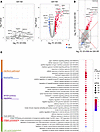 Figure 2
Differential expression genes by transcriptomic analysis at D1 after vaccination in QIV-HD and QIV-SD arms. (A) Left panel: Volcano plot of differentially expressed genes (DEG) (D1/D0) of arm QIV-SD. Significance is defined by a FDR adjusted P < 0.05 and a FC > 1.41 (red; upregulated) or < –1.41 (blue; downregulated). Right panel: Volcano plot of DEG: (D1/D0) of arm QIV-HD. The vertical black lines delimit the 1.41-FC effects. (B) Differential FC (D1/D0) comparison of gene expression between QIV-SD and QIV-HD groups. The black square delimits the 1.41-FC effects. Significance is defined by an FDR adjusted P <0.05 and a FC > 1.41 (red; upregulated) or < –1.41 (blue; downregulated). (C) Biological processes enriched by the DEG in the QIV-HD. DEG were ranked by their value of FC (P <0.05), and the GSEA algorithm using Gene Ontology – Biological Processes was performed to extract functional information from gene expression data.
Although to different extents in terms of FC and P values, QIV-HD vaccines induced expression of genes involved in the same biological pathways, as observed in the enrichment analysis performed by Gene Set Enrichment Analysis (GSEA) algorithm using the Gene Ontology (GO) database (Figure 2C). Among the biological activated pathways, we observe those related to “innate immune response”, “responses to virus and to interferons (IFNs)”, and “antigen processing and presentation”. Indeed, among the top DEG (lowest P values and highest FC), many were known to be involved in these major biological pathways, such as UBE2L6 (Class I MHC antigen processing and presentation), GBP5 and GBP1 (IFN inducible GTPases), SERPING1 (regulation of complement cascade), and ANKRD22 (antiviral activity) (Supplemental Table 6).
Gene signature of H3N2 HIA titers following QIV-HD vaccination in elderly individuals. We sought to define an early innate gene signature associated with HIA titers following QIV-HD influenza immunization. Considering the intensity of humoral responses to A/H3N2 HIA titers in our dataset, and consistent with previous studies on the dominance of A/H3N2 HIA titers (16), we observed that the log2 FC of 213 genes correlated with the log2 FC of A/H3N2 HIA titers (Supplemental Table 7). We applied hierarchical clustering to the expression profile of these 213 genes for which the log2 FC was found significantly correlated (P < 0.05 and r > 0.4) with the log2 FC of A/H3N2 HIA titers. As shown in Figure 3A, we observed their expression among volunteers with increasing values of antibody response against H3N2 virus strain (Figure 3A and Supplemental Table 7). We found genes that are involved with antiviral and IFN signaling responses as well as other innate immunity pathways. In Figure 3B, we represented a few examples of genes (IFNA7, IFNG, CALM1, and CAMK2B) with the expression levels that are positively or negatively correlated with log2 FC of A/H3N2 HIA titers. STRING analysis (https://string-db.org/) showed their biological link (Figure 3C). CALM1 and CAMK2 belongs to the calmodulin pathway, as well as CAMK4, which was described by Nakaya et al. (17) and negatively correlated with Ab responses at D3 after vaccination.
 Figure 3
Early innate gene signature following QIV-HD vaccination in elderly. (A) Heatmap of the log2 FC values of the 213 genes correlated with the log2 FC of anti–A H3N2 HIA titers. The graph displays the values for each patient, ordered by increasing values in the log2 of antibody titers, which are displayed in the bar plot (Spearman correlation, P < 0.05 and r > 0.4). (B) Correlation plots of the log2 FC of H3N2 HIA titers (y axis) and the log2 FC of some of the top genes correlated with them (x axis). (C) STRING pathway analysis of genes correlated with the log2 FC of anti–A H3N2 HIA titers, without disconnected nodes in the network. Edges represent protein-protein associations with minimum required interaction score of 0.4 edge confidence (line thickness indicates the strength of data support).
Our study thereby validates previous findings on an early innate gene signature linked to HIA titers following QIV-HD with pronounced effect in elderly individuals.
Early whole blood cellular variation following QIV-HD compared with QIV-SD vaccination in the elderly population. We analyzed the abundance of different blood cell subpopulation at D1 after vaccination as indicated in the gating strategy (Supplemental Figure 2). The results are represented in percentage of CD45+ cells, excluding eosinophils. Different blood cell populations were identified using conventional surface markers: T and B cells; neutrophils; basophils; CD56bright early and CD56dim NK cells; classical, intermediate, and nonclassical monocytes; and plasmacytoid-, type 1 and 2 conventional-, and monocyte-derived DCs (pDC, cDC1, cDC2, and moDC, respectively). These blood cell populations remained were stable before (D–7) and upon randomization (D0) (Supplemental Figure 3). To compare the modulation of blood cell populations following vaccination (D1) by trial arm, we normalized and represented the FC differences (D1/D0) by arm using a radar chart (Figure 4A). Two main populations were significantly lowered in the QIV-HD arm 24 hours after vaccination, compared with the QIV-SD arm (Figure 4, A and B): cDC2 and early CD56bright NK cells (adjusted P = 0.03 and < 0.0001, respectively), whereas other circulating blood cell populations remained stable (Supplemental Figure 4). The percentages of cDC2 and CD56bright NK cells are more strongly decreased for the QIV-HD group compared with the QIV-SD group (Figure 4B). Only neutrophils, major blood cells, were increase in QIV-HD group but not significantly (FC = 0.2363; Figure 4A). Principal component analysis (PCA) displayed in Figure 4C visualized FC of neutrophils, cDC2, and early CD56bright NK cells by trial arm. This reduction considers approximatively for 87.9% of the variation of the initial information, segregating QIV-HD and QIV-SD vaccinated individuals according to neutrophils, cDC2 and CD56bright NK cells.
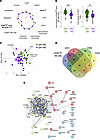 Figure 4
Innate cellular responses following QIV-HD and QIV-SD vaccination in elderly. (A) Radar chart presents the 1 and –1 FC (log2) for participant groups. The medians of each blood cell population (T and B cells; neutrophils; basophils; CD56bright early and CD56dim NK cells; classical, intermediate, and nonclassical monocytes; pDCs, cDC1, cDC2, and moDCs) are presented for QIV-SD (green) and QIV-HD (violet) groups. (B) Violin plot of log2 FC (D1/D0) are represented for CD56bright early NK cells and cDC2 for 2 vaccinated groups. (C) Principal component analysis (PCA) representation of QIV-SD (green) and QIV-HD (violet) groups based on induced blood cell populations at D1/D0. Arrows indicate the prominent parameter distinguishing features (neutrophils, CD56bright early NK cells and cDC2). (D) Venn diagram of common DEG correlated with anti–A H3N2 (green) and –A H1N1 (yellow) HIA titers, CD56bright early NK cell FC (blue), and cDC2 FC (red). (E) STRING pathway analysis (with 3 K-means clustering represented by 3 node colors) of 46 genes are in common between all these 4 parameters. Statistical analyses were performed with 1-way ANOVA and Bonferroni’s multiple-comparison tests, and indicated as adjusted P values. **P < 0.01, ****P < 0.0001.
We then investigated gene signature correlated with differential blood circulation of cDC2 and CD56bright NK cells. Among the 293 DEG identified for QIV-HD (Figure 2B and Supplemental Table 5), we found 129 DEG correlated with cDC2 FC and 204 DEG with CD56bright NK cell FC (Supplemental Tables 8 and 9, respectively). The Venn diagram displayed in Figure 4D depict differentially up- and downregulated genes at D1 correlated with cDC2, CD56bright NK cell population, and influenza H1N1 and H3N2 HIA titers. Common gene are represented at the interactions in the Venn diagram (Figure 4D). We found 46 common genes between these 4 variables, including genes that are associated with IFN signaling pathways as represented in a functional protein association network (https://string-db.org/) (Figure 4E). These results suggest that perturbation of cells and gene expression in the 24 hours following vaccination (D1) are a trademark of differences between HD and SD influenza vaccination.
Similarities of gene signatures associated with early innate response modules among elderly individuals vaccinated with QIV-HD and young adults vaccinated with trivalent inactivated vaccine-standard dose. The gene signature (293 DEG) that we identified among elderly individuals vaccinated with QIV-HD was involved in the antiviral and IFN signaling, monocyte/inflammation, antigen-processing and presentation (Figure 5A and Supplemental Table 10), and NK cell activation (Supplemental Figure 5 and Supplemental Table 11). Interestingly, this signature of humoral responses reflects the overall pattern of immune activation observed following vaccination in young adults as published previously (9, 18–20). We explored the extent of the overlap between gene signature observed in elderly receiving QIV-HD vaccine to that of the established signature in young adults, using the MetavolcanoR package. This allowed us to integrate data from various gene expression studies accessible in public repositories, all generated using similar transcriptomic arrays. Specifically, we focused on 3 studies that compared gene expression on the first day after influenza vaccination against D0 in young adults (18–20): GSE30101, GSE48023, and GSE48018 data sets. We observed that QIV-HD led to the enrichment of biological pathways described above with a significant proportion of upregulated and downregulated genes likely to the gene ensemble of young adult cohorts vaccinated with trivalent standard dose influenza vaccine (TIV-SD). We did not observe this comparability of signal intensity with QIV-SD vaccination (Figure 5A). Since we observed the enrichment of many IFN-related pathways, and the correlation of some of the genes from these modules with the antibody response in the elderly cohort (Figure 3), we next sought to inspect the differences in the expression of these genes among groups. The heatmap in the figure (Figure 5B) represents the average of the FC values for each of these genes for each cohort (QIV-HD, QIV-SD, and TIV-SD [young cohort]). We observe that, indeed, the perturbations in the expression of these genes in the QIV-HD (elderly) and the TIV-SD (young adults) are similar, while the QIV-SD (elderly) presented minor upregulation of these gens. In fact, some of the genes, such as IFI35, RSAD2, and ISG15, presented the highest FC average in the elderly group that received the QIV-HD.
 Figure 5
Significant up- and downregulated gene associated with early innate response modules in elderly individuals vaccinated with QIV-SD and QIV-HD compared with young adults vaccinated with TIV-SD. (A) The tmod enrichment analysis for QIV-SD, QIV-HD and young adults vaccinated with TIV-SD. From the list of genes provided by the limma R package, genes were ranked by their P values, and the enriched blood transcription modules were obtained by the CERNO test. The effect size is proportional to the size of the pie, while the adjusted P value is proportional to color intensity. Within each pie, the proportion of significantly upregulated and downregulated genes is shown in red and blue, respectively. The gray portion of the pie represents genes that are not significantly differentially regulated. (B) Heatmap of the log2 FC of the biomarkers of immune response that belong to the IFN signaling pathway, comparing the QIV-SD and QIV-HD arms with the meta-analysis of studies with young adults vaccinated with TIV-SD. The combining approach from the MetavolcanoR package was used to summarize the FC of the studies based on the mean of the values, while the P value was combined using the Fisher method.
In summary, the administration of HD influenza vaccine in elderly induce elevated innate gene expression in correlation with HIA titers, comparable with that observed in younger adults administered with TIV-SD.


