
Abstract
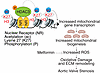
Aortic valve stenosis is a progressive and increasingly prevalent disease in older adults, with no approved pharmacologic therapies to prevent or slow its progression. Although genetic risk factors have been identified, the contribution of epigenetic regulation remains poorly understood. Here, we demonstrated that histone deacetylase 3 (HDAC3) maintains aortic valve structure by suppressing mitochondrial biogenesis and preserving extracellular matrix integrity in valvular interstitial fibroblasts. Human stenotic valves displayed elevated acetylation of histone H3 at lysine 27 (H3K27ac) and reduced HDAC3 activity in diseased regions. Mice lacking HDAC3 in aortic valves developed aortic valve stenosis, disrupted collagen organization, increased H3K27ac, and premature mortality. Mechanistically, HDAC3 loss led to activation of nuclear hormone receptor–regulated mitochondrial gene programs, increased oxidative phosphorylation, and reactive oxygen species–induced damage. Treatment with metformin, a mitochondrial complex I inhibitor, restored redox balance, preserved collagen structure, and improved valve function in Hdac3-deficient mice. Supporting these experimental findings, retrospective clinical analysis revealed a significantly lower prevalence and slower progression of aortic valve stenosis in patients treated with metformin. These results uncovered a potentially previously unrecognized role for HDAC3 in coordinating epigenetic and metabolic homeostasis in the aortic valve, suggesting that targeting mitochondrial dysfunction may offer a therapeutic strategy for noncalcific aortic valve disease.
Authors
Timothy J. Cashman, Sherin Saheera, Ashley E. Blau, Edith Mensah Otabil, Nouran Y. Nagy, Thomas D. Samenuk, Timothy P. Fitzgibbons, David D. McManus, Chinmay M. Trivedi
Abstract
Cardiac hypertrophy is a common adaptation to cardiovascular stress and often a prelude to heart failure. We examined how S-palmitoylation of the small GTPase, Ras-related C3 botulinum toxin substrate 1 (Rac1), impacts cardiomyocyte stress signaling. Mutation of the cysteine-178 palmitoylation site impaired activation of Rac1 when overexpressed in cardiomyocytes. Cardiomyocyte-specific Rac1 conditional knock-in (Rac1cKI) mice expressing a Rac1C178S mutant protein exhibit normal cardiac structure-function but develop more severe cardiac hypertrophy in response to angiotensin-II (AngII) infusion, cardiomyocyte-specific overexpression of AngII type-I receptor (AT1R), and cardiac pressure overload. Moreover, pressure overload and AT1R overexpression evoked cardiac failure phenotypes in Rac1cKI mice not observed in controls. Mechanistically, Rac1cKI hearts and cardiomyocytes genetically-resistant to Rac1 S-palmitoylation have a profound increase in protein kinase A (PKA) substrate phosphorylation in response to acute β-adrenergic stimulation, as do Rac1cKI hearts subjected to chronic AngII treatment, AT1R overexpression, or pressure overload that correlates with more advanced heart failure phenotypes. This is not associated with increased PKA enzymatic activity, suggesting potential deficits in phosphatase activity at PKA-regulated phospho-sites. Taken together, this study suggests Rac1 S-palmitoylation dampens adrenergic drive and PKA-dependent modulation of the phospho-proteome in response to cardiovascular stress, revealing essential functions for S-acylated Rac1 in cardiac adaptation.
Authors
James P. Teuber, Rachel E. Scissors, Arasakumar Subramani, Nageswara Madamanchi, Matthew J. Brody
Abstract
Inflammation plays important roles in the pathogenesis of vascular diseases. We here show the involvement of perivascular inflammation in aortic dilatation of Marfan syndrome (MFS). In the aorta of MFS patients and Fbn1C1041G/+ mice, macrophages markedly accumulated in periaortic tissues with increased inflammatory cytokine expression. Metabolic inflammatory stress induced by a high-fat diet (HFD) enhanced vascular inflammation predominantly in periaortic tissues and accelerated aortic dilatation in Fbn1C1041G/+ mice, both of which were inhibited by low-dose pitavastatin. HFD feeding also intensifies structural disorganization of the tunica media in Fbn1C1041G/+ mice, including elastic fiber fragmentation, fibrosis, and proteoglycan accumulation, along with increased activation of TGF-β downstream targets. Pitavastatin treatment mitigated these alterations. For non-invasive assessment of PVAT inflammation in a clinical setting, we developed an automated analysis program for CT images using machine learning techniques to calculate the perivascular fat attenuation index of the ascending aorta (AA-FAI), correlating with periaortic fat inflammation. The AA-FAI was significantly higher in patients with MFS compared to patients without hereditary connective tissue disorders. These results suggest that perivascular inflammation contributes to aneurysm formation in MFS and might be a potential target for preventing and treating vascular events in MFS.
Authors
Hiroyuki Sowa, Hiroki Yagi, Kazutaka Ueda, Masaki Hashimoto, Kohei Karasaki, Qing Liu, Atsumasa Kurozumi, Yusuke Adachi, Tomonobu Yanase, Shun Okamura, Bowen Zhai, Norifumi Takeda, Masahiko Ando, Haruo Yamauchi, Nobuhiko Ito, Minoru Ono, Hiroshi Akazawa, Issei Komuro

Abstract
Abdominal aortic aneurysm (AAA) is a life-threatening vascular disease with no effective pharmacological interventions. While single-cell transcriptomics has advanced our understanding of AAA, it lacks spatial context. Here, we employed Seq-Scope, an ultra-high-resolution spatial transcriptomic technology, to decipher the spatial landscape of angiotensin II–induced AAA in Apoe–/– mice. Our analysis revealed the heterogeneity of macrophages, fibroblasts, and smooth muscle cells (SMCs), with specific responses in different layers of the AAA tissue. SMCs in the inner layers showed associations with Mgp-expressing fibroblasts and GPNMB-expressing macrophages, whereas the outer layers had different dominant cell types. Notably, GPNMB-expressing macrophages were concentrated near SMCs in regions of severe elastic lamina damage. Immunofluorescent staining confirmed their colocalization, and scRNA-seq reanalysis independently validated the presence of GPNMB-high macrophages in AAA tissues, highlighting their involvement in inflammation and tissue remodeling. Moreover, we discovered that macrophage-derived soluble GPNMB induces SMC phenotypic switching, reducing contractile markers while increasing cytokines and metalloproteinases. This effect was partly mediated by CD44 signaling. These findings suggest that GPNMB-high macrophages contribute to AAA development by driving SMC dysfunction. This study highlights the importance of high-resolution spatial transcriptomics in complementing single-cell transcriptomics, offering valuable insights into molecular and cellular responses in the AAA microenvironment.
Authors
Guizhen Zhao, Chun-Seok Cho, Hongyu Liu, Yongha Hwang, Yichen Si, Myungjin Kim, Yongjie Deng, Yang Zhao, Chao Xue, Yanhong Guo, Lin Chang, Dogukan Mizrak, Bo Yang, Hyun Min Kang, Jifeng Zhang, Jun Hee Lee, Y. Eugene Chen
Abstract
Authors
Joshua A. Keefe, Jose Alberto Navarro-Garcia, Shuai Zhao, Mihail G. Chelu, Xander H.T. Wehrens

Abstract
Hypertrophic cardiomyopathy (HCM) is a hereditary heart condition characterized by either preserved or reduced ejection fraction without any underlying secondary causes. The primary cause of HCM is sarcomeric gene mutations, which account for only 40%–50% of the total cases. Here, we identified a pathogenic missense variant in tubulin tyrosine ligase (TTL p.G219S) in a patient with HCM. We used clinical, genetics, computational, and protein biochemistry approaches, as well as patient-specific and CRISPR gene-edited induced pluripotent stem cell–derived cardiomyocytes (iPSC-CMs), to demonstrate that the TTL pathogenic variant results in a reduced enzymatic activity and the accumulation of detyrosinated tubulin leading to the disruption of redox signaling, ultimately leading to HCM. Our findings highlight — for the first time to our knowledge — the crucial roles of the TTL variant in cardiac remodeling resulting in disease.
Authors
Pratul Kumar Jain, Susobhan Mahanty, Harshil Chittora, Veronique Henriot, Carsten Janke, Minhajuddin Sirajuddin, Perundurai S. Dhandapany
Abstract
Pathological cardiac remodeling is associated with the reactivation of fetal genes, yet the extent of the heart’s fetal gene program and its impact on proteome compositions remain incompletely understood. Here, using a new proteome-wide protein ratio quantification strategy with mass spectrometry, we identify pervasive isoform usage shifts in fetal and postnatal mouse hearts, involving 145 pairs of highly homologous paralogs and alternative splicing-derived isoform proteins. Proteome-wide ratio comparisons readily rediscover hallmark fetal gene signatures in muscle contraction and glucose metabolism pathways, while revealing novel isoform usage in mitochondrial and gene expression proteins, including PPA1/PPA2, ANT1/ANT2, and PCBP1/PCBP2 switches. Paralogs with differential fetal usage tend to be evolutionarily recent, consistent with functional diversification. Alternative splicing adds another rich source of fetal isoform usage differences, involving PKM M1/M2, GLS-1 KGA/GAC, PDLIM5 long/short, and other spliceoforms. When comparing absolute protein proportions, we observe a partial reversion toward fetal gene usage in pathological hearts. In summary, we present a ratiometric catalog of paralogs and spliceoform pairs in the cardiac fetal gene program. More generally, the results demonstrate the potential of applying the proteome-wide ratio test concept to discover new regulatory modalities beyond differential gene expression.
Authors
Yu Han, Shaonil Binti, Sara A. Wennersten, Boomathi Pandi, Dominic C.M. Ng, Edward Lau, Maggie P.Y. Lam
Abstract
Biallelic variants in SCN1B, encoding the voltage-gated sodium channel β1/β1B subunits, are linked to DEE52, a developmental and epileptic encephalopathy with a high risk of Sudden Unexpected Death in Epilepsy (SUDEP). DEE52 patients present clinically with Dravet syndrome or the more severe early infantile DEE. SCN1B is expressed in brain and heart in humans and in mice. Thus, we have proposed that, in addition to generalized seizures, cardiac arrhythmia may play a role in SUDEP. Mice with homozygous expression of the DEE52 variant Scn1b-c.265C>T, predicting p.R89C, have spontaneous and hyperthermia-induced generalized seizures and SUDEP. Here we conducted cardiac characterization of Scn1b-c.265C>T mice and studied induced pluripotent stem cell cardiomyocytes (iPSC-CMs) derived from two SCN1B-c.265C>T DEE52 patients. Scn1bC89/C89 mouse CMs showed increased transient outward potassium current (Ito) density and heart sections revealed ventricular fibrosis. Scn1bC89/C89 mice were susceptible to pacing-induced cardiac arrhythmias. Patient-derived iPSC-CMs with biallelic SCN1B-c.265C>T variant expression showed increased sodium current (INa), late INaL, and Ito current densities. We conclude that, while mouse and human cardiac AP waveforms have critical differences, increased Ito is common to both models of DEE52. Overall, our data suggest that electrical and structural substrates may lead to arrhythmias and contribute to SUDEP in DEE52.
Authors
Roberto Ramos-Mondragon, Shuyun Wang, Nnamdi Edokobi, Qinghua Liu, Xiaotan Qiao, Maya Shih, Louis T. Dang, Yao-Chang Tsan, Katalin Štěrbová, Adam S. Helms, Sarah Weckhuysen, Luis F. Lopez-Santiago, Jack M. Parent, Lori L. Isom
Abstract
Heterozygosity for missense mutations in one of 3 seemingly redundant calmodulin (CALM)-encoding genes can cause life-threatening arrhythmias, suggesting that small fractions of mutant CALM protein suffice to cause a severe phenotype. However, the exact molar ratios of wildtype to mutant CALM protein in calmodulinopathy hearts remain unknown. The aim of the present study was to quantitate mutant versus wildtype CALM transcript and protein levels in hearts of knock-in mice harboring the p.N98S mutation in the Calm1 gene. We found that the transcripts from the mutant Calm1 allele were the least abundantly expressed Calm transcripts in both hetero- and homozygous mutant hearts, while mutant hearts accumulate high levels of N98S-CALM protein in a Calm1N98S allele dosage-dependent manner, exceeding those of wildtype CALM protein. We further show that the severity of the electrophysiological phenotype incrementally increases with the graded increase in the mutant-to-wildtype CALM protein expression ratio seen in homozygous versus heterozygous mutant mice. We finally show a decrease in N98S-CALM protein degradation, suggesting that mutant CALM stabilization contributed to its enrichment in the heart. Our results support what we believe to be a novel mechanism by which a mutation in a single Calm gene can give rise to a severe phenotype.
Authors
Wen-Chin Tsai, Chiu-Fen Yang, Shu-Yu Lin, Suh-Yuen Liang, Wei-Chung Tsai, Shuai Guo, Xiaochun Li, Susan Ofner, Kai-Chien Yang, Tzu-Ching Meng, Peng-Sheng Chen, Michael Rubart
Abstract
Hereditary cardiomyopathies are the prototypic forms of heart failure and major causes of sudden cardiac death. The genome in cardiomyopathies is exposed to internal stressors, which damage the DNA and activate the DNA damage response (DDR) pathways. We set to determine whether the DDR pathways were activated and pathogenic in an established mouse model of desmoplakin (DSP)-cardiomyopathy generated upon deletion of the Dsp gene in cardiac myocytes (Myh6-McmTam:DspF/F). The mice exhibited premature death, cardiac dysfunction, myocardial cell death, fibrosis, and increased expression levels of the pro-inflammatory cytokines, consistent with the phenotype of human DSP-cardiomyopathy. Cytosolic nuclear self-DNA (nDNA) and mitochondrial DNA (mtDNA) were increased in cardiac myocyte cytosol in the Myh6-McmTam:DspF/F mice. Likewise, the DDR pathway proteins, including the cyclic GMP-AMP synthase (CGAS), stimulator of interferon response 1 (STING1) were upregulated as were the transcript levels of interferon response factor 3 (IRF3) and the nuclear factor κB (NFκB) target genes. Deletion of the Mb21d1 gene encoding CGAS in the Myh6-McmTam:DspF/F mice prolonged survival, improved cardiac function, attenuated fibrosis, and reduced cell death. Thus, cytosolic nDNA and mtDNA are increased and the DDR pathways are activated and pathogenic in a mouse model of DSP-cardiomyopathy, whereas genetic blockade of CGAS is salubrious.
Authors
Weiyue Wang, Benjamin Cathcart, Quoc D. Nguyen, Loi Q. Lao, Amelia Bryans, Sara E. Coleman, Leila Rouhi, Priyatansh Gurha, Ali J. Marian
No posts were found with this tag.


