
Submit a comment
Abstract
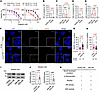
Acquired resistance to poly(ADP-ribose) polymerase inhibitors (PARPi) limits their therapeutic benefits in patients with high-grade serous ovarian cancer (HGSC). Identifying therapeutic vulnerabilities that function across distinct forms of acquired PARPi resistance is an urgent need. In BRCA2-deficient PARPi-naive cells, targeting RAD52 can be synthetic lethal with a PARPi, making RAD52 an attractive therapeutic target. However, this approach has not been tested in HGSC models of acquired PARPi resistance. Here, we assessed the effects of RAD52 loss in 2 distinct Brca2-deficient mouse models of HGSC with acquired PARPi resistance. RAD52 loss suppressed homologous recombination and single-strand annealing DNA repair activity in both models. Genetic depletion and pharmacologic inhibition of RAD52 restored PARPi sensitivity both in vitro and in vivo. Furthermore, RAD52 expression was elevated in a newly derived human model of BRCA2-deficient HGSC with acquired PARPi resistance. In this cell line, RAD52 inhibition synergized with a PARPi. Finally, elevated RAD52 expression was associated with poor survival in patients with HGSC. Collectively, these findings establish RAD52 as a clinically relevant therapeutic vulnerability in multiple models of HGSC with acquired PARPi resistance.
Authors
Yukihide Ota, Maia L. Elizagaray, Vijayalaxmi Gupta, Bisiayo E. Fashemi, Moreniola Akande, Preedia Babu, Prasanth Kumar Thuthika, Elena Lomonosova, Joshua Brill, Lulu Sun, Brooke Sanders, Lindsay M. Kuroki, Carolyn K. McCourt, Andrea R. Hagemann, Ian S. Hagemann, Premal H. Thaker, David G. Mutch, Matthew A. Powell, Krzysztof Hyrc, Priyanka Verma, John Krais, Benjamin G. Bitler, Mary M. Mullen, Dineo Khabele
Guidelines
The Editorial Board will only consider comments that are deemed relevant and of interest to readers. The Journal will not post data that have not been subjected to peer review; or a comment that is essentially a reiteration of another comment.
- Comments appear on the Journal’s website and are linked from the original article’s web page.
- Authors are notified by email if their comments are posted.
- The Journal reserves the right to edit comments for length and clarity.
- No appeals will be considered.
- Comments are not indexed in PubMed.
Specific requirements
- Maximum length, 400 words
- Entered as plain text or HTML
- Author’s name and email address, to be posted with the comment
- Declaration of all potential conflicts of interest (even if these are not ultimately posted); see the Journal’s conflict-of-interest policy
- Comments may not include figures


