
Submit a comment
Abstract
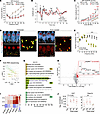
Noise-induced hearing loss (NIHL) is a major public health problem caused by damage to cochlear hair cells, synapses, and spiral ganglion neurons (SGNs). Since effective treatments are lacking, we investigated cellular stress responses induced by moderate and loud noise in a mouse model of cochlear synaptopathy. RNA-seq and spatial transcriptomics revealed that noise exposure elicited a robust but transient upregulation of endoplasmic reticulum chaperones and proteasome subunits in SGNs and their supporting cells. To target this response, we administered TRC051384, a small-molecule activator of the heat shock transcription factor Hsf1, prior to noise exposure. TRC051384 crossed the blood-labyrinth barrier and reached the cochlea, induced heat shock protein gene expression, and restored ubiquitin-proteasome function in SGNs. Notably, TRC051384 treatment enhanced auditory brainstem response threshold recovery, preserved Wave I amplitudes, and maintained ribbon synapse density. Together with the existing literature, these findings identify proteotoxic stress in SGNs as a contributor to noise-induced hearing loss and support pharmacological activation of HSF1 as a promising therapeutic strategy.
Authors
Jintao Yu, Miguel A. Ramirez, Yi-Zhi Wang, Seby Edassery, Maxwell Shramuk, SangEun Yeom, Casey Jiaxi Li, Yuvraj Joshi, Mary Ann Cheatham, Mark A. Rutherford, Leah J. Welty, Jeffrey N. Savas
Guidelines
The Editorial Board will only consider comments that are deemed relevant and of interest to readers. The Journal will not post data that have not been subjected to peer review; or a comment that is essentially a reiteration of another comment.
- Comments appear on the Journal’s website and are linked from the original article’s web page.
- Authors are notified by email if their comments are posted.
- The Journal reserves the right to edit comments for length and clarity.
- No appeals will be considered.
- Comments are not indexed in PubMed.
Specific requirements
- Maximum length, 400 words
- Entered as plain text or HTML
- Author’s name and email address, to be posted with the comment
- Declaration of all potential conflicts of interest (even if these are not ultimately posted); see the Journal’s conflict-of-interest policy
- Comments may not include figures


