
Go to The Journal of Clinical Investigation
  • About
  • Editors
  • Consulting Editors
  • For authors
  • Publication ethics
  • Publication alerts by email
  • Transfers
  • Advertising
  • Job board
  • Contact
  • Physician-Scientist Development
  • Current issue
  • Past issues
  • By specialty
    • COVID-19
    • Cardiology
    • Immunology
    • Metabolism
    • Nephrology
    • Oncology
    • Pulmonology
    • All ...
  • Videos
  • Collections
    • In-Press Preview
    • Resource and Technical Advances
    • Clinical Research and Public Health
    • Research Letters
    • Editorials
    • Perspectives
    • Physician-Scientist Development
    • Reviews
    • Top read articles

  • Current issue
  • Past issues
  • Specialties
  • In-Press Preview
  • Resource and Technical Advances
  • Clinical Research and Public Health
  • Research Letters
  • Editorials
  • Perspectives
  • Physician-Scientist Development
  • Reviews
  • Top read articles
  • About
  • Editors
  • Consulting Editors
  • For authors
  • Publication ethics
  • Publication alerts by email
  • Transfers
  • Advertising
  • Job board
  • Contact

Submit a comment

NOTCH1 acts as a tumor suppressor that induces early differentiation in head and neck cancer
Chenfei Huang, Shhyam Moorthy, Qiuli Li, Kazi M. Ahmed, Kalil Saab, Defeng Deng, Jiping Wang, Xiayu Rao, Jiexin Zhang, Yuanxin Xi, Jing Wang, Zhiyi Liu, Noriaki Tanaka, David A. Wheeler, Eve Shinbrot, Rami Saade, Curtis R. Pickering, Tong-Xin Xie, Adel K. El-Naggar, Abdullah A. Osman, Kunal Rai, Patrick A. Zweidler-McKay, John V. Heymach, Lauren A. Byers, Faye M. Johnson, Vlad C. Sandulache, Jeffrey N. Myers, Pedram Yadollahi, Mitchell J. Frederick
View: Text | PDF
Research Article Cell biology Oncology

NOTCH1 acts as a tumor suppressor that induces early differentiation in head and neck cancer

  • Text
  • PDF
Abstract

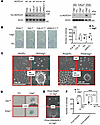
Inactivating NOTCH1 mutations in head and neck squamous cell carcinoma (HNSCC) were described over a decade ago, suggesting a tumor suppressor function — unlike its oncogenic role in other tumors. Today, much debate persists regarding a putative oncogenic role in HNSCC as well, with reports that NOTCH1 signaling drives tumor growth and a cancer stem cell (CSC) phenotype. In this work, comprehensive experiments unequivocally demonstrate that NOTCH1 is a tumor suppressor in HNSCC regardless of mutation or activation status and that it reduces CSC frequency. We developed a signature of NOTCH1 activation showing the pathway is associated with very early differentiation, an altered tumor microenvironment, and better prognosis. Clarifying whether NOTCH1 occasionally functions as an oncogenic driver in HNSCC is crucial to prognosis and personalized therapy. The results presented unify the field, reconcile conflicting data, and provide critical insights into the biological and clinical significance of NOTCH1, with broader implications in other squamous carcinomas with NOTCH1 mutations.

Authors

Chenfei Huang, Shhyam Moorthy, Qiuli Li, Kazi M. Ahmed, Kalil Saab, Defeng Deng, Jiping Wang, Xiayu Rao, Jiexin Zhang, Yuanxin Xi, Jing Wang, Zhiyi Liu, Noriaki Tanaka, David A. Wheeler, Eve Shinbrot, Rami Saade, Curtis R. Pickering, Tong-Xin Xie, Adel K. El-Naggar, Abdullah A. Osman, Kunal Rai, Patrick A. Zweidler-McKay, John V. Heymach, Lauren A. Byers, Faye M. Johnson, Vlad C. Sandulache, Jeffrey N. Myers, Pedram Yadollahi, Mitchell J. Frederick

×

Guidelines

The Editorial Board will only consider comments that are deemed relevant and of interest to readers. The Journal will not post data that have not been subjected to peer review; or a comment that is essentially a reiteration of another comment.

  • Comments appear on the Journal’s website and are linked from the original article’s web page.
  • Authors are notified by email if their comments are posted.
  • The Journal reserves the right to edit comments for length and clarity.
  • No appeals will be considered.
  • Comments are not indexed in PubMed.

Specific requirements

  • Maximum length, 400 words
  • Entered as plain text or HTML
  • Author’s name and email address, to be posted with the comment
  • Declaration of all potential conflicts of interest (even if these are not ultimately posted); see the Journal’s conflict-of-interest policy
  • Comments may not include figures
This field is required

Copyright © 2026 American Society for Clinical Investigation
ISSN 2379-3708

Sign up for email alerts