
Submit a comment
Abstract
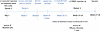
Vascularized skins were 3D printed using single donor human fibroblasts, pericytes, keratinocytes, and endothelial cells (ECs), the latter either unmodified (WT-ECs) or deleted of MHC molecules (KO-ECs). Adult MISTRG6 immunodeficient mice neonatally inoculated with adult human hematopoietic stem cells (HSCs) received printed skin allogeneic to the HSCs and were boosted 3 weeks after grafting with human PBMCs autologous to the HSCs. HSC inoculation alone produced low levels of circulating human myeloid and lymphoid cells without affecting grafts; PBMC boosting dramatically increased circulating human CD4+ T cells and boosted CD8+ T cells only in mice with WT-EC grafts. These grafts became infiltrated by human macrophages, dendritic cells, CD4+ and CD8+ T cells and showed evidence of rejection. Shared T cell clones were present in skin and spleen. KO-EC grafts had minimal infiltration of graft or spleen without rejection, despite MHC molecule expression on other graft cell types.
Authors
Zuzana Tobiasova, Esen Sefik, Lingfeng Qin, Jennifer M. McNiff, Gwendolyn Davis, Richard A. Flavell, W. Mark Saltzman, Jordan S. Pober
Guidelines
The Editorial Board will only consider comments that are deemed relevant and of interest to readers. The Journal will not post data that have not been subjected to peer review; or a comment that is essentially a reiteration of another comment.
- Comments appear on the Journal’s website and are linked from the original article’s web page.
- Authors are notified by email if their comments are posted.
- The Journal reserves the right to edit comments for length and clarity.
- No appeals will be considered.
- Comments are not indexed in PubMed.
Specific requirements
- Maximum length, 400 words
- Entered as plain text or HTML
- Author’s name and email address, to be posted with the comment
- Declaration of all potential conflicts of interest (even if these are not ultimately posted); see the Journal’s conflict-of-interest policy
- Comments may not include figures


