
Submit a comment
Abstract
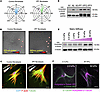
Matrix stiffening sustains fibrosis by recruiting fibroblasts to stiff fibrotic areas through durotaxis. Once recruited, fibroblasts become mechanically activated and promote scar formation. Although actin-based mechanotransduction and focal adhesion signaling are well established, how microtubules contribute to stiffness sensing and fibroblast activation in fibrosis remains incompletely understood. Here, we identify αTAT1-mediated microtubule acetylation as a key regulator of fibroblast mechanosensing, durotaxis, and profibrotic activation. Through α-tubulin K40 acetylation, αTAT1 promotes microtubule flexibility, directional alignment, and persistent polarity along stiffness gradients, thereby enabling stiffness-directed migration and fibroblast activation. Mechanistically, αTAT1-dependent microtubule acetylation regulates focal adhesion dynamics and downstream mechanotransduction. αTAT1 loss abolishes K40 acetylation, impairs FAK-mediated YAP/TAZ signaling, and prevents stiffness- and TGF-β–induced myofibroblast differentiation. Accordingly, global or fibroblast-specific Atat1 depletion reduces fibroblast durotaxis and the accumulation of profibrotic fibroblasts, protecting mice from lung, dermal, and kidney fibrosis without affecting inflammation or vascular integrity. Our findings establish αTAT1-dependent microtubule acetylation as a conserved mechanosensing pathway that links fibroblast durotaxis and activation to fibrosis across organs in vivo, and identify αTAT1 catalytic activity as a potential mechano-therapeutic target in fibrotic disease.
Authors
Alba Santos, Tamanna Islam, Maria-Anna Chrysovergi, Paula E. Grasberger, Vera Auernheimer, Taslim A. Al-Hilal, Santiago Lamas, David Lagares
Guidelines
The Editorial Board will only consider comments that are deemed relevant and of interest to readers. The Journal will not post data that have not been subjected to peer review; or a comment that is essentially a reiteration of another comment.
- Comments appear on the Journal’s website and are linked from the original article’s web page.
- Authors are notified by email if their comments are posted.
- The Journal reserves the right to edit comments for length and clarity.
- No appeals will be considered.
- Comments are not indexed in PubMed.
Specific requirements
- Maximum length, 400 words
- Entered as plain text or HTML
- Author’s name and email address, to be posted with the comment
- Declaration of all potential conflicts of interest (even if these are not ultimately posted); see the Journal’s conflict-of-interest policy
- Comments may not include figures


