
Submit a comment
Abstract
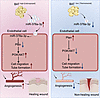
Interscapular brown adipose tissue (BAT), one of the most vascularized tissues in the body, exemplifies the intricate crosstalk between the vascular system and adipocytes. BAT is known to secrete abundant exosomes into circulation, and exosomes are known to play a key role in vascular remodeling and cell migration. However, whether BAT-derived exosomes (BATexos) modulate peripheral vasculature remains unclear. Here, we report that BATexos promoted peripheral angiogenesis and vascular repair. Among their cargo, miR-378a-3p was highly enriched and identified as a key mediator of endothelial angiogenic function. The overexpression of miR-378a-3p in endothelial cells substantially promoted cell migration and tube formation. Conversely, inhibition of exosome secretion from BAT impaired vascular repair and delayed wound healing. Mechanistically, miR-378a-3p directly targeted the phosphatase and tensin homolog (Pten), thereby activating the PI3K/AKT signaling pathway. Liposomes encapsulating miR-378 mimics promoted angiogenesis and accelerated wound healing in a diabetic mouse model. Collectively, this study uncovers BAT-derived miR-378a-3p as a key regulator of vessel regeneration and tissue repair after injury, offering therapeutic potential for treating vascular complications in metabolic disease.
Authors
Hongyan Deng, Yuyu Xie, Jiadai Liu, Jing Ge, Qianqian Kang, Rui He, Zhihan Wang, Xuemin Peng, Zengzhe Zhu, Wenshe Wang, Yulian Liu, Ronghui Gao, Ruping Pan, Min Yang, Yong Chen
Guidelines
The Editorial Board will only consider comments that are deemed relevant and of interest to readers. The Journal will not post data that have not been subjected to peer review; or a comment that is essentially a reiteration of another comment.
- Comments appear on the Journal’s website and are linked from the original article’s web page.
- Authors are notified by email if their comments are posted.
- The Journal reserves the right to edit comments for length and clarity.
- No appeals will be considered.
- Comments are not indexed in PubMed.
Specific requirements
- Maximum length, 400 words
- Entered as plain text or HTML
- Author’s name and email address, to be posted with the comment
- Declaration of all potential conflicts of interest (even if these are not ultimately posted); see the Journal’s conflict-of-interest policy
- Comments may not include figures


