
Submit a comment
Abstract
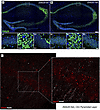
Among the known genetic causes of syndromic autism spectrum disorders (ASDs) are transcription factor deficiencies. In this regard, haploinsufficiency of the zinc finger and broad complex, tramtrack, bric and brac domain–containing protein 20 (ZBTB20) leads to a prototypical clinical picture, referred to as Primrose syndrome, comprising severe ASD symptoms together with intellectual disability. Here, we present a comprehensive behavioral and phenotypical characterization of Zbtb20+/– mice, a construct valid model of this thus far untreatable human condition. Zbtb20+/– mice exhibited diminished sociability, reduced vocalization, distinct repetitive behaviors, impaired cognitive flexibility, hyperactivity, and hypoalgesia. Magnetic resonance imaging revealed increased volumes of hippocampus, cerebellum, brain matter, and whole brain, confirmed by postmortem brain weight measurements. Due to our previous observation of enhanced ZBTB20 expression in CA1 pyramidal neurons upon recombinant human erythropoietin (rhEPO) injections, we anticipated a mitigating effect through rhEPO treatment of Zbtb20 deficiency/Primrose syndrome. Indeed, after 3 weeks of alternate-day rhEPO injections, a remarkable improvement in the behavioral phenotype was observed. Our results highlight rhEPO as promising treatment for Primrose syndrome.
Authors
Martin Hindermann, Justus B.H. Wilke, Yasmina Curto, Stefan N. Oline, Vinicius Daguano Gastaldi, Umer Javed Butt, Rakshit Dadarwal, Umut Çakır, Anja Ronnenberg, Kurt Hammerschmidt, Susann Boretius, Anastassia Stoykova, Anton B. Tonchev, Klaus-Armin Nave, Manvendra Singh, Hannelore Ehrenreich
Guidelines
The Editorial Board will only consider comments that are deemed relevant and of interest to readers. The Journal will not post data that have not been subjected to peer review; or a comment that is essentially a reiteration of another comment.
- Comments appear on the Journal’s website and are linked from the original article’s web page.
- Authors are notified by email if their comments are posted.
- The Journal reserves the right to edit comments for length and clarity.
- No appeals will be considered.
- Comments are not indexed in PubMed.
Specific requirements
- Maximum length, 400 words
- Entered as plain text or HTML
- Author’s name and email address, to be posted with the comment
- Declaration of all potential conflicts of interest (even if these are not ultimately posted); see the Journal’s conflict-of-interest policy
- Comments may not include figures


