
Submit a comment
Abstract
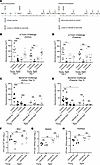
It remains unclear why vaccines targeting prominent microbial virulence factors often fail in clinical trials. Because microbial virulence depends on interaction with the host immune system, we investigated how changes in host immune function alter vaccine efficacy. Using a vaccine against Staphylococcus aureus α-toxin (Hla), which targets host metalloprotease ADAM10 on myeloid cells, we show that Hla virulence is reduced in aged mice due to diminished ADAM10 activity and impaired myeloid cell function. Depletion of myeloid cells with cyclophosphamide in young mice similarly reduced toxin virulence. Immunization against Hla conferred strong protection against S. aureus infection in young but not aged mice. These findings indicate that pathogenic functions of microbial factors characterized in immunocompetent young animals may not predict virulence or vaccine efficacy in immunocompromised hosts. These findings underscore the need to account for host immune status in the development and evaluation of vaccines targeting microbial virulence factors.
Authors
Xin Du, Ching Wen Tseng, Elisabet Bjånes, Hunter Gage, Jaclyn Swan, Chih-Ming Tsai, Irshad A. Hajam, Cesia Gonzalez, Brian Lin, Victor Nizet, George Y. Liu
Guidelines
The Editorial Board will only consider comments that are deemed relevant and of interest to readers. The Journal will not post data that have not been subjected to peer review; or a comment that is essentially a reiteration of another comment.
- Comments appear on the Journal’s website and are linked from the original article’s web page.
- Authors are notified by email if their comments are posted.
- The Journal reserves the right to edit comments for length and clarity.
- No appeals will be considered.
- Comments are not indexed in PubMed.
Specific requirements
- Maximum length, 400 words
- Entered as plain text or HTML
- Author’s name and email address, to be posted with the comment
- Declaration of all potential conflicts of interest (even if these are not ultimately posted); see the Journal’s conflict-of-interest policy
- Comments may not include figures


