
Submit a comment
Abstract
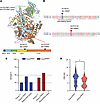
Mitochondrial gene expression is essential for oxidative phosphorylation that generates the bulk of the cellular ATP, and mitochondrial dysfunction is a common cause of human metabolic diseases. Recently, the first pathogenic variants in the only known mitochondrial RNA polymerase (POLRMT) were described in patients presenting with a wide variety of clinical manifestations, including hypotonia, short stature, and developmental delay. Here, we modeled two human pathogenic POLRMT variants by creating the corresponding substitutions in mice: the dominant S582F and the recessive R984C variant. Mice homozygous for the R984C variant showed perinatal lethality without apparent embryonic developmental defects, a finding consistent with a failure to adapt to the metabolic transition to oxidative metabolism at birth. Mice carrying the S582F variant were viable and exhibited decreased mitochondrial transcript levels due to impaired de novo transcription. However, mtDNA levels and in organello mtDNA replication remained normal, which recapitulates the molecular phenotypes observed in patients. Altogether, our findings indicate that the conserved arginine near the active site is essential for POLRMT function, while the serine in the intercalating hairpin of the N-terminal domain is required for near-genome length transcription but not primase activity. This study highlights genotype-phenotype differences and provides new insights into POLRMT function.
Authors
David Alsina, Diana Rubalcava-Gracia, Kristina Bubb, Rodolfo Garcia-Villegas, Akos Vegvari, Roberta Filograna, Florian A. Rosenberger, Camilla Koolmeister, Nils-Göran Larsson
Guidelines
The Editorial Board will only consider comments that are deemed relevant and of interest to readers. The Journal will not post data that have not been subjected to peer review; or a comment that is essentially a reiteration of another comment.
- Comments appear on the Journal’s website and are linked from the original article’s web page.
- Authors are notified by email if their comments are posted.
- The Journal reserves the right to edit comments for length and clarity.
- No appeals will be considered.
- Comments are not indexed in PubMed.
Specific requirements
- Maximum length, 400 words
- Entered as plain text or HTML
- Author’s name and email address, to be posted with the comment
- Declaration of all potential conflicts of interest (even if these are not ultimately posted); see the Journal’s conflict-of-interest policy
- Comments may not include figures


