
Submit a comment
Abstract
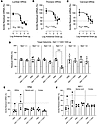
Genome-targeting strategies to address NaV1.7-mediated signaling in nociceptive afferents are of great clinical interest given its high selectivity and persistent analgesic outcomes. In the present work, we analyze concentration-dependent effects of suppressing primary afferent NaV1.7 using the intrathecal delivery of an antisense oligonucleotide (ASO) on pain behaviors and demonstrate that NaV1.7 ASOs are likely to modulate pain traffic by blocking afferent signaling at the dorsal root ganglion (DRG) level. Intrathecal NaV1.7 ASOs induced a concentration-dependent gradient of knockdown in DRGs (lumbar to cervical) of Scn9a mRNA and ATTO488-ProTx-II binding in small DRG neurons, and a suppression of pain behaviors initiated by mechanical compression, inflammation, and the NaV1.7 agonist OD-1. The rostro-caudal reduction in mRNA correlated with ASO distribution, with implications for dose-related analgesic profiles. Marked reduction in DRG NaV1.7 binding was seen after intrathecal delivery of an ASO optimal dose, with high selectivity for small DRG neurons. Changes in sciatic nerve NaV1.7 binding were not detected, indicating a pain traffic modulation likely happening due to a block of afferent signaling at the DRG level.
Authors
Kaue Malange, Julia Borges Paes Lemes, Briana Noble, Yuvicza Anchondo, Carlos E. Morado-Urbina, Saee Jadhav, Saurabh Yadav, Jingrui Ma, Vineet Augustine, Sara A. Dochnal, Chiraag Kambalimath, Marie Duong, Pedro Alvarez, Bethany Fitzsimmons, Curt Mazur, Holly B. Kordasiewicz, Kim Dore, Hien T. Zhao, Tony Yaksh
Guidelines
The Editorial Board will only consider comments that are deemed relevant and of interest to readers. The Journal will not post data that have not been subjected to peer review; or a comment that is essentially a reiteration of another comment.
- Comments appear on the Journal’s website and are linked from the original article’s web page.
- Authors are notified by email if their comments are posted.
- The Journal reserves the right to edit comments for length and clarity.
- No appeals will be considered.
- Comments are not indexed in PubMed.
Specific requirements
- Maximum length, 400 words
- Entered as plain text or HTML
- Author’s name and email address, to be posted with the comment
- Declaration of all potential conflicts of interest (even if these are not ultimately posted); see the Journal’s conflict-of-interest policy
- Comments may not include figures


