
Submit a comment
Abstract
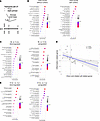
Elexacaftor/tezacaftor/ivacaftor (ETI) cystic fibrosis transmembrane conductance regulator (CFTR) modulator therapy has led to rapid and substantial improvements in cystic fibrosis (CF) airway disease. Underlying molecular and cellular mechanisms, long-term efficacy, and ability to reverse airway epithelial remodeling in established disease remain unclear. Longitudinal nasal brushes from an adult CF cohort were used to evaluate gene expression, cellular composition, stem cell function, and microbiome changes at baseline and at 6 months and 2 years after ETI. The baseline to 6 month span showed a massive downregulation of extensive neutrophilic inflammatory gene expression programs that correlated with increased pulmonary function and decreased sinusitis. Primary airway epithelial stem cell cultures from matched donor samples showed partially improved differentiation and barrier capacity at 6 months. Although clinical outcomes remained stable during the 6 month to 2 year span, transcriptional changes revealed a resurgence of baseline inflammatory programs. The time course of gene expression was consistent with ongoing normalization of epithelial remodeling. Relative abundance of Pseudomonas also decreased during the time course. These data suggest that ETI rectifies inflammation, epithelial remodeling, and bacterial infection in the airways, but resurgence of inflammatory gene expression may indicate ongoing inflammation, potentially presaging disease progression with long-term therapy.
Authors
Eszter K. Vladar, Austin E. Gillen, Sangya Yadav, Mikayla R. Murphree, David Baraghoshi, J. Kirk Harris, Elmar Pruesse, Sierra S. Niemiec, Alexandra W.M. Wilson, Katherine B. Hisert, Stephen M. Humphries, Matthew Strand, David A. Lynch, Max A. Seibold, Daniel M. Beswick, Jennifer L. Taylor-Cousar
Guidelines
The Editorial Board will only consider comments that are deemed relevant and of interest to readers. The Journal will not post data that have not been subjected to peer review; or a comment that is essentially a reiteration of another comment.
- Comments appear on the Journal’s website and are linked from the original article’s web page.
- Authors are notified by email if their comments are posted.
- The Journal reserves the right to edit comments for length and clarity.
- No appeals will be considered.
- Comments are not indexed in PubMed.
Specific requirements
- Maximum length, 400 words
- Entered as plain text or HTML
- Author’s name and email address, to be posted with the comment
- Declaration of all potential conflicts of interest (even if these are not ultimately posted); see the Journal’s conflict-of-interest policy
- Comments may not include figures


