
Submit a comment
Abstract
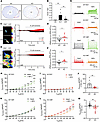
Resident cardiac fibroblast–derived (RCF-derived) cardiac myofibroblasts (CMFs) contribute to myocardial repair but also drive adverse ventricular remodeling and contractile dysfunction after myocardial infarction (MI). The sodium-activated potassium channel Slick (Slo2.1) has been described in cardiomyocyte (CM) mitochondria; however, transcriptomic analyses indicate higher Slick expression in RCFs/CMFs. Here, we investigated the role of Slick in cardiac fibroblast function and post-MI remodeling. Using live-cell imaging and whole-cell patch-clamp recordings, we found that plasma membrane Slick channels in RCFs and CMFs regulated potassium (K+) efflux and modulated store-operated calcium entry (SOCE), particularly in CMFs. Global Slick KO and conditional CMF-specific KO hearts exhibited reduced fibrosis and preserved left ventricular function after ischemia/reperfusion injury. This cardioprotection was associated with diminished CMF activation and proliferation, reduced inflammation, and improved CM survival after MI. Collectively, these findings identify fibroblast Slick channels as regulators of SOCE-dependent fibrogenesis and demonstrate that their deletion mitigates maladaptive remodeling and functional decline after MI.
Authors
Jiaqi Yang, Lin Zhu, David Spähn, Melanie Cruz Santos, Sophia Schanz, Selina Maier, Lena Birkenfeld, Helmut Bischof, Anna Roslan, Nina Wettschureck, Oliver Borst, Lucas Matt, Robert Lukowski
Guidelines
The Editorial Board will only consider comments that are deemed relevant and of interest to readers. The Journal will not post data that have not been subjected to peer review; or a comment that is essentially a reiteration of another comment.
- Comments appear on the Journal’s website and are linked from the original article’s web page.
- Authors are notified by email if their comments are posted.
- The Journal reserves the right to edit comments for length and clarity.
- No appeals will be considered.
- Comments are not indexed in PubMed.
Specific requirements
- Maximum length, 400 words
- Entered as plain text or HTML
- Author’s name and email address, to be posted with the comment
- Declaration of all potential conflicts of interest (even if these are not ultimately posted); see the Journal’s conflict-of-interest policy
- Comments may not include figures


