
Submit a comment
Abstract
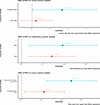
Sickle cell disease (SCD) causes severe morbidity and early mortality, yet it varies phenotypically. Both air pollution and SCD affect the cardiorespiratory, inflammatory, and endothelial systems; however, limited evidence exists on the effect of long-term air pollution exposure in SCD. We hypothesized that annual ambient (outdoor) concentrations of fine particulate matter (PM2.5), particles with a diameter of 2.5 μm or less, at a child’s home would be significantly associated with worse clinical, laboratory, and stroke-risk imaging outcomes. Patient data for this retrospective study were obtained from a cohort of children with SCD (from 2010 to 2019). Annual PM2.5 exposure was estimated using remote-sensing air pollution datasets. Statistical analyses employed fixed effects multivariable models, offering a robust approach to isolate the effect of PM2.5 exposure. The final cohort included 1,089 children with SCD. Higher annual PM2.5 concentrations were significantly associated with more annual hospital days, higher likelihood of hospitalization and abnormal stroke-risk screening, and elevated inflammatory markers. Of note, hydroxyurea use mitigated the inflammatory response to PM2.5 but did not mitigate the effect of PM2.5 on clinical outcomes. Importantly, the elevated stroke risk associated with PM2.5 exposure persisted, even among children receiving hydroxyurea therapy, highlighting a critical concern in pediatric SCD management. These results underscore the clinical importance of addressing environmental factors for comprehensive SCD care.
Authors
Paul E. George, Grace Kalmus, Joseph Lipscomb, David H. Howard, Benjamin Kopp, Wilbur A. Lam, Stefanie Ebelt
Guidelines
The Editorial Board will only consider comments that are deemed relevant and of interest to readers. The Journal will not post data that have not been subjected to peer review; or a comment that is essentially a reiteration of another comment.
- Comments appear on the Journal’s website and are linked from the original article’s web page.
- Authors are notified by email if their comments are posted.
- The Journal reserves the right to edit comments for length and clarity.
- No appeals will be considered.
- Comments are not indexed in PubMed.
Specific requirements
- Maximum length, 400 words
- Entered as plain text or HTML
- Author’s name and email address, to be posted with the comment
- Declaration of all potential conflicts of interest (even if these are not ultimately posted); see the Journal’s conflict-of-interest policy
- Comments may not include figures


