
Submit a comment
Abstract
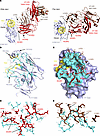
H7N9 avian influenza virus is a zoonotic influenza virus of public health concern, with a 39% mortality rate in humans. H7N9-specific prevention or treatments for humans have not been approved. We previously isolated a human monoclonal antibody (mAb) designated H7-235 that broadly reacts to diverse H7 viruses and neutralizes H7N9 viruses in vitro. Here, we report the crystal structure of H7 HA1 bound to the fragment antigen-binding region (Fab) of recombinant H7-235 (rH7-235). The crystal structure revealed that rH7-235 recognizes residues near but outside of the receptor binding site (RBS). Nevertheless, the rH7-235 IgG potently inhibits hemagglutination mediated by H7N9 viruses due to avidity effect and Fc steric hindrance. This mAb prophylactically protects mice against weight loss and death caused by challenge with lethal H7N9 viruses in vivo. rH7-235 mAb neutralizing activity alone is sufficient for protection when used at a high dose in a prophylactic setting. This study provides insights into mechanisms of viral neutralization by protective, broadly reactive anti-H7 antibodies, informing the rational design of therapeutics and vaccines against H7N9 influenza virus.
Authors
Iuliia M. Gilchuk, Jinhui Dong, Ryan P. Irving, Cameron D. Buchman, Erica Armstrong, Hannah L. Turner, Sheng Li, Andrew B. Ward, Robert H. Carnahan, James E. Crowe Jr.
Guidelines
The Editorial Board will only consider comments that are deemed relevant and of interest to readers. The Journal will not post data that have not been subjected to peer review; or a comment that is essentially a reiteration of another comment.
- Comments appear on the Journal’s website and are linked from the original article’s web page.
- Authors are notified by email if their comments are posted.
- The Journal reserves the right to edit comments for length and clarity.
- No appeals will be considered.
- Comments are not indexed in PubMed.
Specific requirements
- Maximum length, 400 words
- Entered as plain text or HTML
- Author’s name and email address, to be posted with the comment
- Declaration of all potential conflicts of interest (even if these are not ultimately posted); see the Journal’s conflict-of-interest policy
- Comments may not include figures


