
Submit a comment
Abstract
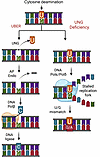
Uracil DNA glycosylase (UNG) excises uracil and 5-fluorouracil bases from DNA and is implicated in fluorodeoxyuridine (FdU) resistance. Here we explore the effects of inhibiting UNG activity, or depleting the UNG protein, in 2 mouse syngeneic models for colorectal cancer. Overexpressing the small UNG inhibitor protein (UGI) in mismatch repair–deficient (MMR-deficient) MC38 cells injected into C57BL/6J mice delayed tumor growth and prolonged survival when combined with FdU. Combining UNG inhibition with FdU numerically increased CD4+ T lymphocytes and B cells compared with FdU or UNG inhibition alone, suggesting an immune component to the effects. In contrast, shRNA depletion of UNG in the absence of FdU treatment resulted in 70% of mice clearing their tumors, and a 3-fold increase in overall survival compared with FdU. Analysis of MC38 tumor–infiltrating immune cells showed UNG depletion increased monocyte and dendritic cell populations, with CD8+ T cells also numerically increased. shRNA depletion of UNG in MMR-proficient CT-26 cells injected into BALB/c mice produced minimal benefit; the addition of anti–PD-1 antibody synergized with UNG depletion to increase survival. Cytotoxic T cell depletion abolished the benefits of UNG depletion in both models. These findings suggest UNG inhibition and/or depletion could enhance antitumor immune responses in humans.
Authors
Eric S. Christenson, Brandon E. Smith, Thanh J. Nguyen, Alens Valentin, Soren Charmsaz, Nicole E. Gross, Sarah M. Shin, Alexei Hernandez, Won Jin Ho, Srinivasan Yegnasubramanian, James T. Stivers
Guidelines
The Editorial Board will only consider comments that are deemed relevant and of interest to readers. The Journal will not post data that have not been subjected to peer review; or a comment that is essentially a reiteration of another comment.
- Comments appear on the Journal’s website and are linked from the original article’s web page.
- Authors are notified by email if their comments are posted.
- The Journal reserves the right to edit comments for length and clarity.
- No appeals will be considered.
- Comments are not indexed in PubMed.
Specific requirements
- Maximum length, 400 words
- Entered as plain text or HTML
- Author’s name and email address, to be posted with the comment
- Declaration of all potential conflicts of interest (even if these are not ultimately posted); see the Journal’s conflict-of-interest policy
- Comments may not include figures


