
Go to The Journal of Clinical Investigation
  • About
  • Editors
  • Consulting Editors
  • For authors
  • Publication ethics
  • Publication alerts by email
  • Transfers
  • Advertising
  • Job board
  • Contact
  • Physician-Scientist Development
  • Current issue
  • Past issues
  • By specialty
    • COVID-19
    • Cardiology
    • Immunology
    • Metabolism
    • Nephrology
    • Oncology
    • Pulmonology
    • All ...
  • Videos
  • Collections
    • In-Press Preview
    • Resource and Technical Advances
    • Clinical Research and Public Health
    • Research Letters
    • Editorials
    • Perspectives
    • Physician-Scientist Development
    • Reviews
    • Top read articles

  • Current issue
  • Past issues
  • Specialties
  • In-Press Preview
  • Resource and Technical Advances
  • Clinical Research and Public Health
  • Research Letters
  • Editorials
  • Perspectives
  • Physician-Scientist Development
  • Reviews
  • Top read articles
  • About
  • Editors
  • Consulting Editors
  • For authors
  • Publication ethics
  • Publication alerts by email
  • Transfers
  • Advertising
  • Job board
  • Contact
SARS-CoV-2 infection produces an IL-33-dependent chronic eosinophilic pneumonia and muco-inflammatory airways disease in mice
Padraig E. Hawkins, Sarah R. Leist, Hong Dang, Minako Saito, Lisa C. Morton, Rodney C. Gilmore, Stephen A. Schworer, Ella F. Burns, Jason R. Rock, Robert S. Hagan, James J. Pestka, Alexandra Schäfer, Kenichi Okuda, Lauren K. Heine, Jack R. Harkema, Wanda K. O'Neal, Alessandra Livraghi-Butrico, Raymond J. Pickles, Ralph S. Baric, Richard C. Boucher
View: Text | PDF
Research In-Press Preview Immunology Pulmonology Virology

SARS-CoV-2 infection produces an IL-33-dependent chronic eosinophilic pneumonia and muco-inflammatory airways disease in mice

  • Text
  • PDF
Abstract

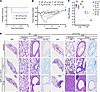
Post-acute sequelae of SARS-CoV-2 (PASC) occurs in subsets of individuals, including those with pre-existing lung disease. To investigate PASC pathogenesis and therapeutics in a chronic bronchitis mouse model (Scnn1b-Tg), Scnn1b-Tg and WT mice were inoculated with a mouse adapted SARS-CoV-2 virus (SARS-CoV-2MA10) and followed for 60 days. Viral titer, histology, immunohistochemistry (IHC), single-cell RNA sequencing, RNA in situ hybridization, and spatial transcriptomic profiling characterized disease pathologies. Scnn1b-Tg mice inoculated with SARS-CoV-2MA10 exhibited lower viral titers and less weight loss than WT mice. Airway epithelia of Scnn1b-Tg mice were less infected than epithelia of WT mice, reflecting increased airway mucus and enhanced epithelial antiviral activities in Scnn1b-Tg mice. However, Scnn1b-Tg mice subsequently exhibited heterogeneous airway and parenchymal disease with elevated Il33 expression characteristic of human eosinophilic pneumonia. Cohorts of infected mice were administered a monoclonal antibody targeting the IL-33 receptor (ST2) or enteral prednisone. Administration of an anti-ST2 monoclonal antibody mitigated development of eosinophilic pneumonia while enteral prednisone suppressed IL33 expression and disease. The eosinophilic pneumonia in Scnn1b-Tg mice after SARS-CoV-2MA10 infection mimics reports of eosinophilic pneumonia in humans post-SARS-CoV-2, suggesting targeting of IL-33 may be beneficial in treating post-viral eosinophilic pneumonia in humans.

Authors

Padraig E. Hawkins, Sarah R. Leist, Hong Dang, Minako Saito, Lisa C. Morton, Rodney C. Gilmore, Stephen A. Schworer, Ella F. Burns, Jason R. Rock, Robert S. Hagan, James J. Pestka, Alexandra Schäfer, Kenichi Okuda, Lauren K. Heine, Jack R. Harkema, Wanda K. O'Neal, Alessandra Livraghi-Butrico, Raymond J. Pickles, Ralph S. Baric, Richard C. Boucher

×
Problems with a PDF?

This file is in Adobe Acrobat (PDF) format. If you have not installed and configured the Adobe Acrobat Reader on your system.

Having trouble reading a PDF?

PDFs are designed to be printed out and read, but if you prefer to read them online, you may find it easier if you increase the view size to 125%.

Having trouble saving a PDF?

Many versions of the free Acrobat Reader do not allow Save. You must instead save the PDF from the JCI Online page you downloaded it from. PC users: Right-click on the Download link and choose the option that says something like "Save Link As...". Mac users should hold the mouse button down on the link to get these same options.

Having trouble printing a PDF?

  1. Try printing one page at a time or to a newer printer.
  2. Try saving the file to disk before printing rather than opening it "on the fly." This requires that you configure your browser to "Save" rather than "Launch Application" for the file type "application/pdf", and can usually be done in the "Helper Applications" options.
  3. Make sure you are using the latest version of Adobe's Acrobat Reader.

- Download (30.62 MB)

Advertisement

Copyright © 2026 American Society for Clinical Investigation
ISSN 2379-3708

Sign up for email alerts