
Abstract
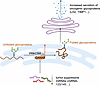
Non-small cell lung cancer (NSCLC) remains a leading cause of cancer-related mortality worldwide, yet its molecular drivers are not fully defined. Emerging evidence highlights the importance of tumor-stroma interactions mediated by secreted glycoproteins. However, the mechanisms by which cancer cells regulate the secretion of these protumorigenic proteins remain largely unknown. Endoplasmic reticulum–resident (ER-resident) N-glycan–processing enzymes regulate proper protein folding, a prerequisite for glycoproteins to exit the ER and undergo secretion. By evaluating their prognostic significance in lung tumors and conducting functional screening in lung cancer cells, we identify α-glucosidase II (α-Glc II) as a key regulator of NSCLC progression. α-Glc II promotes tumor growth and dissemination in a glucosidase activity–dependent manner in orthotopic mouse lung tumor model. Genetic disruption of α-Glc II induced ER stress and reduced cell proliferation and motility. Mechanistically, α-Glc II–mediated N-glycan modification regulated the ER-to-Golgi trafficking and secretion of specific oncogenic glycoproteins, including lysyl hydroxylase 2 (LH2), Tissue Inhibitor of Metalloproteinase 1 (TIMP1), and TGF-β, which are known to be associated with extracellular matrix remodeling. These findings uncover a role for ER glycosylation machinery in shaping the NSCLC secretome and highlight α-Glc II as a potential therapeutic target.
Authors
Shike Wang, Na Ding, Angelo Chen, Derrick Cardin, Yuting Xu, Kate Grimley, William K. Russell, Jun Xu, Jonathan M. Kurie, Guan-Yu Xiao, Xiaochao Tan
This file is in Adobe Acrobat (PDF) format. If you have not installed and configured the Adobe Acrobat Reader on your system.
Having trouble reading a PDF?
PDFs are designed to be printed out and read, but if you prefer to read them online, you may find it easier if you increase the view size to 125%.
Having trouble saving a PDF?
Many versions of the free Acrobat Reader do not allow Save. You must instead save the PDF from the JCI Online page you downloaded it from. PC users: Right-click on the Download link and choose the option that says something like "Save Link As...". Mac users should hold the mouse button down on the link to get these same options.
Having trouble printing a PDF?
- Try printing one page at a time or to a newer printer.
- Try saving the file to disk before printing rather than opening it "on the fly." This requires that you configure your browser to "Save" rather than "Launch Application" for the file type "application/pdf", and can usually be done in the "Helper Applications" options.
- Make sure you are using the latest version of Adobe's Acrobat Reader.


